What Size Air Conditioner Do I Need? A Homeowner's Sizing Guide
Bigger isn't better when it comes to AC. Learn how HVAC sizing really works, why an oversized unit is a problem, and how pros size a system for your home.

Owner & Lead HVAC Technician, Alex Air & Heating · EPA 608 Universal Certified · Ontario, CA

TL;DR
The right air conditioner size comes from a Manual J load calculation, not a rule of thumb. Bigger is not better: an oversized unit short-cycles, never runs long enough to pull humidity out, and wears itself out early, while an undersized one runs non-stop and still falls behind. A proper load calculation weighs square footage, insulation, windows, orientation and local climate.
On this page
Ask most people what size air conditioner they need and they'll guess 'a big one — it's hot here.' But when it comes to AC sizing, bigger is not better. An air conditioner that's too large will actually leave you less comfortable and cost you more. Here's how sizing really works and how the pros get it right.
What 'size' means: tons and BTUs
AC capacity is measured in tons (or BTUs — one ton equals 12,000 BTU/h of cooling). A typical home system ranges from about 1.5 to 5 tons. The goal is to match the system's capacity to how much heat your specific home gains on a hot day — not too much, not too little.
Why an oversized AC is a real problem
It seems logical that a bigger unit would cool better. In practice, an oversized system cools the air so fast that it shuts off before it can pull humidity out of your home. The result is short-cycling: the system rapidly turns on and off, leaving you cold and clammy, wearing out the compressor, wasting energy and creating uneven temperatures.
Why an undersized AC is just as bad
On the other end, an undersized unit runs nonstop and still can't keep up when it's 105° outside. It never gets a break, your bills climb, and the constant runtime shortens its life. In a hot region like the Inland Empire, undersizing shows up fast in July and August.
The rough rule of thumb (and why it's only a start)
A common starting estimate is about 20 BTU per square foot of living space — so a 2,000 sq ft home might land somewhere around 3–3.5 tons. But that's only a rough first guess. Your real number depends on much more than square footage.
What a proper sizing actually considers
- Square footage and ceiling height.
- Insulation quality and the age of the home.
- Number, size, type and direction of windows.
- Sun exposure and which way the home faces.
- Local climate — and Inland Empire summers are no joke.
- Ductwork condition and air leakage.
- Number of occupants and heat-generating appliances.
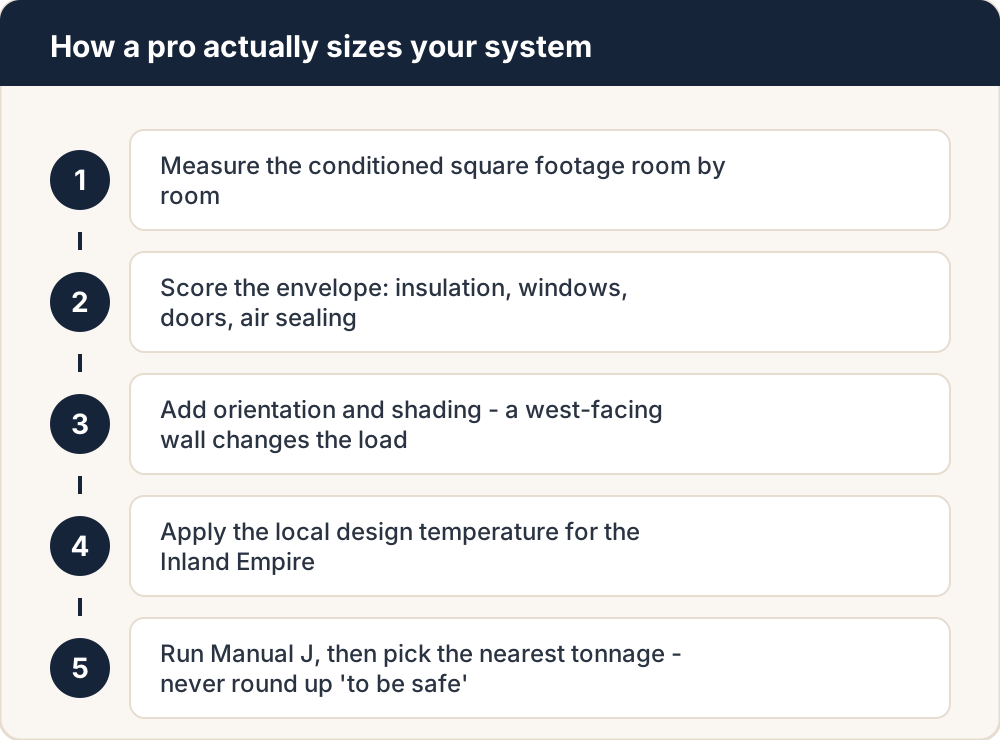
Professionals run what's called a Manual J load calculation that weighs all of these together. It's the difference between a system that's matched to your home and one that's merely guessed from the old unit's label.
Get it sized right the first time
Replacing your AC with the wrong size is an expensive mistake to live with for the next 15 years. Before you buy, get a real load calculation from a licensed pro. Call Alex Air & Heating at 626-777-4822 for an accurate, honest sizing and quote anywhere in the Inland Empire & LA County.
Every install we quote starts with a real load calculation, not a guess - across Ontario, the Inland Empire and East LA County, with upfront written pricing. AC installation
Frequently asked questions
Request an assessment when there is a safety concern, the system stops operating, the issue repeats, or confirming the cause would require opening equipment or touching electrical connections.
No. A guide can help you understand the questions and observations, but system condition, compatibility, and scope can only be confirmed from the equipment and site.
Note the symptom, when it began, thermostat settings, and any visible damage from a safe distance. If it is accessible without removing panels, the equipment model can also help.
Alex Air & Heating serves Ontario, the Inland Empire, and East Los Angeles County. Appointment availability is confirmed against the current schedule.
Local next step
Turn this guide into a site-specific answer.
Guides explain the decision. Equipment condition, access, and safe next steps still need to match the home or business. Review the relevant service scope or request an assessment for Ontario, the Inland Empire, or East Los Angeles County. Availability depends on the current schedule.