AC Repair vs. Replace in 2026: The Age Rule, the $5,000 Rule, and R-410A Costs
Over 10-15 years old, a repair topping 50% of replacement, or an R-410A recharge now running $600-$800? In 2026 the math tips toward replace. Here is the framework.

Owner & Lead HVAC Technician, Alex Air & Heating · EPA 608 Universal Certified · Ontario, CA
TL;DR
Repair your AC if it is under 10 years old and the fix is minor; in 2026, replace it when it is over 10-15 years old, when one repair tops 50% of a new system, or when age multiplied by repair cost exceeds $5,000. R-410A recharges that ran about $400 in 2022 now cost $600-$800+, tipping older units toward replacement.
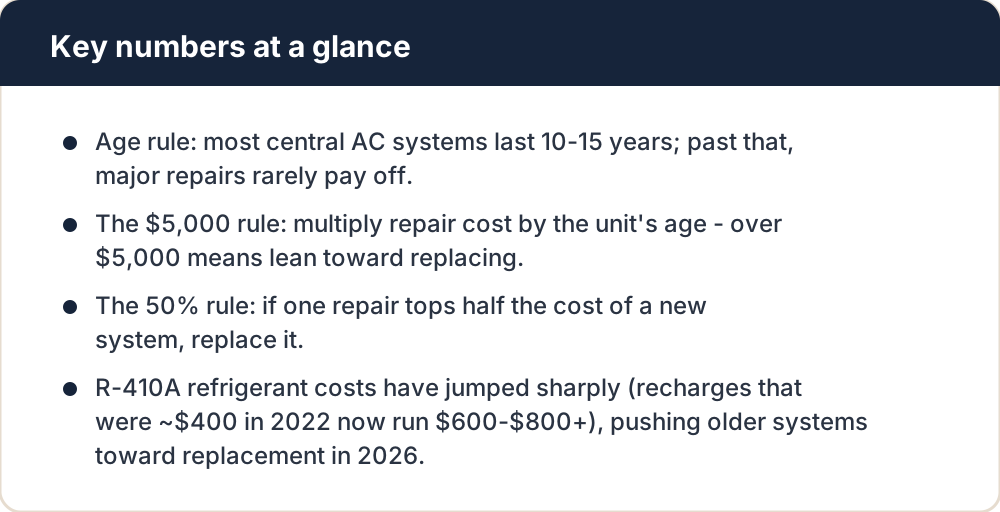
- Age rule: most central AC systems last 10-15 years; past that, major repairs rarely pay off.
- The $5,000 rule: multiply repair cost by the unit's age - over $5,000 means lean toward replacing.
- The 50% rule: if one repair tops half the cost of a new system, replace it.
- R-410A refrigerant costs have jumped sharply (recharges that were ~$400 in 2022 now run $600-$800+), pushing older systems toward replacement in 2026.
On this page
- Should I repair or replace my AC in 2026?
- The age rule: how long should an AC last?
- The $5,000 rule: a quick dollar test
- The 50% rule: comparing to a new system
- Why does R-410A refrigerant change the 2026 math?
- What about efficiency gains from a new system?
- How often is too often to break down?
- A clear decision framework
Should I repair or replace my AC in 2026?
Replace it if the system is more than 10-15 years old and facing a major repair, if a single repair quote exceeds half the cost of a new system, or if it runs on R-410A refrigerant and needs a refrigerant-related fix. Repair it if the unit is under about 10 years old, the fix is minor, and it is not an R-410A system needing a recharge.
That is the short answer. The rest of this guide gives you the three simple rules the pros use and one new 2026 wrinkle - the refrigerant transition - that has moved the replace-versus-repair line earlier than it was even two years ago. It matters for homeowners across Ontario, Pomona, Diamond Bar, Walnut, Claremont, and Rowland Heights running AC hard through triple-digit summers.
The age rule: how long should an AC last?
A central air conditioner typically lasts 10 to 15 years. In the Inland Empire, where systems run long hours through brutal summers, many land at the lower end of that range. Age alone does not force a replacement, but it changes the odds: a well-maintained 8-year-old unit with a minor fault is usually worth repairing, while a 14-year-old unit facing a compressor or coil failure rarely is.
The reason is simple. Past the 10-15 year mark, one repair tends to be followed by another, and you are pouring money into equipment that is also significantly less efficient than what you can buy today.
| Situation | Age under 10 yrs | Age 10-15+ yrs |
|---|---|---|
| Minor repair (under $400) | Repair | Repair, but plan ahead |
| Major repair (compressor/coil) | Compare with 50% rule | Replace |
| R-410A leak + recharge needed | Repair, weigh refrigerant cost | Replace |
| 3+ service calls in 24 months | Investigate root cause | Replace |
| Repair cost x age over $5,000 | Rare - recheck quote | Replace |
The $5,000 rule: a quick dollar test
The $5,000 rule is the easiest gut-check there is: multiply the cost of the repair by the age of your AC in years. If the result is over $5,000, replacement usually makes more sense; if it is well under, repair.
For example, a $400 repair on a 6-year-old unit is 400 x 6 = $2,400 - repair. The same $400 repair on a 14-year-old unit is 400 x 14 = $5,600 - lean toward replacing. It is a rough tool, not gospel, but it captures the key idea: money spent on an old system buys you far less runway than the same money on a newer one.
The 50% rule: comparing to a new system
The 50% rule looks at the repair against the price of replacement. If a single repair costs more than half of what a new comparable system would cost, replace instead. A $2,500 repair on a system that would cost $5,000 to replace is almost never worth it - you are spending half the price of new to keep an aging unit alive.
This rule is especially decisive for 10-15 year old systems facing big-ticket repairs like a failed compressor, a leaking evaporator coil, or a cracked heat exchanger. When age and the 50% rule both point the same way, the decision is usually clear.
Why does R-410A refrigerant change the 2026 math?
This is the new factor that did not exist a few years ago. As of January 1, 2026, new systems can no longer be manufactured or installed using high-GWP refrigerants like R-410A - the industry has moved to A2L refrigerants such as R-454B and R-32. R-410A is still legal to buy for servicing existing systems, but supply is tightening and prices are climbing fast.
The cost impact on repairs is real. Recharges that ran roughly $400 in 2022 now commonly run $600-$800 in 2026, and wholesale R-410A has moved from single-digit dollars per pound a few years ago into the $25-$45 per pound range in many markets, with the trajectory still upward. If your AC is over about 12 years old and needs a refrigerant leak repaired and recharged, you are paying premium prices to keep a soon-obsolete system running - a strong signal to replace.
What about efficiency gains from a new system?
Replacing is not only about avoiding repairs - a new unit costs less to run every month. Air conditioners have gotten meaningfully more efficient, and the 2026 A2L systems are engineered to be roughly 10-15% more efficient than the equipment they replace. Swap a 10-15 year old unit for a modern high-SEER2 system and cooling costs can drop substantially.
That matters enormously in SCE territory, where the average residential rate reached about 34 cents per kWh in 2026 and peak time-of-use windows run 58-74 cents. In a climate where the AC runs half the year, a more efficient system claws back part of its cost through lower bills - a factor the repair-only path never delivers.
How often is too often to break down?
Frequency is its own signal. If you have called for service three or more times in the last two years, the pattern usually costs more than a planned replacement - in repair bills, in lost comfort during heat waves, and in the risk of a total failure on the hottest day of the year.
Add rising energy bills, uneven cooling, and a system that struggles to keep up during a July heat wave, and you have a unit telling you it is near the end. One more repair may buy a few weeks; replacement buys years of reliability and lower bills.
A clear decision framework
Put the rules together and the decision is usually straightforward. Lean toward replacing when two or more of these are true; repair when the unit is young, the fix is minor, and refrigerant is not involved.
When in doubt, get a written diagnosis and a replacement quote from a licensed California contractor, then run the numbers yourself with the rules below.
- The system is over 10-15 years old.
- Repair cost times age exceeds $5,000 (the $5,000 rule).
- One repair tops 50% of a new system's cost (the 50% rule).
- It runs on R-410A and needs a refrigerant leak fixed or a recharge.
- You have had three or more service calls in the last 24 months.
- Bills are rising and cooling is uneven despite maintenance.
Frequently asked questions
Multiply the repair cost by the age of the unit in years. If the result exceeds $5,000, replacement usually makes more financial sense. For example, a $400 repair on a 14-year-old unit is $5,600 - lean toward replacing.
If it is over about 12 years old and needs a refrigerant-related repair, usually yes. R-410A is being phased out, supply is tightening, and recharges that cost around $400 in 2022 now run $600-$800 or more - premium money for a soon-obsolete system.
Typically 10 to 15 years. In the Inland Empire's long, hot summers many reach the lower end. Past that mark, major repairs rarely pay off because the system is also far less efficient than a new one.
It depends on age and repair cost. Use the 50% rule (replace if one repair tops half a new system's cost) and the $5,000 rule (replace if repair cost times age exceeds $5,000). For 10-15 year old R-410A units facing major repairs, replacement usually wins in 2026.
Local next step
Turn this guide into a site-specific answer.
Guides explain the decision. Equipment condition, access, and safe next steps still need to match the home or business. Review the relevant service scope or request an assessment for Ontario, the Inland Empire, or East Los Angeles County. Availability depends on the current schedule.