Ductless Mini Split Installation Cost in 2026: California Prices by Zone ($3,000-$15,000)
A single-zone mini split runs $3,000-$6,000 installed in 2026; whole-home multi-zone systems hit $10,000-$15,000. Here is what drives the price in the Inland Empire.

Owner & Lead HVAC Technician, Alex Air & Heating · EPA 608 Universal Certified · Ontario, CA
TL;DR
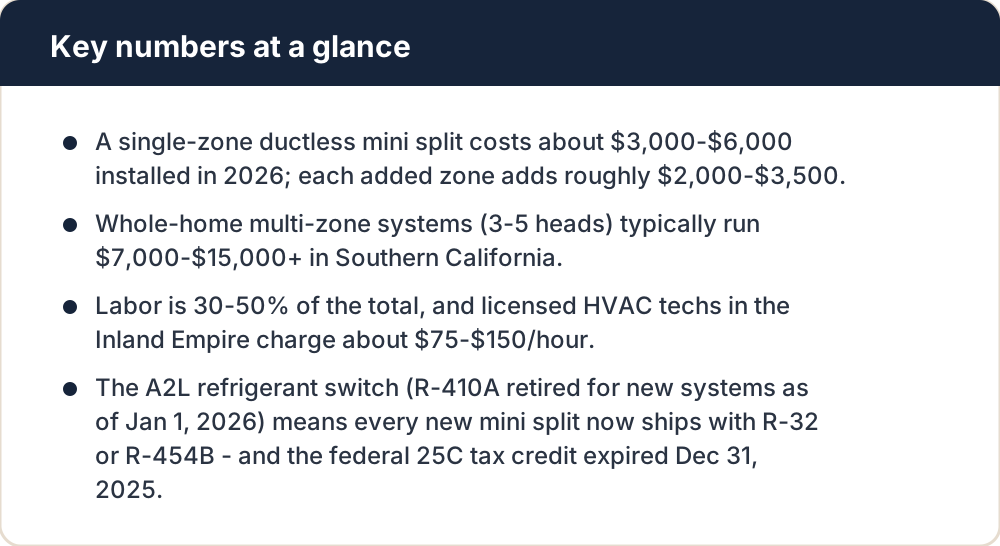
A ductless mini split costs about $3,000-$6,000 installed for a single zone in 2026, while whole-home multi-zone systems (3-5 heads) run roughly $7,000-$15,000+ in Southern California. Each added zone adds about $2,000-$3,500, and labor is 30-50% of the total. Prices edged up after R-410A was retired for new systems on January 1, 2026.
- A single-zone ductless mini split costs about $3,000-$6,000 installed in 2026; each added zone adds roughly $2,000-$3,500.
- Whole-home multi-zone systems (3-5 heads) typically run $7,000-$15,000+ in Southern California.
- Labor is 30-50% of the total, and licensed HVAC techs in the Inland Empire charge about $75-$150/hour.
- The A2L refrigerant switch (R-410A retired for new systems as of Jan 1, 2026) means every new mini split now ships with R-32 or R-454B - and the federal 25C tax credit expired Dec 31, 2025.
On this page
- How much does a ductless mini split cost to install in 2026?
- What does a mini split cost by number of zones?
- What drives the price up or down?
- Why does the A2L refrigerant change matter for 2026 pricing?
- What will a mini split cost to run in the Inland Empire?
- Are there rebates or tax credits left in 2026?
- Is a ductless mini split worth it for a SoCal home?
How much does a ductless mini split cost to install in 2026?
In 2026, a professionally installed ductless mini split runs roughly $3,000 to $6,000 for a single-zone system and $7,000 to $15,000 or more for a multi-zone system that conditions several rooms. The number of indoor heads (zones) is the single biggest lever on price, followed by total BTU capacity, efficiency rating, and how hard the install is at your specific house.
For homeowners here in Ontario and across the Inland Empire and East LA County - Pomona, Diamond Bar, Walnut, Claremont, and Rowland Heights - the sweet spot for a typical retrofit is one outdoor condenser paired with two to four wall-mounted heads, which usually lands in the $6,000 to $12,000 range once permits, line sets, electrical, and labor are all included.
What does a mini split cost by number of zones?
A zone is simply one indoor head connected to your outdoor condenser. A single head cools or heats one room or open area; multi-zone systems tie several heads to one outdoor unit so you can set each room to its own temperature.
As a rule of thumb, budget the base single-zone cost and then add roughly $2,000 to $3,500 for each additional zone. Premium head styles - ceiling cassettes or slim ducted air handlers instead of standard wall units - push the per-zone figure toward the top of that range.
- Single-zone (1 room): about $3,000-$6,000 installed.
- 2-zone: about $4,500-$8,500 installed.
- 3-zone: about $7,000-$11,000 installed.
- 4-zone: about $9,000-$14,000 installed.
- 5-zone / whole-home: about $11,000-$15,000+ installed.
| System | Typical rooms | Installed cost range | Notes |
|---|---|---|---|
| Single-zone | 1 room / open area | $3,000-$6,000 | Best value per zone |
| 2-zone | 2 rooms | $4,500-$8,500 | Common bedroom + living room combo |
| 3-zone | 3 rooms | $7,000-$11,000 | One condenser, three heads |
| 4-zone | 4 rooms | $9,000-$14,000 | Approaching whole-home |
| 5-zone / whole-home | 5+ rooms | $11,000-$15,000+ | Premium heads push higher |
What drives the price up or down?
Two houses on the same street can get very different quotes. The variables that move your number the most are efficiency, capacity, and install difficulty.
- Efficiency (SEER2): Ductless systems commonly rate from 18 up to the low 30s SEER2, versus roughly 13-21 for central AC. Higher-SEER2 units cost 20-50% more up front but cut running costs.
- Capacity (BTU): Heads are sold from about 9,000 BTU (three-quarter ton) up to 36,000 BTU (three tons). A correctly sized head matters far more than a big one - oversizing wastes money and hurts humidity control.
- Head style: Wall-mounted heads are cheapest; floor consoles, ceiling cassettes, and concealed-duct air handlers cost more.
- Line-set length and routing: Long refrigerant runs, second-story heads, and finished walls that need patching add labor.
- Electrical: Many installs need a new dedicated circuit or a panel with spare capacity - a common add-on in older Inland Empire homes.
- Permits: A California mechanical permit and inspection are part of a legitimate job; skipping them is a red flag, not a saving.
Why does the A2L refrigerant change matter for 2026 pricing?
This is the biggest behind-the-scenes shift in HVAC in over a decade, and it directly affects what you buy in 2026. Under the EPA's Technology Transitions Program, new residential systems using refrigerants with a Global Warming Potential (GWP) over 700 can no longer be installed as of January 1, 2026. That retires R-410A from new equipment.
In its place, new mini splits ship with low-GWP A2L refrigerants: R-32 (GWP around 675) is common in ductless systems, while R-454B (GWP around 466) dominates larger ducted equipment. For comparison, the old R-410A had a GWP near 2,088, so the new blends are roughly 70-75% lower impact.
What this means for your wallet: A2L systems are engineered to be about 10-15% more efficient than the equipment they replace, but they are 'mildly flammable' (that is what the A2L classification means), so installers follow updated handling and, in some cases, leak-detection requirements. Make sure whoever installs your system is trained and certified on A2L equipment - it is now the standard, not an upgrade.
What will a mini split cost to run in the Inland Empire?
Running cost is where ductless systems earn back their price, but Southern California's high electricity rates make sizing and efficiency crucial. Southern California Edison's average residential rate reached about 34 cents per kWh in 2026, with tiered usage climbing toward 42 cents and time-of-use peak windows (typically 4-9 p.m.) running as high as 58-74 cents per kWh.
A modern 12,000 BTU (1-ton) head at 20+ SEER2 draws roughly 600 watts while cooling. Run it eight hours on a 100-degree Inland Empire afternoon and you use about 4-5 kWh, which is roughly $1.50-$2.00 per zone per day at average SCE rates. The advantage of ductless is that you only power the rooms you are using instead of cooling the whole house, and you avoid the duct losses that waste more than 30% of central-system energy when ducts run through a hot attic.
Are there rebates or tax credits left in 2026?
Here is the honest, current picture. The federal 25C Energy Efficient Home Improvement Credit - which used to return up to $2,000 on a qualifying heat pump - expired on December 31, 2025 under the 2025 federal tax law. To have qualified, equipment had to be 'placed in service' (installed and running) by that date. There is no federal 25C credit for systems installed in 2026 or later.
State and utility incentives still exist but are tight. California's statewide TECH Clean California and HEEHRA heat-pump rebates (historically about $2,500 for a ductless mini split and $3,000 for a ducted heat pump) were fully reserved or waitlisted for single-family projects across Southern California as of early 2026. Before you count on any rebate, confirm live availability directly with Southern California Edison and TECH Clean California - do not assume a number you read online is still funded.
Is a ductless mini split worth it for a SoCal home?
For the right house, yes. Ductless shines in homes with no existing ductwork, room additions, converted garages, ADUs, sunrooms, and older Inland Empire houses where adding or repairing ducts would cost as much as the system itself. Because there is no duct network to leak, ductless heat pumps carry at least a 15% inherent efficiency edge over standard ducted systems.
Where central AC still makes sense is a home with sound existing ducts and a preference for hidden, whole-house airflow. The best way to know which fits - and to get an accurate price rather than a phone guess - is an in-home load calculation from a licensed California contractor.
Frequently asked questions
About $3,000 to $6,000 installed for a standard wall-mounted single-zone system, depending on BTU capacity, SEER2 rating, brand, and how difficult the install is at your home. Labor alone is typically 30-50% of that total.
No. The federal 25C Energy Efficient Home Improvement Credit expired December 31, 2025. Equipment had to be installed and placed in service by that date to qualify. Check with Southern California Edison and TECH Clean California for any remaining state or utility rebates, but many were fully reserved by early 2026.
As of January 1, 2026, new residential systems can no longer use high-GWP refrigerants like R-410A. New mini splits use low-GWP A2L refrigerants - usually R-32 (GWP ~675) for ductless or R-454B (GWP ~466) for larger systems - which are about 70-75% lower impact and require A2L-trained installers.
Usually less, if it is sized correctly. Because ductless systems avoid the 30%+ of energy lost through leaky ducts and only cool the rooms you use, they typically cut cooling costs, which matters at SCE's 34-cents-plus average rate and 58-74 cent peak windows.
Local next step
Turn this guide into a site-specific answer.
Guides explain the decision. Equipment condition, access, and safe next steps still need to match the home or business. Review the relevant service scope or request an assessment for Ontario, the Inland Empire, or East Los Angeles County. Availability depends on the current schedule.