Furnace Won't Ignite? 8 Causes and a Safe Fix Order (Inland Empire Guide)
Most gas furnaces lock out after 3 failed ignition tries. Work this checklist in order — 4 fixes are DIY, the rest need a licensed pro.

Owner & Lead HVAC Technician, Alex Air & Heating · EPA 608 Universal Certified · Ontario, CA
TL;DR
If your furnace will not ignite, work this order: confirm the thermostat is on HEAT, the breaker is on, the gas valve is open, the filter is clean, and the front panel is fully seated. A dirty flame sensor is the most common cause, and most furnaces hard-lock after about three failed tries and need a 30-second power reset to clear. Anything past the burner-gas valve, pressure switch, heat exchanger-is licensed pro work.
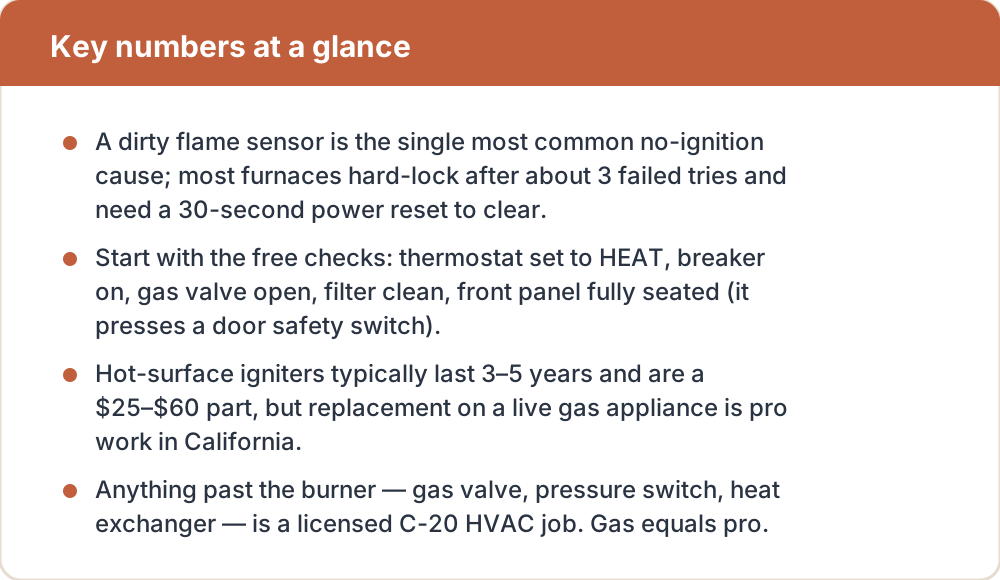
- A dirty flame sensor is the single most common no-ignition cause; most furnaces hard-lock after about 3 failed tries and need a 30-second power reset to clear.
- Start with the free checks: thermostat set to HEAT, breaker on, gas valve open, filter clean, front panel fully seated (it presses a door safety switch).
- Hot-surface igniters typically last 3–5 years and are a $25–$60 part, but replacement on a live gas appliance is pro work in California.
- Anything past the burner — gas valve, pressure switch, heat exchanger — is a licensed C-20 HVAC job. Gas equals pro.
On this page
- Why won't my furnace ignite?
- Step 1: Is it the thermostat or power? (DIY-safe)
- Step 2: Check the filter, vents, and blower door
- What is ignition lockout and how do I reset it?
- The flame sensor and igniter: the two usual suspects
- Gas supply, condensate, and safety switches (pro territory)
- DIY-safe vs. licensed pro — and why gas is always a pro
Why won't my furnace ignite?
A gas furnace won't ignite because one link in its safety-first startup chain is broken — and the control board would rather shut down than run unsafely. In order, a call for heat has to satisfy: thermostat and power, a closed blower-door safety switch, a proving draft (inducer motor and pressure switch), a working igniter, gas flow through the valve, and a flame sensor that confirms a flame within a few seconds. If any step fails, the board retries and, after roughly three failed attempts, drops into a hard lockout to protect the heat exchanger and gas valve.
The good news for Inland Empire homeowners: winters here are mild, so a no-heat night in Ontario, Pomona, or Rowland Heights is rarely an emergency the way it is in Minnesota. That gives you time to safely walk the free checks below before calling anyone. The most common culprit isn't a dead furnace at all — it's a dirty flame sensor or a clogged filter, both cheap fixes.
Work the causes in the order given. Roughly the first four are homeowner-safe; the rest involve gas, high voltage, or the sealed combustion path and belong to a licensed pro.
Step 1: Is it the thermostat or power? (DIY-safe)
Before touching the furnace, rule out the two things that mimic a dead unit. Set the thermostat to HEAT and push the target several degrees above room temperature; a fan set to ON instead of AUTO can also fool you into thinking the furnace ran. If the screen is blank, replace the batteries.
Then check power. Furnaces have two shutoffs people forget: the wall breaker labeled 'furnace' or 'air handler,' and a light-switch-style service switch on or near the unit itself. A tripped breaker or a bumped service switch is one of the most common 'my furnace is dead' calls. Reset the breaker once. If it trips again immediately, stop — a repeat trip signals an electrical fault for a pro.
| Symptom | Likely cause | DIY or Pro |
|---|---|---|
| No display, nothing happens | Dead thermostat battery or tripped breaker/service switch | DIY |
| Blower runs, no heat, then shuts off | Clogged filter tripping high-limit switch | DIY |
| Igniter glows, gas lights, then quits in ~2–3 sec | Dirty flame sensor | DIY (clean) / Pro if it recurs |
| Igniter never glows during startup | Cracked/burned-out hot-surface igniter | Pro (gas appliance) |
| Clicks and retries, then flashing lockout code | Ignition lockout after ~3 failed tries | DIY reset once; Pro if it re-locks |
| Ran last winter, dead first cold night this year | Clogged condensate/pressure switch or bad igniter | Pro |
| Boom on ignition, gas smell, or CO alarm | Delayed ignition / unsafe combustion | Shut off, evacuate, call gas utility + Pro |
Step 2: Check the filter, vents, and blower door
A clogged filter is a top hidden cause of no-heat. When airflow is choked, the furnace overheats and a high-limit switch cuts the burners — sometimes before you ever feel heat. The U.S. Department of Energy recommends checking the filter monthly and changing it every 1–3 months; dusty, near-freeway homes along the I-10 and 60 corridors clog faster. A fresh $10–$25 filter fixes a surprising share of ignition and short-cycling complaints.
Also confirm the front access panel is fully seated. Most furnaces have a door interlock switch that cuts power to the burners when the panel is off or loose — a classic gotcha after someone changes a filter and doesn't click the cover back into place. Make sure supply and return vents throughout the house are open and unblocked so the system can move air.
What is ignition lockout and how do I reset it?
Ignition lockout is a safety state the control board enters after repeated failed light attempts — typically three. It's the furnace saying 'I tried, I couldn't confirm a safe flame, I'm stopping.' Many boards flash a diagnostic code through a small window on the blower housing; the legend is printed on the inside of the access door. A steady or specific blink pattern points you toward flame sensor, pressure switch, or limit-switch faults.
To clear a soft lockout, cut power at the service switch or breaker for 30 seconds, then restore it and watch one full startup. If the furnace lights and stays lit, the lockout was a one-off. If it re-locks after one or two cycles, something in the chain is genuinely failing — don't keep resetting it repeatedly, because you're forcing repeated gas-valve openings. Note the code and call a pro.
The flame sensor and igniter: the two usual suspects
If power, thermostat, and filter are all fine, the burner-area components are next — and the flame sensor leads the list. It's a thin metal rod that must detect the flame's tiny electrical current (measured in microamps) within seconds of ignition. A film of soot or oxidation insulates the rod, the board sees no flame, and it shuts the gas within 2–3 seconds. On many units, gently cleaning the rod with fine abrasive pad or emery cloth restores it — the closest thing to a free fix.
The hot-surface igniter is the other frequent failure. It glows like a toaster element to light the gas and is brittle silicon carbide or nitride that typically lasts 3–5 years; the part runs about $25–$60. If it never glows during startup, it's likely cracked or burned out. Older furnaces use a standing pilot instead — if the pilot is out, follow the lighting instructions on the unit's label, but if it won't stay lit, that's a thermocouple or gas-valve issue for a pro.
Gas supply, condensate, and safety switches (pro territory)
If the igniter glows but nothing lights, suspect gas delivery. Confirm the manual gas valve at the furnace is parallel to the pipe (open) and that other gas appliances — stove, water heater — are working; if none have gas, call SoCalGas about a supply or meter issue. Do not attempt any repair on the gas valve itself.
High-efficiency condensing furnaces (90%+ AFUE), which are the norm in new California installs, produce acidic water that drains through a small tube. If that condensate line or trap clogs, a pressure switch senses the blockage and blocks ignition — a common cause on units that ran fine last season. Clearing it safely means opening the combustion path, which is pro work. The same goes for a tripped rollout or limit switch: these are safety devices reacting to a real problem (often a cracked heat exchanger or blocked flue), and resetting them without diagnosis is dangerous.
DIY-safe vs. licensed pro — and why gas is always a pro
Homeowner-safe: thermostat settings and batteries, resetting a breaker once, changing the filter, reseating the access panel, opening vents, cleaning a visible flame sensor, and a single 30-second lockout reset. Everything involving the gas valve, igniter replacement on a live appliance, pressure/limit/rollout switches, the inducer motor, the heat exchanger, or the flue is licensed-contractor work.
In California, gas-appliance and HVAC repairs should be done by a contractor holding a C-20 (Warm-Air Heating, Ventilating and Air-Conditioning) license — verify any contractor at the CSLB website before they touch your system. There's also a hard safety line: a furnace that ignites with a boom or delay, a persistent gas smell, or a headache/nausea in the home means shut it off, leave, and call SoCalGas and a pro. Every heating home in Ontario, Diamond Bar, Walnut, and Claremont should have a working carbon monoxide alarm — it's required by California law in homes with gas appliances.
Frequently asked questions
Turn off power at the furnace service switch or the wall breaker for 30 seconds, then restore it and watch one full startup cycle. This clears a soft ignition lockout. If the furnace re-locks after one or two cycles, stop resetting it and call a licensed HVAC contractor — repeated resets keep forcing the gas valve open.
Yes, this is homeowner-safe if you first cut all power to the furnace. The flame sensor is a single thin metal rod near the burners, usually held by one screw. Gently buff off the soot or oxidation with fine abrasive pad or emery cloth (not sandpaper's coarse grit), reseat it snugly, and restore power. A dirty flame sensor is the most common reason a furnace lights and then shuts off seconds later.
That short-cycle pattern almost always means the flame sensor isn't confirming the flame — usually because it's dirty or failing — so the board shuts the gas as a safety response within about 2–3 seconds. Clean the sensor first. If that doesn't fix it, the sensor, igniter, or control board may need replacement by a pro.
No. After about three failed attempts most furnaces lock out on purpose, and repeatedly cutting power to force more tries opens the gas valve over and over. If it won't light after one clean reset, or you smell gas or hear a boom on ignition, shut the unit off and call a professional and SoCalGas.
Local next step
Turn this guide into a site-specific answer.
Guides explain the decision. Equipment condition, access, and safe next steps still need to match the home or business. Review the relevant service scope or request an assessment for Ontario, the Inland Empire, or East Los Angeles County. Availability depends on the current schedule.