Heat Pump vs. Gas Furnace in Southern California: Why Heat Pumps Win Mild Winters
Inland Empire winters rarely dip below the 40s, so a heat pump runs at 250–350% efficiency here — and heats and cools from one system.

Owner & Lead HVAC Technician, Alex Air & Heating · EPA 608 Universal Certified · Ontario, CA
TL;DR
In Southern California's mild winters, a heat pump usually beats a gas furnace: it runs at roughly 250-350% efficiency versus 80-96% for gas, heats and cools from one system, and rarely needs backup heat in the Inland Empire. Installed cost is higher ($6,000-$12,000+ versus $4,000-$9,000 for a furnace), and the federal 25C tax credit ended December 31, 2025, so California utility and TECH Clean rebates are now the main incentives.
- In the mild Inland Empire climate, a heat pump runs at roughly 250–350% efficiency (delivering 2.5–3.5 units of heat per unit of electricity) versus 80–96% for a gas furnace, and it replaces your AC too.
- Installed cost is higher for heat pumps (about $6,000–$12,000+) than a gas furnace (about $4,000–$9,000 installed in California), but a heat pump does both heating and cooling.
- The federal 25C tax credit ended December 31, 2025 — there is no 25C credit for 2026 installs. California utility and TECH Clean rebates are now the main incentives.
- For a typical Ontario or Diamond Bar home, mild winters mean a heat pump rarely needs backup heat, so annual operating cost often runs lower than gas even at California electricity rates.
On this page
Heat pump or gas furnace — which is right for a SoCal home?
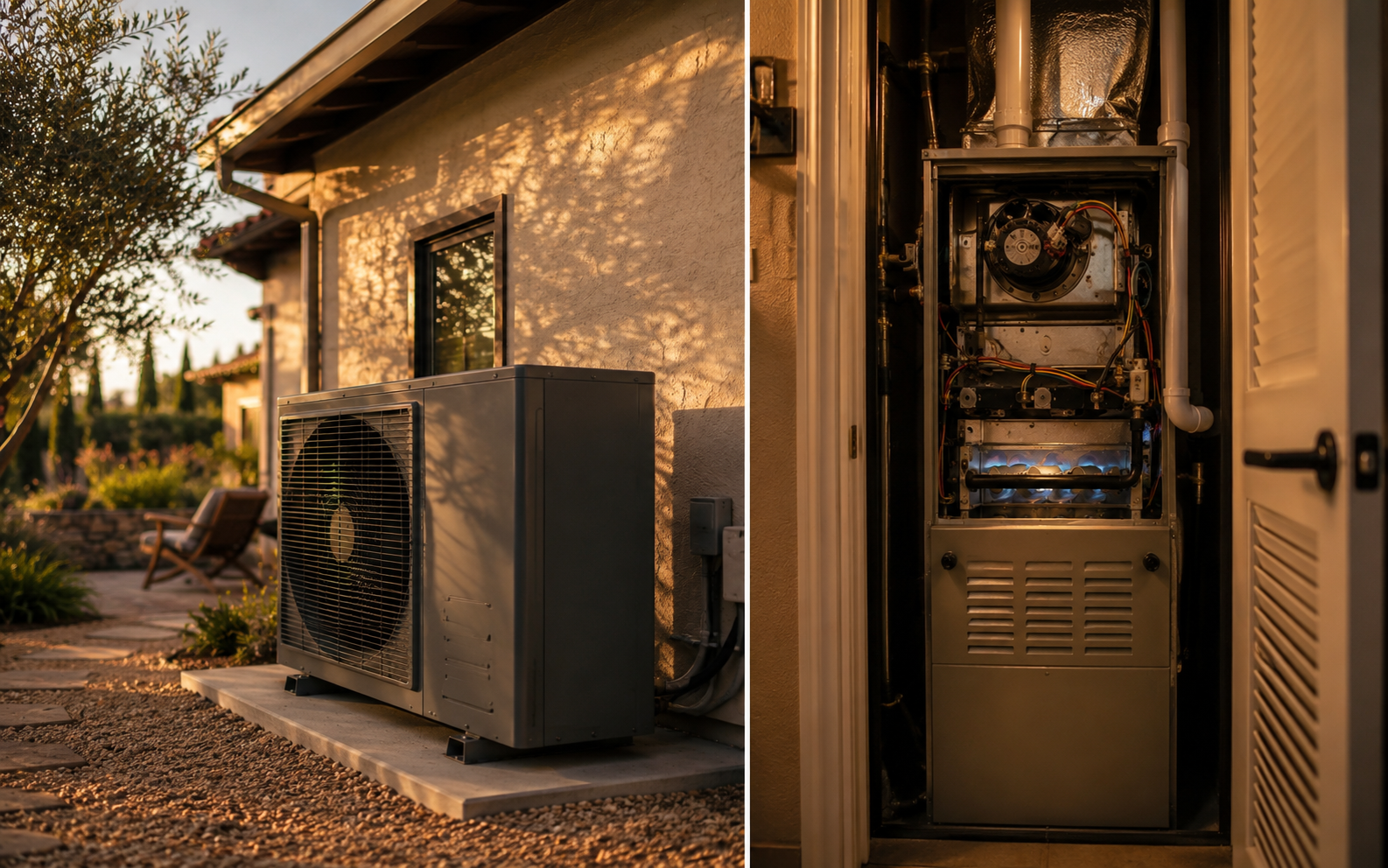
For most homes in the Inland Empire and East LA County, a heat pump is the stronger long-term choice, and the reason is climate. Heat pumps lose efficiency in deep cold, which is why they were historically a tougher sell in the Midwest and Northeast. But that weakness essentially doesn't exist in Ontario, Pomona, Walnut, Claremont, or Rowland Heights, where winter lows usually sit in the 40s and only occasionally dip toward the mid-30s. In that range a modern heat pump runs at peak efficiency and almost never needs auxiliary backup heat.
There's a second, bigger reason: a heat pump is a single system that both heats and cools. Every home in this region already needs strong air conditioning for triple-digit summers. A heat pump is essentially an air conditioner that can run in reverse to heat, so you replace two systems with one. A gas furnace only heats — you still need a separate AC.
A gas furnace still makes sense in a few cases: if you have very cheap natural gas, an existing gas line and flue, a recently replaced AC you don't want to touch, or you're on a tight upfront budget. But for a from-scratch or full-system replacement in this climate, the heat pump math usually wins.
How each system works
A gas furnace makes heat by burning natural gas. Its efficiency is rated by AFUE (Annual Fuel Utilization Efficiency) — a 96% AFUE furnace turns 96% of the gas's energy into usable heat and sends the rest up the flue. The current federal minimum is 80% AFUE, though the Department of Energy has finalized a 95% minimum taking effect in late 2028.
A heat pump doesn't create heat — it moves it. Using a refrigerant cycle (the same technology as your refrigerator and AC), it pulls heat out of the outdoor air and pumps it inside, even when it's chilly out. Because it's moving heat rather than burning fuel, it can deliver far more heat energy than the electricity it consumes. Its heating efficiency is rated by HSPF2 (higher is better) and, at a given moment, by COP — a COP of 3.0 means 3 units of heat per unit of electricity, or 300% efficiency. In summer it reverses to cool, rated by SEER2.
| Factor | Heat pump | Gas furnace |
|---|---|---|
| Heats and cools | Yes — one system does both | Heating only; needs separate AC |
| Efficiency (heating) | ~250–350% (COP 2.5–3.5) in mild climate | 80–96% AFUE |
| Installed cost (CA) | ~$6,000–$12,000+ | ~$4,000–$9,000 (plus AC) |
| Vent air temp | Gentle, steady (~90–105°F) | Hot bursts (~120–140°F) |
| Fuel | Electricity (works with solar) | Natural gas |
| Combustion / CO risk | None | Yes — needs CO alarm and flue |
| Fit for mild SoCal winters | Excellent — rarely needs backup | Good, but oversized for the climate |
| 2026 federal 25C credit | Expired Dec 31, 2025 | Expired Dec 31, 2025 |
Installation cost compared
Upfront, gas furnaces are cheaper. A new gas furnace runs roughly $4,000–$9,000 installed in California depending on efficiency and size; a whole-home heat pump system typically runs about $6,000–$12,000 or more installed. But the comparison is apples-to-oranges: the heat pump price includes your cooling system, while the furnace does not — add a new AC to the furnace and the totals converge or flip.
Two local factors matter. First, if your home already has ductwork and a gas line, a like-for-like furnace swap is the cheapest path. Second, if you're replacing both an aging furnace and an aging AC at the same time — common for 15–20-year-old Inland Empire systems — a heat pump replaces both boxes with one and often comes out ahead on total installed cost.
Operating cost: what you'll actually pay to run it
Operating cost depends on local energy prices, and Southern California has expensive electricity but relatively moderate gas. A high-efficiency gas furnace heating a typical 1,600–1,900 sq ft home might use a few hundred therms over our short heating season, costing roughly $400–$1,000 at SoCalGas rates. A heat pump heating the same home uses electricity but so efficiently — 250–350% — that annual heating cost often lands in a similar or lower range even at Southern California Edison's higher per-kWh prices, precisely because our winters are mild and short.
The heat pump's real edge is that its efficiency erodes only in deep cold, which we rarely get. In colder states the gas furnace often wins on operating cost; in the Inland Empire's mild climate, the heat pump's efficiency advantage holds all winter. Actual bills vary with your rate plan, home insulation, and thermostat habits, so treat these as ranges, not quotes.
Efficiency and comfort in a mild climate
Efficiency numbers only tell part of the story. Gas furnaces produce very hot air (roughly 120–140°F at the vent), which feels toasty in short bursts. Heat pumps deliver gentler, steadier warmth (around 90–105°F) over longer, quieter cycles — many people find it more comfortable and even, and it avoids the dry-air feeling of gas heat. In our climate, where you're rarely fighting brutal cold, that steady low-and-slow heating is a good match.
Heat pumps also help with California's electrification and air-quality goals: they burn no gas in the home, so no combustion byproducts and no carbon monoxide risk from the heating system. For homeowners already thinking about solar, pairing panels with a heat pump can offset much of the electric heating cost.
Rebates and incentives in 2026 (read this carefully)
The incentive landscape changed at the start of 2026, and a lot of older articles are now wrong. The federal Energy Efficient Home Improvement Credit (Section 25C) — the 30% credit worth up to $2,000 for a qualifying heat pump — expired on December 31, 2025 under the 2025 tax law. There is no 25C credit for equipment placed in service in 2026. Don't budget around it.
What remains are state and utility programs, which are where 2026 savings live:
- TECH Clean California offers heat-pump incentives through participating contractors — amounts and availability change, so confirm current funding.
- Southern California Edison and SoCalGas run periodic HVAC rebates on qualifying high-efficiency equipment; check their current rebate catalogs.
- Income-qualified electrification rebates (HEEHRA/IRA-funded) had heavy demand in SoCal and moved to a waitlist in early 2026 — verify status before counting on them.
- Gas furnaces generally qualify for fewer and smaller rebates than heat pumps, which further narrows the cost gap.
Because these programs open, close, and change funding frequently, verify current eligibility with the utility or program directly (or ask a licensed contractor who files them for you) before signing a contract.
Which is right for your Inland Empire home?
Choose a heat pump if you're replacing both heating and cooling, want the lowest long-term operating cost in our mild climate, care about electrification or indoor air quality, or have (or plan) solar. Choose a gas furnace if you have cheap gas and an existing gas line and flue, only your furnace is failing while your AC is newer, or upfront budget is the deciding factor.
For a typical Ontario, Diamond Bar, or Claremont home due for a full system replacement, the heat pump usually wins on total value: one system, no combustion in the home, excellent efficiency in a climate that never really tests it, and the utility rebates now tilted in its favor. Get a load calculation (Manual J) from a licensed C-20 contractor — not a rule-of-thumb guess — so the system is sized right for your specific home.
Frequently asked questions
Extremely well. Heat pumps only lose significant efficiency in deep cold, and Inland Empire winter lows generally stay in the 40s with only occasional dips toward the mid-30s. In that range a modern heat pump runs near peak efficiency and almost never needs backup heat, making our climate close to ideal for one.
Often yes, because our heating season is short and mild, letting the heat pump's 250–350% efficiency offset California's higher electricity prices. In colder states gas frequently wins on operating cost, but in the Inland Empire the heat pump's efficiency advantage holds all winter. Your actual bill depends on your rate plan, home, and habits.
No federal 25C credit. The Energy Efficient Home Improvement Credit that offered up to $2,000 for a qualifying heat pump expired December 31, 2025, and does not apply to equipment installed in 2026. Look instead to California utility rebates (SCE, SoCalGas) and programs like TECH Clean California, which change frequently — verify current funding before you buy.
If your AC is also aging, usually yes — a heat pump replaces both boxes with one, fits our mild winters, and avoids in-home combustion. If only your furnace failed and your AC is newer, a gas furnace swap may be cheaper short-term. Get a Manual J load calculation from a licensed contractor before deciding.
Local next step
Turn this guide into a site-specific answer.
Guides explain the decision. Equipment condition, access, and safe next steps still need to match the home or business. Review the relevant service scope or request an assessment for Ontario, the Inland Empire, or East Los Angeles County. Availability depends on the current schedule.