Air Duct Repair vs Replacement: Which Does Your Home Need?
Use measured leakage, physical condition, duct sizing, and access—not age alone—to decide whether Southern California ductwork needs a focused repair or replacement.

Owner & Lead HVAC Technician, Alex Air & Heating · EPA 608 Universal Certified · Ontario, CA
TL;DR
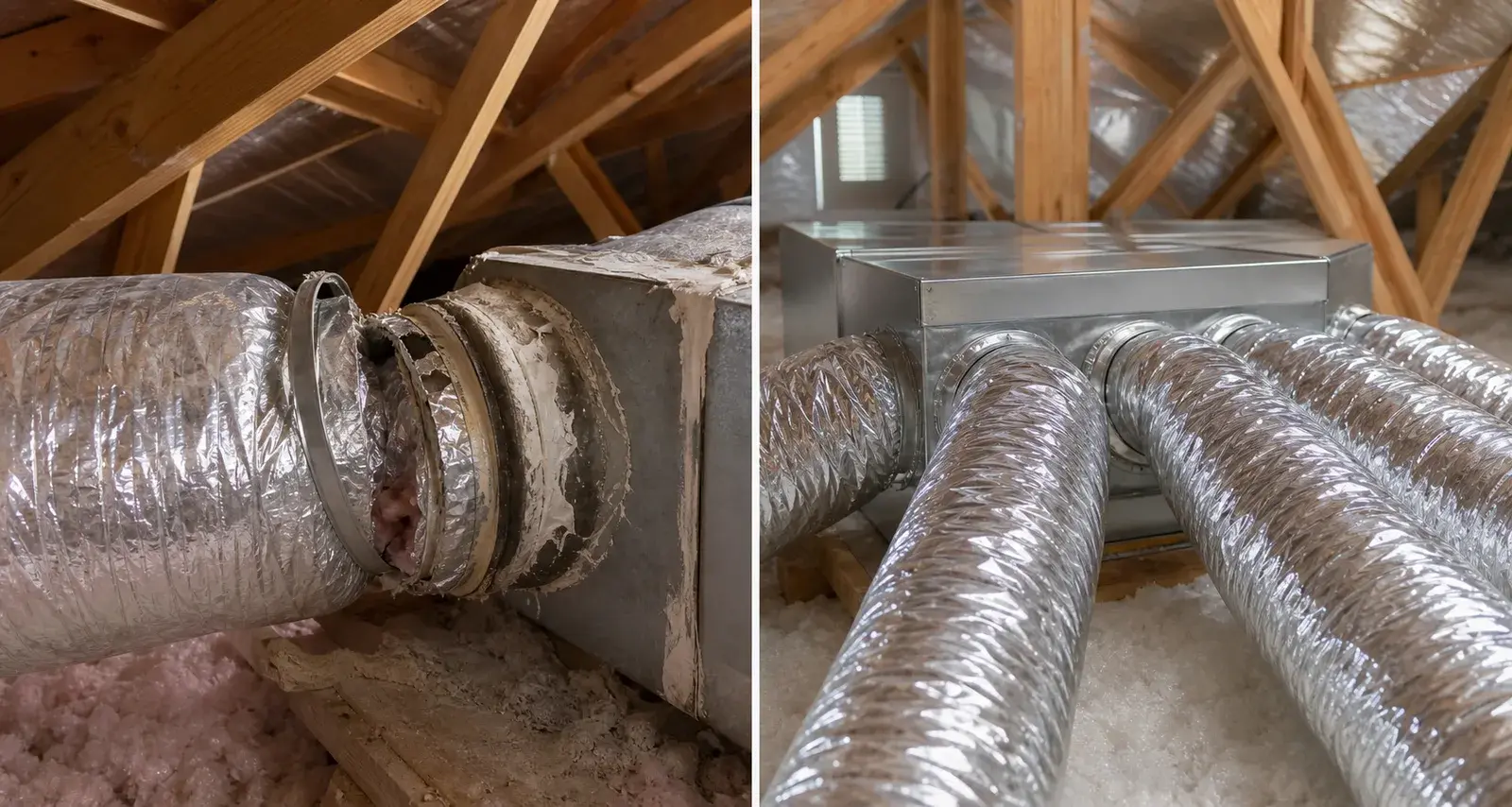
Air duct repair is usually the right choice when the layout and sizing are sound and the problem is limited to accessible leaks, loose connections, or one damaged run. Replacement is more defensible when ducts are repeatedly torn, crushed, contaminated, badly undersized, or failing across the system. In Southern California, confirm the condition with an inspection and airflow or leakage testing before spending on either option.
- Age is a screening clue, not a replacement verdict; condition, design, access, and measured performance decide the scope.
- Reconnect and mechanically secure a failed run before sealing it; mastic or UL-rated foil tape is for appropriate joints, not structural damage.
- A duct replacement project should evaluate airflow and sizing, not simply copy a flawed old layout.
- California HVAC alterations can trigger duct sealing and field-verification requirements; confirm the permit scope before work begins.
On this page
- Quick answer: repair sound ducts; replace failed or misdesigned ductwork
- What evidence should drive an air duct repair vs replacement decision?
- When a focused duct repair is the better investment
- When partial or full duct replacement is the safer long-term choice
- Why sizing and static pressure matter before replacing ducts
- What California rules can change the scope?
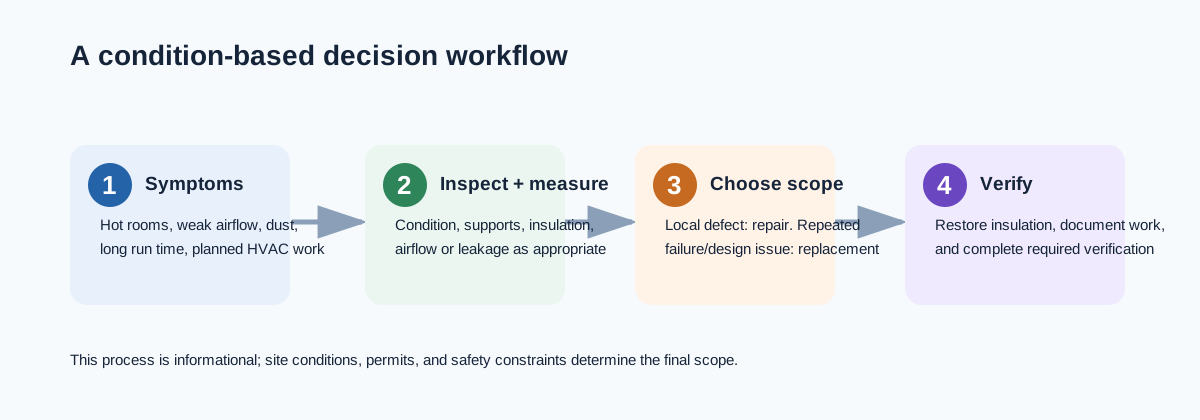
- A practical decision process for homes in our service area
Quick answer: repair sound ducts; replace failed or misdesigned ductwork
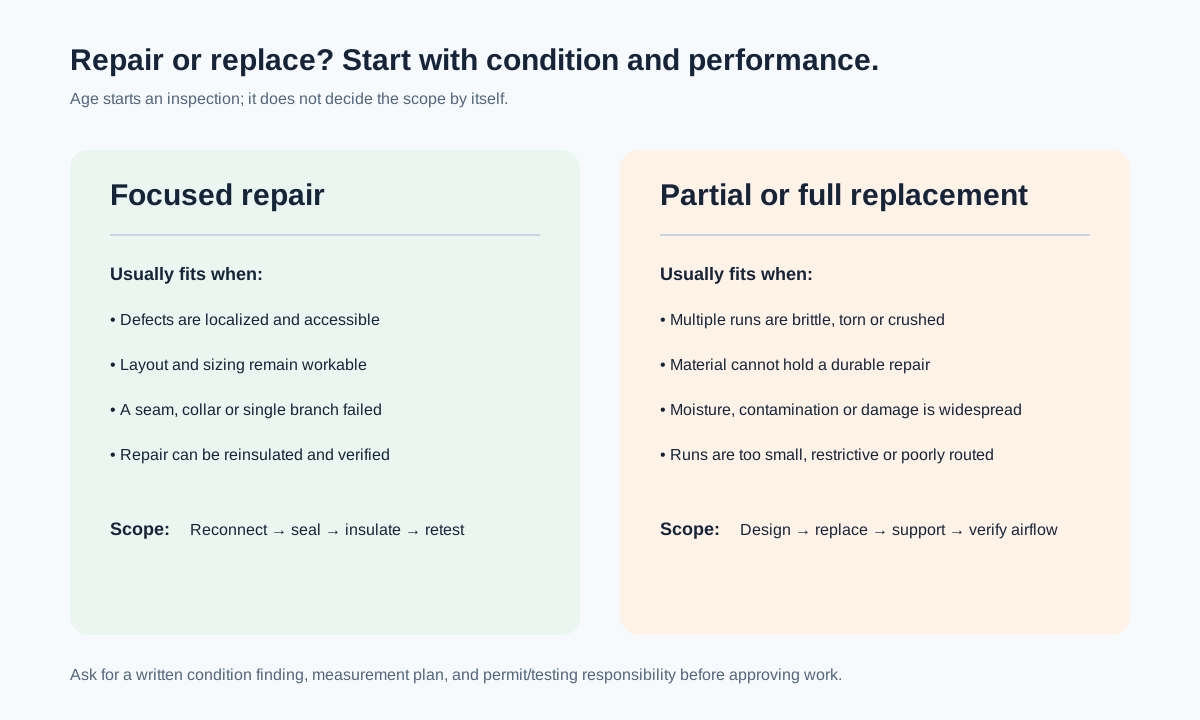
For most homes, the choice is not “old equals replacement.” Repair makes sense when a duct system still has a workable layout and enough capacity, but one or a few accessible failures are wasting air: a loose collar, an open seam, a torn branch, or failed insulation. Replacement deserves stronger consideration when failures repeat through many runs, the material cannot hold a durable repair, access consumes the budget, or the system was never sized and routed to deliver airflow to the rooms that need it.
What evidence should drive an air duct repair vs replacement decision?
| What the inspection finds | Usually supports repair | Usually supports replacement |
|---|---|---|
| One loose collar or open metal seam | Reconnect, mechanically secure, seal, and reinsulate | Only if the connection keeps failing because the run or layout is unsuitable |
| One torn or crushed branch run | Replace that branch and verify airflow | Replace additional runs only if similar failure is widespread |
| Failed mastic, foil tape, or insulation at accessible joints | Repair and reseal sound ductwork | Not needed solely because a seal has failed |
| Brittle, water-damaged, contaminated, or collapsed material in many locations | Temporary repair only when safe and justified | Partial or full replacement is usually easier to make durable |
| Persistent hot rooms with little leakage | Investigate balancing, return air, and equipment airflow | Replace/redesign runs if sizing or routing is the root cause |
| Major work tied to equipment replacement | Repair only if the existing system is proven suitable | Evaluate replacement and design before installing new equipment |
This distinction closes a common SERP gap: generic articles often use a fixed 15- or 20-year rule. The Air Duct Council instead notes that properly installed flexible duct may last for the life of a dwelling. That is not a promise that every old run is healthy; it is a reminder to inspect support, liner condition, routing, insulation, connections, and delivered airflow before treating age as a verdict.
When a focused duct repair is the better investment
Choose a focused repair when the underlying duct path remains sensible and the defect is localized. Examples include a supply run that slipped off a collar, a return connection with an accessible gap, a damaged boot, or a single flex run with a tear. The durable sequence is mechanical repair first, then seal the appropriate joint, then restore the insulation jacket. ENERGY STAR recommends mastic sealant or metal-backed tape for accessible duct sealing and warns that ordinary cloth duct tape is not a long-lasting solution.
Repair should still be evidence-led. A hot room can also come from solar gain, poor envelope insulation, a restrictive filter, a blower setting, a frozen coil, an undersized branch, or a return-air problem. If the symptom is mostly one room, start with our uneven cooling and hot-room guide. If you first need to confirm leakage, see leaky air ducts: signs, tests, and the right fix.
When partial or full duct replacement is the safer long-term choice
Replacement becomes more rational when a repair cannot remain mechanically sound or cannot restore the system’s intended airflow. Typical triggers include repeated disconnections, compressed or sharply kinked flex duct, damaged inner liners, pervasive degradation, moisture damage, contamination that cannot be safely addressed, inaccessible failed runs, or a layout with undersized trunks and branches. A replacement scope should also address supports, bends, return paths, and insulation—not simply install new material on the old route.
Why sizing and static pressure matter before replacing ducts
ACCA’s Manual D is the industry design reference for residential duct systems. In plain language, ducts are a distribution system: too-small, excessively long, sagging, or poorly routed runs add resistance and can starve rooms of air even when the equipment itself is healthy. Replacing visible damaged sections without checking the return path, branch sizing, and airflow may preserve the original comfort problem. Ask for the basis of a replacement recommendation: what was observed, what is being measured, and what design constraint is being corrected?
What California rules can change the scope?
California’s 2025 Building Energy Efficiency Standards apply to permits submitted on or after January 1, 2026. The California Energy Commission explains that many HVAC additions and alterations require duct sealing and field verification. For applicable alteration work, the cited requirements can include limits of 10% total duct leakage or 7% leakage to outside, with project-specific exceptions and alternative compliance paths. This is not a substitute for permit guidance: confirm the exact job scope, testing method, and responsibility with the contractor and local jurisdiction.
A practical decision process for homes in our service area
In Ontario, Pomona, Diamond Bar, Walnut, Claremont, Rowland Heights, and nearby Inland Empire and East Los Angeles County communities, ducts often run through very hot vented attics. That makes a supply leak more costly in summer and can allow a return leak to draw dusty attic air. Before replacing an AC because a back bedroom is warm, have the duct system inspected and the airflow question separated from the equipment question. If the evidence points to widespread deterioration or a flawed layout, a duct replacement assessment can define a replacement scope that supports the new or existing HVAC system.
Alex Air & Heating can inspect accessible ductwork, explain whether the evidence supports repair, partial replacement, or a redesigned replacement scope, and provide a written next step for homes in the Inland Empire and East Los Angeles County. Explore duct replacement.
Frequently asked questions
Repair is often appropriate when the ducts are correctly sized and generally sound but have localized loose collars, failed seams, or a limited damaged section. Consider partial or full replacement when multiple runs are brittle, crushed, contaminated, inaccessible to repair, or fundamentally undersized. A visual condition report plus leakage or airflow evidence is more reliable than a rule based only on age.
Often, yes. A technician can reconnect failed joints, replace a damaged branch, seal accessible seams with mastic or UL-rated foil tape, restore insulation, and retest. That approach does not solve a pervasive design problem, widespread material failure, or a duct system that cannot deliver required airflow.
Replace flex duct that is torn, crushed, brittle, water-damaged, contaminated, badly sagging, or repeatedly disconnected. Intact, properly supported flex duct does not have a universal expiration date. Its physical condition, support, routing, and airflow performance matter more than a generic lifespan number.
Not necessarily. New equipment cannot correct a disconnected branch, major leakage, restrictive return, or an undersized run. During an HVAC replacement, confirm duct condition and the applicable California verification requirements so the new equipment is not asked to overcome an old distribution problem.
Many California alterations require duct sealing and field verification, but requirements and exceptions depend on the exact scope and permit documents. The California Energy Commission describes situations involving split-system component replacement and duct extensions. Ask who will coordinate testing and any required HERS or ECC-Rater verification.
Local next step
Turn this guide into a site-specific answer.
Guides explain the decision. Equipment condition, access, and safe next steps still need to match the home or business. Review the relevant service scope or request an assessment for Ontario, the Inland Empire, or East Los Angeles County. Availability depends on the current schedule.