Office HVAC Maintenance Checklist for LA County
An office HVAC maintenance checklist should coordinate occupancy, ventilation paths, filters, drains, controls and documented follow-up—not assume every office has the same schedule or indoor-air-quality needs.

Owner & Lead HVAC Technician, Alex Air & Heating · EPA 608 Universal Certified · Ontario, CA
TL;DR
An office HVAC maintenance checklist should coordinate the ventilation and temperature schedule with actual occupancy, keep supply and return paths clear, check filters and condensate concerns, review controls after layout or schedule changes, and document complaints plus corrective actions. In LA County, the useful result is an evidence-based maintenance scope—not a fixed one-size-fits-all interval.
- Coordinate the checklist with actual office hours, events and layout changes.
- Keep supply and return paths accessible; filters are only one part of the air path.
- Record complaints with location and time so controls and conditions can be reviewed.
- Use a documented scope for the property rather than promising a universal maintenance interval.
On this page
Use the checklist around occupancy and indoor-air-quality needs
An office HVAC maintenance checklist is most useful when it reflects the actual workday: occupied zones, meeting-heavy periods, layout changes, complaints and building access. EPA guidance for office occupants emphasizes communication and clear air paths alongside the operation and maintenance of ventilation systems. Begin with the building’s current evidence and a commercial HVAC maintenance scope, rather than a generic promise about air quality or service timing.
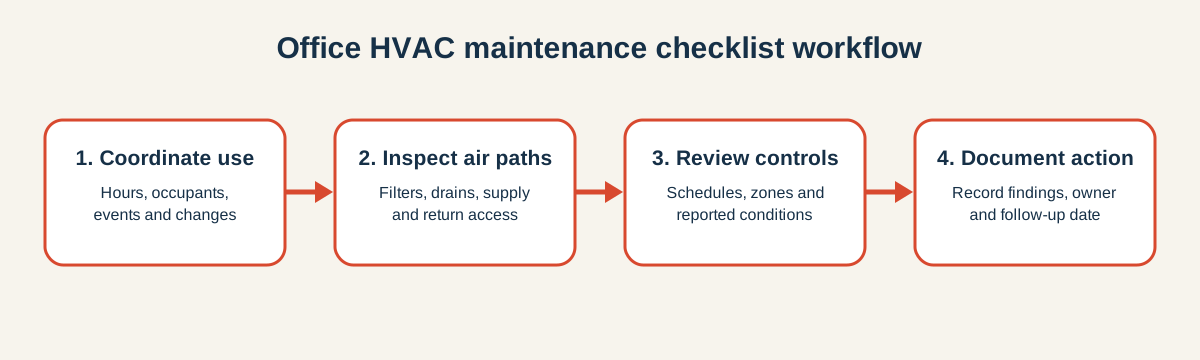
Four steps for using the office checklist
Use the following sequence when building or reviewing the property-specific checklist. It supports the visible HowTo structured data and does not replace equipment manuals or a site assessment.
- 1Map office hours, events, layout changes and recurring reports by zone.
- 2Inspect the agreed air paths, filters, drains and equipment condition.
- 3Compare control schedules and settings with current occupancy.
- 4Document findings, responsible parties and follow-up dates.
| Office change or condition | Checklist question | Record to keep |
|---|---|---|
| New seating or partitions | Are supply and return paths still clear? | Affected zone and layout date |
| Different work hours | Do controls match current occupancy? | Schedule and override history |
| Recurring comfort report | What location and time are involved? | Report details and follow-up owner |
| Renovation or new source | Has the ventilation and maintenance plan been reviewed? | Work scope and coordination note |
Look beyond filters without making an IAQ diagnosis
A filter check is not a complete indoor-air-quality conclusion. EPA materials for offices identify ventilation, pollutant sources and building operation as related considerations. Keep return and supply paths accessible, coordinate changes such as remodeling or cleaning products, and route recurring concerns through the property’s documented process. This article does not diagnose a building or make a health claim.
Use records to make the next visit more useful
A small, consistent record—location, time, schedule, observation and owner—can make a future inspection more targeted. Warehouse teams can adapt the asset-first approach in warehouse HVAC maintenance in the Inland Empire, while commercial HVAC maintenance in Los Angeles County covers the broader preventive-maintenance framework.
For a listed East Los Angeles County or Inland Empire service area, discuss a property-specific office scope through commercial HVAC maintenance. Availability and final scope depend on the site and schedule.
Frequently asked questions
Include current occupancy and schedule information, filter and air-path observations, condensate and equipment-condition checks within the agreed scope, control-schedule review, reported conditions by time and zone, and documented follow-up actions.
No. Filters are important, but office indoor air quality can also be affected by ventilation operation, blocked supply or return paths, occupancy, remodeling, cleaning products and other sources. Review the building-specific situation instead of treating a filter change as a complete IAQ conclusion.
Review it when operating hours, tenant layout, occupancy patterns, events or comfort reports change, and as part of the property’s planned maintenance process. The correct settings depend on the building and controls.
Record the location, time, observed condition, number of occupants if relevant and whether the concern is recurring. Those details help a facilities team connect a report to a zone and schedule rather than guessing from a general complaint.
Alex Air & Heating serves listed East Los Angeles County and Inland Empire communities. The site does not claim a Los Angeles city storefront; service availability and the maintenance scope depend on the building, service area and schedule.
Local next step
Turn this guide into a site-specific answer.
Guides explain the decision. Equipment condition, access, and safe next steps still need to match the home or business. Review the relevant service scope or request an assessment for Ontario, the Inland Empire, or East Los Angeles County. Availability depends on the current schedule.