Commercial HVAC Maintenance Los Angeles: Costs, ROI & Schedule
What commercial HVAC maintenance in Los Angeles actually includes, how often rooftop units need service, real contract pricing, and how to judge the ROI.

Owner & Lead HVAC Technician, Alex Air & Heating · EPA 608 Universal Certified · Ontario, CA
TL;DR
Commercial HVAC maintenance in Los Angeles is a scheduled program of quarterly or semi-annual rooftop-unit service, filter and belt changes, coil cleaning, refrigerant and amp-draw testing, and control checks that keeps a business open, protects warranties, and typically costs 50 to 120 dollars per cooling ton per year.
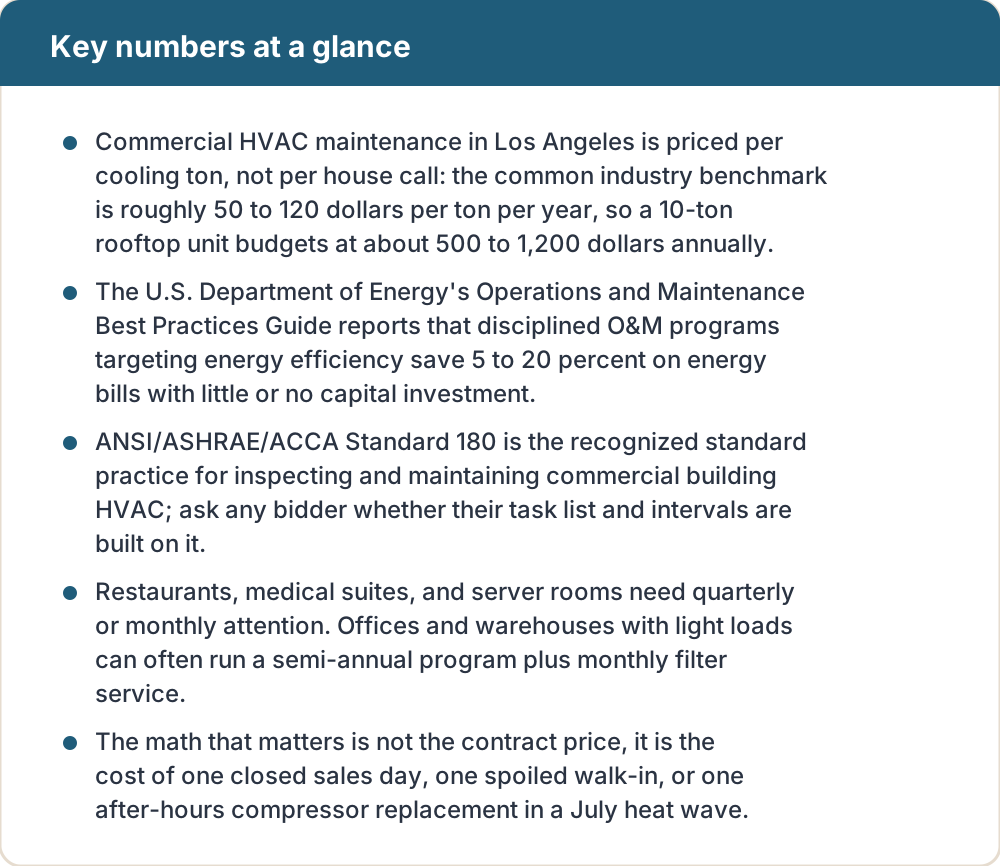
- Commercial HVAC maintenance in Los Angeles is priced per cooling ton, not per house call: the common industry benchmark is roughly 50 to 120 dollars per ton per year, so a 10-ton rooftop unit budgets at about 500 to 1,200 dollars annually.
- The U.S. Department of Energy's Operations and Maintenance Best Practices Guide reports that disciplined O&M programs targeting energy efficiency save 5 to 20 percent on energy bills with little or no capital investment.
- ANSI/ASHRAE/ACCA Standard 180 is the recognized standard practice for inspecting and maintaining commercial building HVAC; ask any bidder whether their task list and intervals are built on it.
- Restaurants, medical suites, and server rooms need quarterly or monthly attention. Offices and warehouses with light loads can often run a semi-annual program plus monthly filter service.
- The math that matters is not the contract price, it is the cost of one closed sales day, one spoiled walk-in, or one after-hours compressor replacement in a July heat wave.
On this page
- What does commercial HVAC maintenance in Los Angeles actually include?
- How is commercial HVAC different from residential maintenance?
- How often should a commercial rooftop unit be serviced?
- What does a commercial HVAC maintenance contract cost?
- Does preventive maintenance actually pay for itself?
- Why do LA-area rooftop units fail in summer specifically?
- How do you choose a commercial HVAC maintenance contractor?
- What should a business do first?
What does commercial HVAC maintenance in Los Angeles actually include?
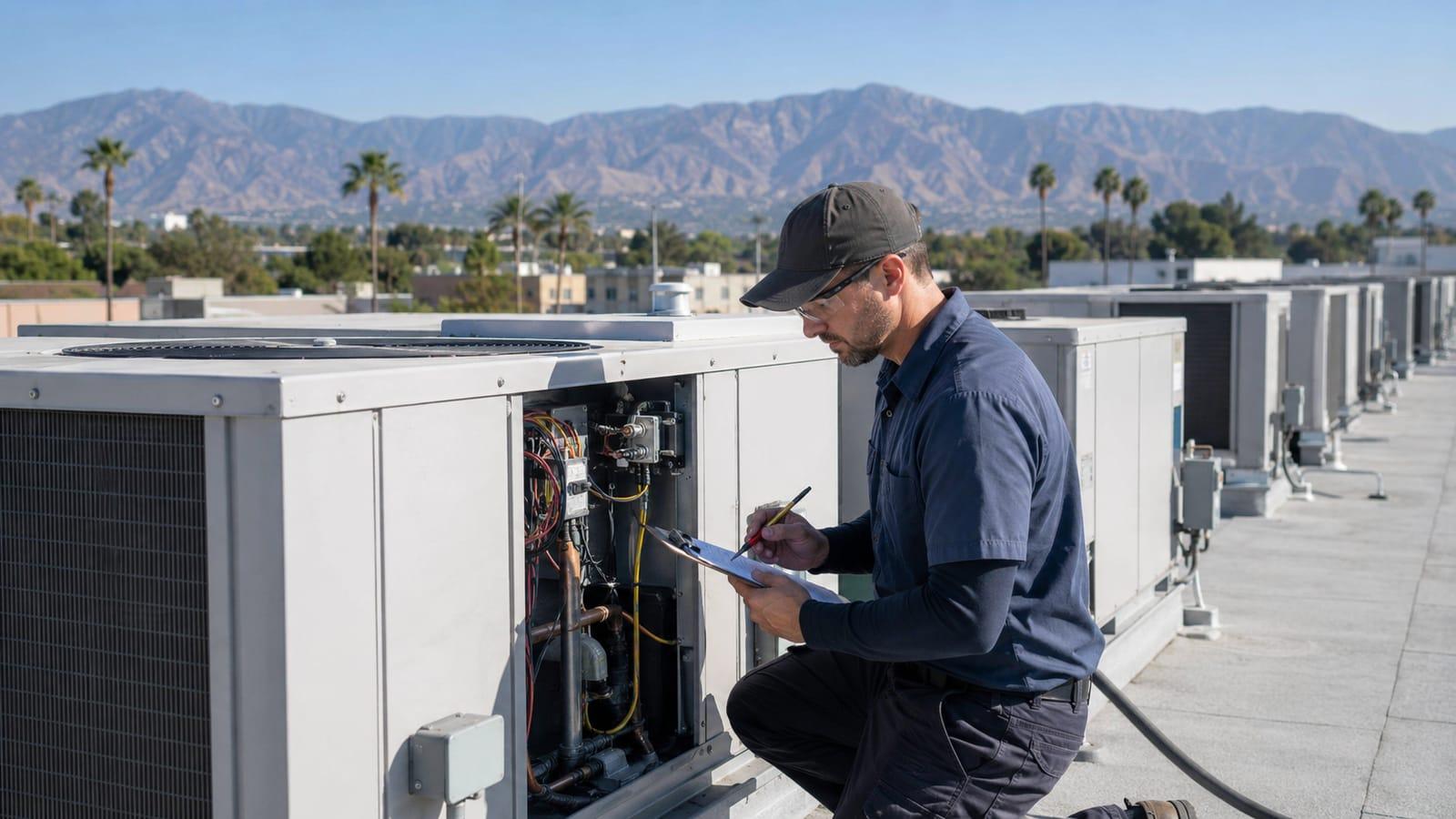
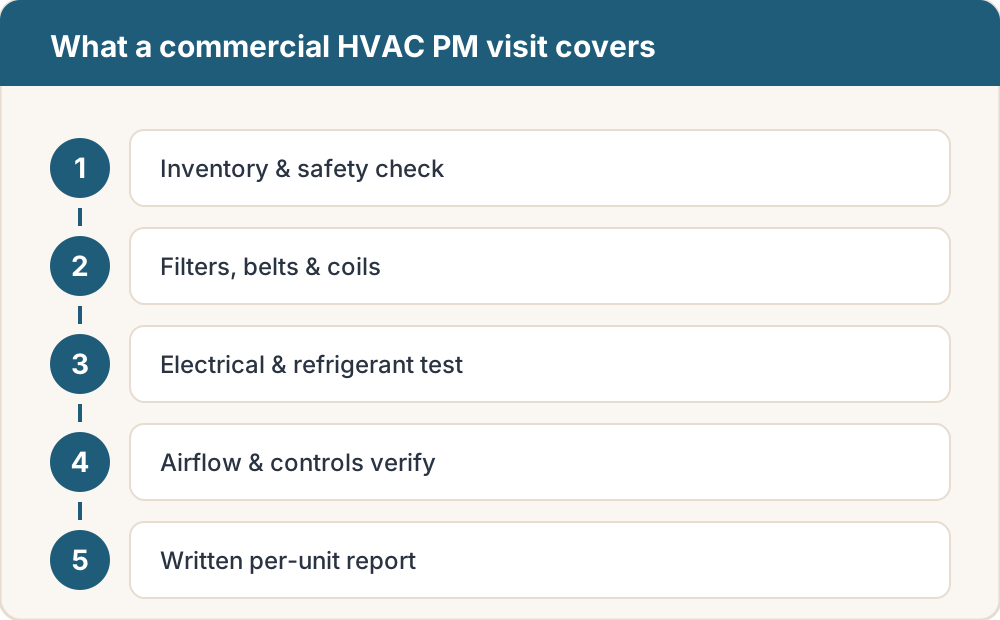
Commercial HVAC maintenance in Los Angeles is not a homeowner tune-up scaled up. It is a documented program with defined tasks, defined intervals, and a paper trail you can hand to a landlord, an insurer, or a manufacturer during a warranty claim. On a typical packaged rooftop unit (RTU) serving a Pomona retail suite or a Rowland Heights office, a full preventive maintenance (PM) visit runs one to three hours per unit and covers mechanical, electrical, airflow, refrigerant, and controls in a fixed sequence.
The core scope of a real commercial maintenance agreement looks like this: replace or inspect filters and log the size and MERV rating; wash condenser and evaporator coils; inspect and tension or replace belts; lubricate bearings and check motor amp draw against nameplate; verify refrigerant charge by superheat and subcooling rather than by gauge pressure alone; clear condensate pans and drain lines; tighten every electrical lug and test contactors and capacitors under load; check economizer dampers and actuators; confirm thermostat and BAS setpoints, schedules, and sensor calibration; and record supply and return temperature split so this visit can be compared to the last one.
That last item is what separates a program from a visit. Trend data on amp draw, temperature split, and refrigerant readings is how a technician tells you in April that a compressor is drifting, instead of telling you in August that it is dead.
- Mechanical: filters, belts, bearings, blower wheel, fan balance, cabinet and curb seal
- Refrigeration: superheat and subcooling, leak check, coil condition, compressor amp draw
- Electrical: contactors, capacitors, lug torque, disconnect, safety controls, wire condition
- Airflow and IAQ: static pressure, temperature split, economizer operation, outside-air intake
- Controls: thermostat or BAS schedules, setpoints, sensor calibration, occupancy programming
- Documentation: per-unit report with readings, photos, deficiencies, and a prioritized repair list
How is commercial HVAC different from residential maintenance?
Three things change once you cross from a house into a business. First, the equipment. Commercial sites usually run packaged rooftop units, split systems with remote condensers, mini-split banks, or in larger buildings chillers and VAV air handlers. RTUs sit exposed on a flat roof, carry economizers and multi-stage compressors, and are almost never visible to the tenant until they stop working.
Second, the duty cycle. A home system in Diamond Bar might run four to six hours on a hot day. A restaurant hood makeup-air unit or a retail RTU on Holt Boulevard runs nearly continuously from open to close, seven days a week, through a Southern California cooling season that realistically stretches from April into October. Run hours are the real driver of wear, and they are why commercial intervals are quarterly where residential is annual.
Third, the stakes and the rules. A business has code and lease obligations, occupant comfort complaints that turn into tenant turnover, indoor air quality expectations in medical and dental settings, and in many cases a landlord clause requiring documented HVAC service. The Department of Energy notes that HVAC is roughly 40 percent of the energy used in a commercial building, so a drifting system is also a line item on your utility bill every single month.
| Business type | Recommended PM frequency | Typical annual cost | Why |
|---|---|---|---|
| Restaurant / commercial kitchen | Quarterly PM + monthly filters | $1,200 - $3,500 per unit | Grease-laden air fouls coils fast and exhaust hoods unbalance makeup air; a hot dining room closes the day |
| Retail strip suite | Quarterly (2 full PM + 2 filter visits) | $700 - $1,600 per unit | Doors open constantly and small packaged RTUs carry full afternoon solar load with no reserve capacity |
| Professional office suite | Semi-annual PM + quarterly filters | $500 - $1,200 per unit | Loads are predictable; the real risk is comfort complaints driving tenant turnover |
| Medical / dental practice | Quarterly | $900 - $2,200 per unit | Ventilation, humidity control, and filtration affect patients, equipment, and compliance documentation |
| Warehouse / distribution | Semi-annual, monthly filters if dusty | $400 - $1,100 per unit | Very large air volumes and high particulate load; failures are tolerable for hours, not days |
| Server room / IT closet | Monthly | $1,500 - $4,000 per unit | Runs 8,760 hours a year with zero tolerance for downtime; a single failure risks hardware |
| Multi-tenant building, 10+ RTUs | Quarterly portfolio program | $50 - $120 per cooling ton | At scale, per-ton pricing becomes the budgeting unit and staggered replacement planning matters most |
How often should a commercial rooftop unit be serviced?
The honest answer is: it depends on run hours, air quality, and consequence of failure. But the defensible baseline most facility teams use is two full PM visits a year, spring and fall, with filter and belt service in between. ANSI/ASHRAE/ACCA Standard 180, the standard practice for inspection and maintenance of commercial building HVAC systems, is written around exactly this idea of documented tasks at defined intervals rather than a single annual once-over.
In practice, most East Los Angeles County businesses land on quarterly. Here is the reasoning we use when we scope a site in Walnut, Claremont, or Rowland Heights:
Filters are the interval that most sites get wrong. A restaurant or a machine shop may need 30-day filter changes; a clean professional office on a 2-inch pleated filter can often go 90 days. The only way to know is to pull the filter at the first few visits and look at it, then set the interval from evidence.
- Monthly: filter inspection and change on grease-, dust-, or particulate-heavy sites; belt tension; condensate drain flush during cooling season
- Quarterly: full PM on restaurants, medical and dental suites, server and telecom rooms, and any single-unit site where failure closes the doors
- Semi-annual: full PM before cooling season and before heating season on offices, warehouses, and lightly loaded retail
- Annual: coil deep clean, blower wheel cleaning, economizer actuator test, full electrical torque check, refrigerant leak survey
One more Southern California specific: schedule the cooling PM in March or April, not June. Every contractor in the Inland Empire is buried the week of the first 100-degree day, and a coil cleaning that takes two hours in spring becomes an emergency call in midsummer.
What does a commercial HVAC maintenance contract cost?
Commercial maintenance is normally priced one of three ways: per unit, per cooling ton, or per square foot. Per ton is the most useful for comparing bids. The widely cited industry benchmark is roughly 50 to 120 dollars per cooling ton per year, so a 10-ton rooftop unit sits somewhere around 500 to 1,200 dollars annually depending on visit frequency, filter count, and whether minor parts are included.
Where bids diverge is coverage tier. A basic agreement buys labor and inspection only. A mid tier adds consumables like filters, belts, and contactors. A full-coverage or planned-service agreement folds in labor on covered repairs, priority dispatch, and after-hours response with no overtime premium. Ask every bidder to state, in writing, the number of visits per year, the task list per visit, what parts are included, the hourly rate for anything not included, and the after-hours rate. If a proposal will not itemize those five things, you cannot compare it to anything.
Alex Air & Heating quotes commercial agreements with upfront written pricing per unit and per visit, so a Pomona strip-center owner with six RTUs can see exactly what each roof position costs before signing. We are EPA 608 certified out of our Ontario, CA base, and our installation work carries 3-year labor, 5-year parts, and 7-year compressor warranty coverage. If you are still weighing whether the agreement pays for itself, we broke down the arithmetic in our maintenance plan ROI analysis.

Does preventive maintenance actually pay for itself?
Two returns show up on the P&L, and only one of them is obvious.
The visible one is energy. The Department of Energy's Operations and Maintenance Best Practices Guide reports that O&M programs targeting energy and water efficiency are estimated to save 5 to 20 percent on energy bills without significant capital investment. ENERGY STAR publishes similar checklists of low- and no-cost measures for commercial buildings, and dirty coils, restricted filters, and slipping belts are on every one of them. On a 40,000-square-foot building where HVAC is the largest single load, mid-single-digit percentage savings is real money every month.
The invisible one is avoided failure, and it is usually the bigger number. Run the arithmetic on your own business rather than on an industry average. A full-service restaurant in Walnut doing 6,000 dollars in covers on a Saturday loses that entire day if the dining room hits 84 degrees at noon. A dental practice that reschedules a day of appointments loses the chair time and the goodwill. A cold-storage or lab client loses inventory. Against those numbers, a 900-dollar annual agreement is not a cost center, it is the cheapest insurance on the roof.
There is also a compounding effect that never shows up in a single year. Coil fouling, low charge, and belt misalignment all push a compressor toward higher head pressure and shorter life. Replacing a rooftop compressor is a four-figure repair; replacing the unit is five figures and a crane permit. Deferred maintenance does not save money, it just moves the invoice into a worse quarter and usually into a hotter month, when emergency commercial repair crews across the region are already booked out.
Why do LA-area rooftop units fail in summer specifically?
Rooftop units in the San Gabriel Valley and the Inland Empire live a harder life than the same model in a coastal city. Roof surface temperatures on a black membrane can run 30 to 50 degrees above ambient, so an RTU pulling condenser air on a 103-degree Ontario afternoon is ingesting air well above the design condition its capacity rating assumes. Head pressure climbs, capacity drops, and the compressor works closer to its safety limits for hours at a time.
Layer on the regional dust and pollen load, the Santa Ana events that pack condenser fins with debris in a single afternoon, and the fact that most RTUs are out of sight and therefore out of mind, and you get the pattern we see every year: a wave of no-cooling calls that starts within 48 hours of the first sustained triple-digit stretch. Almost all of them trace back to something a spring PM visit would have caught, most often a fouled condenser coil, a failed capacitor, a burnt contactor, or a low charge from a slow leak that had been developing since the previous season.
The practical countermeasure is timing plus a short summer-readiness list: wash the condenser coil before the heat arrives, replace weak capacitors on measurement rather than on failure, verify the economizer is not stuck open pulling in 100-degree outside air, confirm condensate drains are clear, and check that the unit's disconnect and lugs are torqued. Businesses in Pomona and the surrounding San Gabriel Valley cities that get this done in March almost never call us in July.
How do you choose a commercial HVAC maintenance contractor?
Most commercial maintenance disappointment comes from a vague agreement, not from a bad technician. Get specific before you sign, and judge every bidder on the same seven questions.
Also weigh response capability separately from the PM price. A cheap agreement from a contractor who cannot get to your roof for four days in August is not cheap. Ask what same-day and after-hours coverage looks like in practice, who answers the phone at 7 p.m. on a Friday, and how far the nearest crew is based from your building. For sites across the Inland Empire and East Los Angeles County, our crews dispatch from Ontario, which is why we can commit to same-day emergency response across Pomona, Diamond Bar, Walnut, Claremont, and Rowland Heights. If the assessment shows a unit is past economical repair, we will say so and quote commercial system replacement with the same written pricing discipline.
- Are your technicians EPA 608 certified, and who specifically will be on my roof?
- Is your task list and interval schedule built on ANSI/ASHRAE/ACCA Standard 180?
- How many visits per year, and what exactly is performed on each one?
- Which parts and consumables are included, and what is the rate for everything else?
- What is the after-hours and holiday rate, and is it waived under this agreement?
- Do I receive a written per-unit report with readings after every visit?
- What is your typical response time for a no-cooling call in July, and can you put it in the agreement?
What should a business do first?
Start with an inventory, not a contract. Walk the roof or send someone up with a phone and photograph every nameplate: manufacturer, model, serial, tonnage, refrigerant type, and manufacture date. That single list determines your per-ton budget, tells you which units are approaching end of service life, and flags any remaining R-22 equipment that will be expensive to keep alive.
Then get two or three proposals scoped against the same visit count and the same task list, so you are comparing price rather than comparing scope. Ask for a first-visit condition assessment that grades each unit red, yellow, or green with photos, and use that to build a two- to three-year capital plan instead of reacting to whichever unit dies first. A property with eight RTUs almost never needs all eight replaced at once, but it does need to know which two are next.
If you own or manage a commercial property anywhere from Ontario through the San Gabriel Valley and want a straight assessment of what your equipment actually needs, call us and we will scope it with written pricing before any work starts.
Sources & references
- 1.U.S. Department of Energy FEMP - Operations & Maintenance Best Practices Guide, Release 3.0
- 2.ASHRAE - Standards 180 & 211 Fact Sheet (Inspection and Maintenance of Commercial Building HVAC Systems)
- 3.Better Buildings Solution Center - ANSI/ASHRAE/ACCA Standard 180 Overview
- 4.ENERGY STAR - Checklists of Energy-Saving Measures for Commercial Buildings
- 5.ENERGY STAR - Fifteen O&M Best Practices for Energy-Efficient Buildings
- 6.ENERGY STAR - Operation and Maintenance Best Practices
Frequently asked questions
Two full preventive maintenance visits a year, one before cooling season and one before heating season, is the defensible minimum. Most LA-area businesses with heavy run hours, such as restaurants, medical offices, and busy retail, do better on a quarterly program with monthly or 90-day filter service. Set filter intervals from evidence by inspecting the actual filter on the first few visits rather than guessing.
The common industry benchmark is roughly 50 to 120 dollars per cooling ton per year, which puts a 10-ton rooftop unit at about 500 to 1,200 dollars annually. Price varies with visit frequency, filter count, and coverage tier, since full-coverage agreements that include repair labor and priority after-hours dispatch cost more than inspection-only plans. Always compare bids on visits per year and task list, not just headline price.
Usually yes, because a single-unit business has no redundancy. If the one RTU fails, the doors effectively close. Compare the annual agreement price against the revenue of one lost operating day plus the after-hours premium on an emergency call, and for most restaurants and retail suites the agreement pays for itself the first time it prevents a shutdown.
Most commercial equipment warranties require documented professional maintenance, and manufacturers can deny a claim if you cannot produce service records. That is why per-unit written reports with dated readings matter as much as the wrench work. Keep the reports with your lease and insurance documents so they are available when a claim is filed.
It is the recognized standard practice for inspection and maintenance of commercial building HVAC systems, establishing minimum tasks and intervals that preserve thermal comfort, energy efficiency, and indoor air quality. You care because it gives you an objective yardstick for comparing contractor proposals. A bidder who builds their task list around it is offering a program; one who cannot describe their intervals is offering a visit.
Yes. Alex Air & Heating is based in Ontario, CA and our EPA 608 certified technicians serve commercial properties across the Inland Empire and East Los Angeles County, including Pomona, Diamond Bar, Walnut, Claremont, and Rowland Heights. We offer scheduled maintenance agreements with upfront written pricing plus same-day and emergency response for no-cooling calls.
Local next step
Turn this guide into a site-specific answer.
Guides explain the decision. Equipment condition, access, and safe next steps still need to match the home or business. Review the relevant service scope or request an assessment for Ontario, the Inland Empire, or East Los Angeles County. Availability depends on the current schedule.