Why Is My House So Dusty With the AC Running? 7 Real Causes
House dusty with the AC running? Leaky return ducts, filter bypass and fan settings are usually to blame. Here is how to find the source and fix it for good.

Owner & Lead HVAC Technician, Alex Air & Heating · EPA 608 Universal Certified · Ontario, CA
TL;DR
Your house dusty with the AC running usually means the return side of the duct system is leaking. Any gap on a return duct sits under suction, so the blower pulls attic insulation fibers, drywall grit and crawlspace soil straight past the filter and into your rooms. A loose or wrong-size filter does the same thing. Seal the returns first, then fix the filter fit.
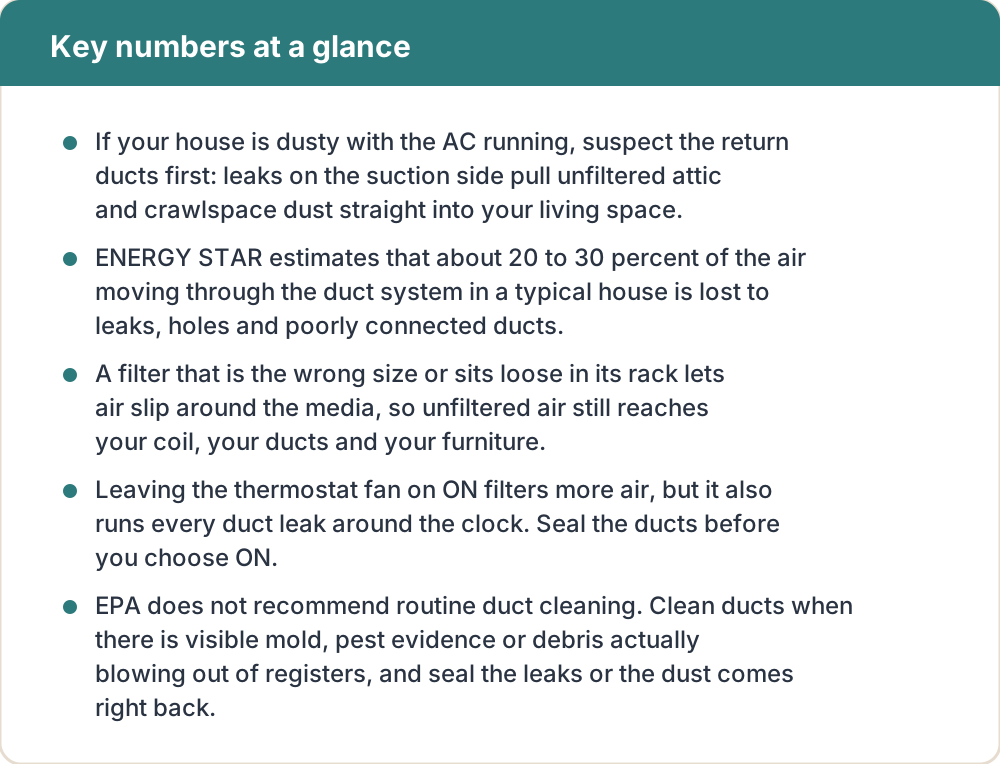
- If your house is dusty with the AC running, suspect the return ducts first: leaks on the suction side pull unfiltered attic and crawlspace dust straight into your living space.
- ENERGY STAR estimates that about 20 to 30 percent of the air moving through the duct system in a typical house is lost to leaks, holes and poorly connected ducts.
- A filter that is the wrong size or sits loose in its rack lets air slip around the media, so unfiltered air still reaches your coil, your ducts and your furniture.
- Leaving the thermostat fan on ON filters more air, but it also runs every duct leak around the clock. Seal the ducts before you choose ON.
- EPA does not recommend routine duct cleaning. Clean ducts when there is visible mold, pest evidence or debris actually blowing out of registers, and seal the leaks or the dust comes right back.
On this page
- Why is my house dusty with the AC running?
- How do leaky return ducts pull attic dust into your home?
- Is your filter actually filtering, or is air going around it?
- Does the fan setting, ON versus AUTO, make dust worse?
- What makes Inland Empire homes dustier than average?
- Is duct cleaning worth it, or a waste of money?
- What can you check yourself in 20 minutes?
- What does a pro test, and how does a duct leakage test work?
- What are the most common mistakes homeowners make with dust?
Why is my house dusty with the AC running?
If your house is dusty with the AC running, the air conditioner is not manufacturing that dust. It is delivering it. A central system pulls your home's entire air volume through its ductwork several times an hour, so anything the ducts touch on the way gets handed to your living room: insulation fibers, drywall grit, dry crawlspace soil. In Ontario and across the Inland Empire, nearly every duct run sits in a vented attic, which is a very dusty path to drag household air through.
The single biggest cause is a leak on the return side. Returns sit under negative pressure whenever the blower runs, so every open seam, torn flex connection and unsealed framing cavity acts like a straw sipping attic air. That air is not cleaned the way you assume, because much of it enters downstream of the filter or through the unsealed cabinet around it.
Second and third place go to filter bypass, meaning a filter that does not truly seal in its slot, and running the blower on ON instead of AUTO, which multiplies both. Pets, open windows and wind events matter too, but they rarely explain dust that reappears two days after you wipe every surface.
How do leaky return ducts pull attic dust into your home?
Picture your duct system as two halves with opposite personalities. The supply side is pressurized, so leaks there blow the cool air you paid for into a superheated attic. The return side is the mirror image: it is under suction. A hole on the return does not leak out, it sucks in, and whatever it pulls arrives in your bedrooms seconds later.
The scale of that leakage is what homeowners underestimate. ENERGY STAR estimates that about 20 to 30 percent of the air moving through the duct system in a typical house is lost to leaks, holes and poorly connected ducts. Sealing those connections is an air quality repair, not just an energy repair, because a sealed system stops drawing on dusty attics and garages in the first place.
- Platform and cavity returns: many older Ontario and Pomona homes use the framed cavity under the furnace as the return. Framing cavities are not airtight.
- Filter rack and blower door: a missing slot cover or an access panel that no longer seats is a return leak located inches from the fan.
- Flex duct at the boot: the inner liner slides off the return collar and ends up held on by a zip tie and optimism.
- Failed tape: cloth duct tape dries out fast in a hot attic and peels, leaving the seam wide open.
- Disconnected runs: a branch knocked loose during an attic visit now returns 100 percent attic air.
The visual tell is a dark, fuzzy shadow on the wall around the return grille, or grey streaking on supply registers in the rooms farthest from the equipment. If you see that and your one-month-old filter is already grey, you are filtering attic air for a living. Sealing or replacing those runs is the durable fix, and it is what duct repair and replacement is for.
| Cause | Tell-tale sign | Fix | DIY or pro |
|---|---|---|---|
| Leaking return ducts in the attic | Filter grey in under 30 days; dark dust lines around the return grille | Seal joints and boots with mastic, or replace degraded flex runs | Pro |
| Filter bypass around the rack | Dust streaked at the filter edges; dusty coil despite a clean-looking filter | Correct the filter size, refit the slot cover, add foam weatherstrip | DIY |
| Missing slot cover or unlatched blower door | You can feel air being pulled at the panel seam when the fan runs | Refit and latch the panel, gasket the filter slot cover | DIY |
| Fan left on ON with leaky ducts | Dust returns within days; filter loads fast; higher electric bill | Switch to AUTO or a timed circulate schedule until ducts are sealed | DIY |
| Debris built up inside the ductwork | Visible fuzz blowing from registers at startup | Clean the ducts, but seal them in the same visit | Pro |
| Unsealed attic penetrations and can lights | Dust film along ceiling edges, closet shelves and top of door frames | Air seal the ceiling plane with fire-rated foam and caulk | Either |
| Undersized or restricted return | Whistling return grille, high static pressure, rooms that never cool | Add or enlarge the return; verify with a static pressure test | Pro |
| Outdoor dust and pet dander | Dust spikes after wind events; hair matting the return grille | Close up during wind events, groom pets, vacuum with a HEPA unit | DIY |
Is your filter actually filtering, or is air going around it?
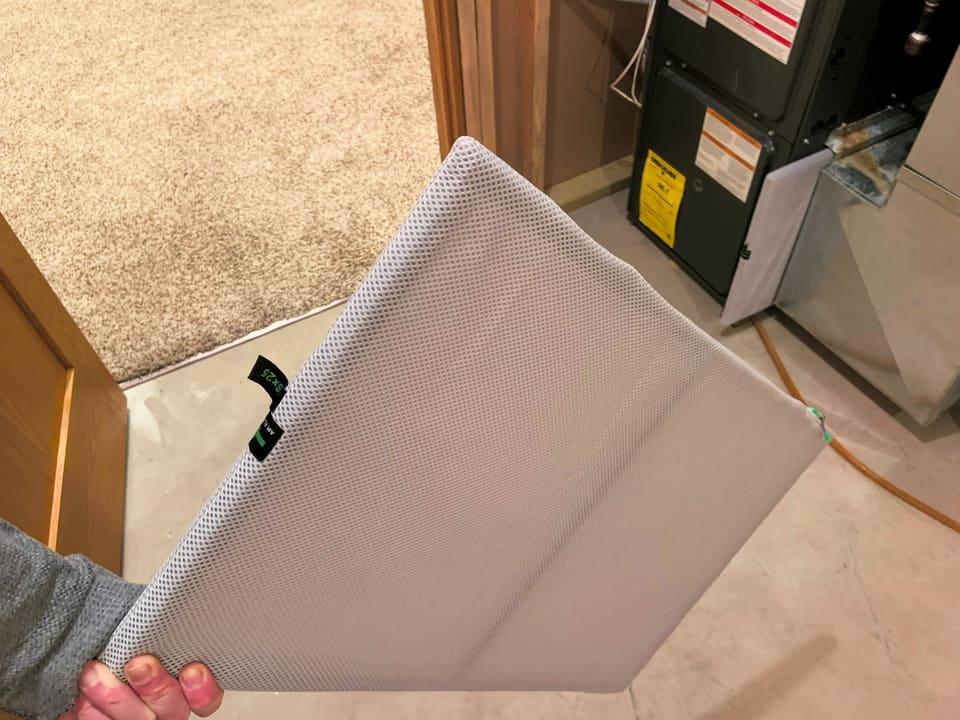
A filter only cleans the air that passes through it, and air takes the path of least resistance. If there is a gap between the filter frame and the rack, a meaningful share of the airflow goes around the media, and the filter can look deceptively clean while your registers and coil get filthy.
- Nominal versus actual size: a 20x25x1 filter really measures about 19.5 by 24.5 inches. Buying by nominal size is fine; buying a close-enough size is not.
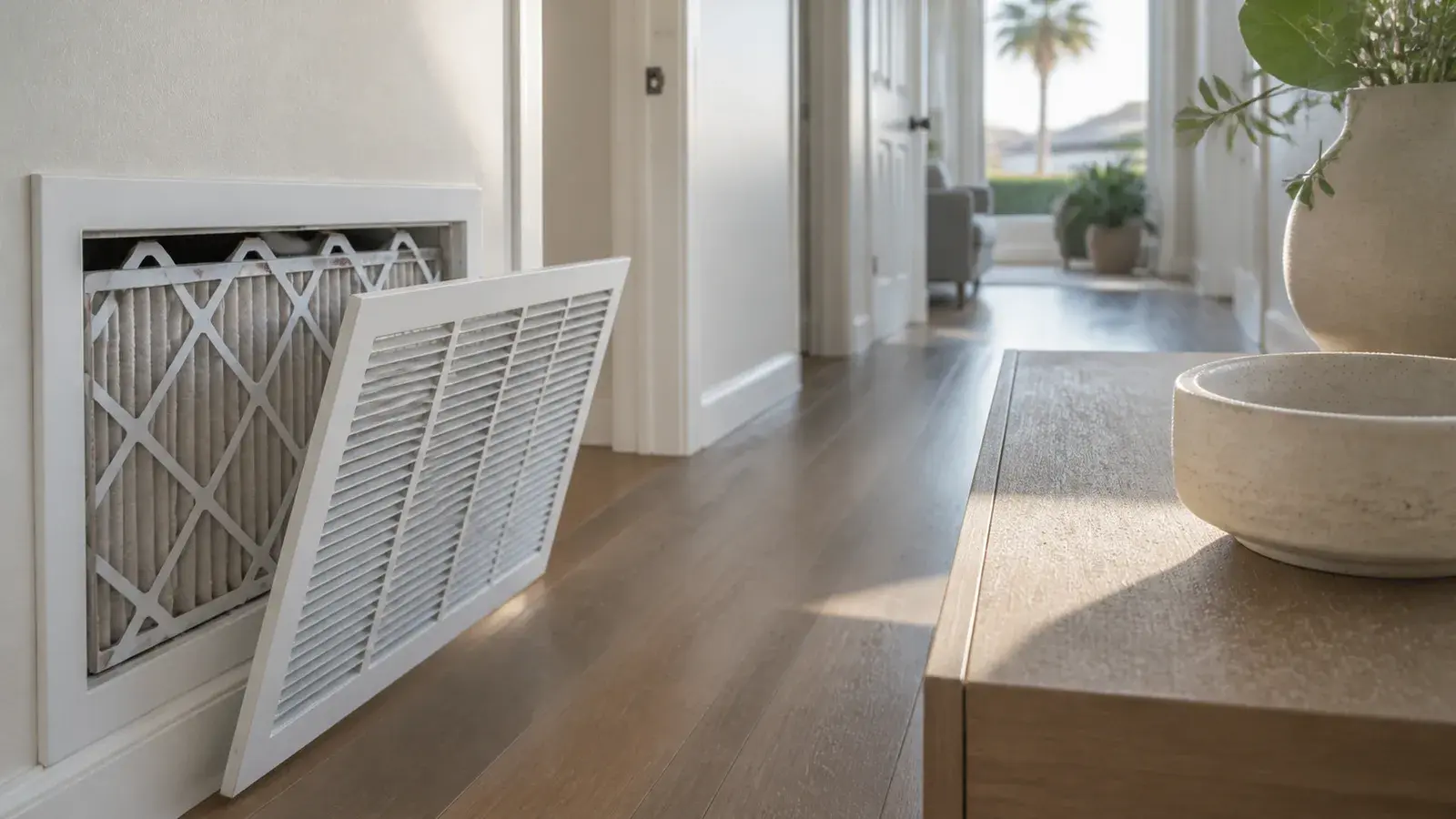
- Missing filter slot cover: an open slot in the return plenum is a direct leak, so the filter is bypassed and attic or closet air comes straight in.
- Warped or collapsed pleats: a thin, loaded filter can bow inward and lift off its seat, opening a gap along a whole edge.
- Two filters, one system: a grille filter plus a furnace filter makes it easy to forget one until it clogs.
- Filter left in too long: higher pressure drop drives more air through whatever gap already exists.
The fix is low tech. The filter should take a little effort to slide in, the slot cover should be present and closed, and a strip of foam weatherstrip on the cover lip kills most bypass. For intervals in Inland Empire dust, see our guide on how often to change your HVAC air filter. Worth saying plainly: fit beats rating. A sealed basic filter outperforms a premium filter with a half-inch gap around it, every time.
Does the fan setting, ON versus AUTO, make dust worse?
Both answers you have read online are right, just for different houses. In a tight, well-sealed duct system, running the blower continuously helps: more air passes the filter and settled dust drops. In a leaky system, ON does the opposite. You are importing attic dust 24 hours a day instead of during the six or eight hours the compressor runs.
- AUTO: the fan runs only during cooling or heating. Less filtration, but far less leakage-driven dust and the lowest fan energy.
- ON: continuous filtration and better mixing, but continuous leakage, higher fan energy and much faster filter loading.
- CIRCULATE, or a fan schedule on most smart thermostats: a set number of minutes per hour. The best compromise once the ducts are sealed.
A common trap: switching to ON to cure a bedroom that never cools. That is an airflow or duct-sizing problem with its own fix, and running the fan all summer just spreads dust farther. We cover the real causes in why one room stays hot.
What makes Inland Empire homes dustier than average?
The Inland Empire sits at the dry end of the basin, ringed by open ground, decomposed granite and near-constant new construction. Wind events push fine mineral dust into attic vents across Fontana, Rancho Cucamonga and Chino, and attic ventilation is designed to let outside air in. Your attic is not a sealed box, and it never was. That is fine, right up until your ductwork starts breathing from it.
Then there is the ceiling itself. Most homes have dozens of openings between the living space and the attic, and every one becomes an entry point when the house sits at negative pressure, which is precisely what leaky returns create.
- Recessed can lights and bath fan housings, often uninsulated and unsealed
- Open top plates above interior walls and around plumbing chases
- An attic hatch with no weatherstrip or latch
- Whole-house fan louvers left uncovered through the summer
- A furnace in the garage with an unsealed cabinet, pulling garage air
- Carpet, upholstery and pets, which shed continuously and reload the system
Order of operations matters more than product choice here. Seal the return ducts first, then the ceiling plane, then consider air cleaning. EPA puts source control ahead of filtration for exactly this reason: removing the source is usually cheaper and more effective than trying to filter it out afterward.
Is duct cleaning worth it, or a waste of money?
Duct cleaning is oversold, but it is not useless. EPA's position is that it should not be routine. It makes sense when there is substantial visible mold on hard duct surfaces, evidence of rodents or insects, or so much debris that particles are actually blowing out of the registers.
EPA also points out that much of the dirt in air ducts adheres to duct surfaces and does not necessarily enter the living space, and that duct cleaning has never been shown to prevent health problems. Translation: if your ducts leak, cleaning them without sealing them is paying to remove dust that will be back in weeks.
- Worth it: after a rodent infestation, after a remodel that dumped drywall dust into open ducts, or when a technician physically shows you loose debris in the trunk line.
- Not worth it: as an annual add-on, as an allergy cure, or as a substitute for finding the leak.
- Skip any offer built around fogging chemical biocides or spraying sealants inside the ducts. EPA notes research has not demonstrated their effectiveness or clarified their health effects.
One more caution specific to older Southern California housing stock. If your flex duct is two decades old, crushed in places, or shedding inner liner, aggressive cleaning can finish it off. At that point honest duct repair or replacement costs less than cleaning something that has to come out anyway.
What can you check yourself in 20 minutes?
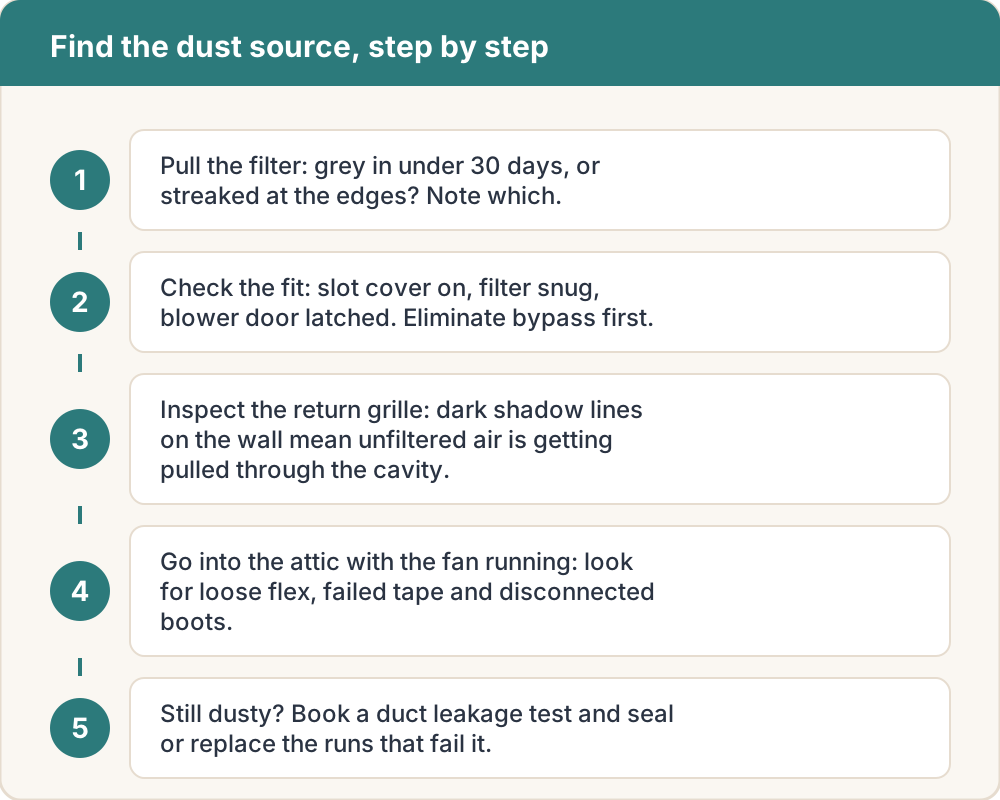
You can narrow this down considerably before anyone visits. Turn the system on, grab a flashlight, and work through the list in order.
- Pull the filter. Is it grey in under 30 days? Is the dust in an even layer, or streaked and heavy at the edges? Edge streaking means bypass.
- Check the fit. Is the slot cover present? Can you slide a fingernail between the filter frame and the rack anywhere along its length?
- Check the blower door. If the panel does not seat and latch cleanly, the cabinet is pulling closet, garage or attic air.
- Look at the wall around the return grille. Dark shadow lines on the paint mean unfiltered air is being drawn through the wall cavity.
- Look at supply registers in the far rooms. Fuzz clinging to the louvers means the dust is arriving from inside the ducts, not from the room.
- Put your head in the attic with the fan running. Loose flex, hanging tape and a disconnected boot are all same-day finds.
- Set the fan to AUTO for one week and compare dust accumulation. That is a free diagnostic that tells you a lot.
If any of those turn up something, you have converted a vague whole-house complaint into a specific defect on a specific component. That is dramatically cheaper to fix than a guess, and it stops you from buying a solution to a problem you do not have.
What does a pro test, and how does a duct leakage test work?
A duct leakage test uses a calibrated fan, often called a duct blaster, connected to the duct system while every register is temporarily sealed. The fan pressurizes the ducts to a reference pressure and a manometer measures how much air the fan must push in to hold that pressure. That figure is your leakage, and it is normally expressed as a percentage of the system's total airflow.
In California this is standard practice, not exotic diagnostics. Duct leakage testing with independent field verification is written into the state energy code when a system or its ductwork is replaced, so any competent contractor in Ontario, Chino or Diamond Bar should be able to perform and explain one. A thorough visit goes further than the number, because a number alone does not tell you where to seal.
- Total leakage measured against leakage to the outside, which separates harmless indoor leaks from attic leaks
- Static pressure readings across the filter and coil, which expose an undersized or restricted return
- Measured airflow, to confirm the system is actually moving the air it should
- Visual inspection of every accessible plenum, boot and branch connection
- Sealing with mastic rather than tape, since mastic survives attic heat and tape does not
Alex Air & Heating is EPA 608 certified and based in Ontario, and we perform duct leakage testing and sealing throughout the Inland Empire and East Los Angeles County with upfront written pricing. If sealing will not get you there because the flex is degraded, we say so before you spend money on a partial fix. Catching a loose return boot early is also one of the reasons an annual AC maintenance visit pays for itself in this climate.
What are the most common mistakes homeowners make with dust?
Most of the money wasted on household dust goes to good products aimed at the wrong problem. These are the errors we see most often on Inland Empire service calls.
- Jumping straight to a denser filter. If air is bypassing the filter, more restriction pushes even more air around the media, not through it.
- Buying duct cleaning before duct sealing. The source is still connected to the system when the crew drives away.
- Leaving the fan on ON to filter more air while the returns are still leaking.
- Closing registers in unused rooms. That raises system pressure and forces more air out of, and into, every existing leak.
- Using cloth duct tape for repairs. Ontario attic heat dries the adhesive out within a season or two. Mastic is the material that lasts.
- Assuming a new condenser fixed the ducts. New equipment does nothing for twenty-year-old flex duct lying in the attic above it.
- Treating a single dusty room as a whole-house problem. One dusty bedroom is usually one leaking branch.
Work in this order: filter fit, return leaks, ceiling penetrations, then filtration upgrades. Most homes see a visible difference by the end of step two, and the ones that do not have usually told you something useful, which is that the dust is walking in through the front door rather than the ductwork.
We test duct leakage and seal or replace the runs that are pulling attic dust into your home - across Ontario, the Inland Empire and East LA County, with upfront written pricing. Duct repair & replacement
Sources & references
- 1.ENERGY STAR - Duct Sealing
- 2.US EPA - Should You Have the Air Ducts in Your Home Cleaned?
- 3.US EPA - Improving Indoor Air Quality
- 4.US EPA - Air Cleaners and Air Filters in the Home
- 5.California Energy Commission - Home Energy Rating System (HERS) Program
- 6.ENERGY STAR - Duct Sealing: The Simple Choice for Energy Efficiency (PDF)
Frequently asked questions
Yes, indirectly. The air conditioner does not create dust, but the blower moves your entire home's air volume through the ducts several times an hour. If those ducts leak on the return side, every cycle imports attic and crawlspace dust and distributes it evenly through the house. Sealed ducts have the opposite effect and reduce settled dust.
Only if the filter seals properly in its rack. Air follows the path of least resistance, so a denser filter with a gap around the frame sends more air around the media, not through it. Fix the fit and the slot cover first. If the dust is entering through duct leaks downstream of the filter, no filter can catch it.
ENERGY STAR estimates that a typical house loses about 20 to 30 percent of the air moving through its duct system to leaks, holes and poorly connected ducts. That is common, not acceptable. California's energy code requires measured duct leakage testing with independent field verification when a system or its ductwork is replaced.
Seal the ducts first, then choose. In a sealed system, continuous or scheduled circulation filters more air and reduces settled dust. In a leaky system, ON runs the leaks around the clock and makes things worse. If you are unsure which you have, run AUTO for a week and compare.
Sometimes. EPA does not recommend it as routine maintenance, and advises it when there is substantial visible mold, a pest infestation, or debris actually blowing out of the registers. After a remodel or a rodent problem it is well justified. Cleaning leaky ducts without sealing them just resets the clock on the same problem.
Most homeowners notice a difference within one to two weeks, once the existing airborne and settled dust has been cleaned up and stops being replenished. Filters typically last noticeably longer too, which is a useful confirmation that the leaks were the source rather than something inside the living space.
Local next step
Turn this guide into a site-specific answer.
Guides explain the decision. Equipment condition, access, and safe next steps still need to match the home or business. Review the relevant service scope or request an assessment for Ontario, the Inland Empire, or East Los Angeles County. Availability depends on the current schedule.