Why Does My AC Keep Tripping the Breaker?
If an AC keeps tripping its breaker, treat it as electrical protection: stop repeated resets, record the pattern, and request measured diagnosis.

Owner & Lead HVAC Technician, Alex Air & Heating · EPA 608 Universal Certified · Ontario, CA
TL;DR
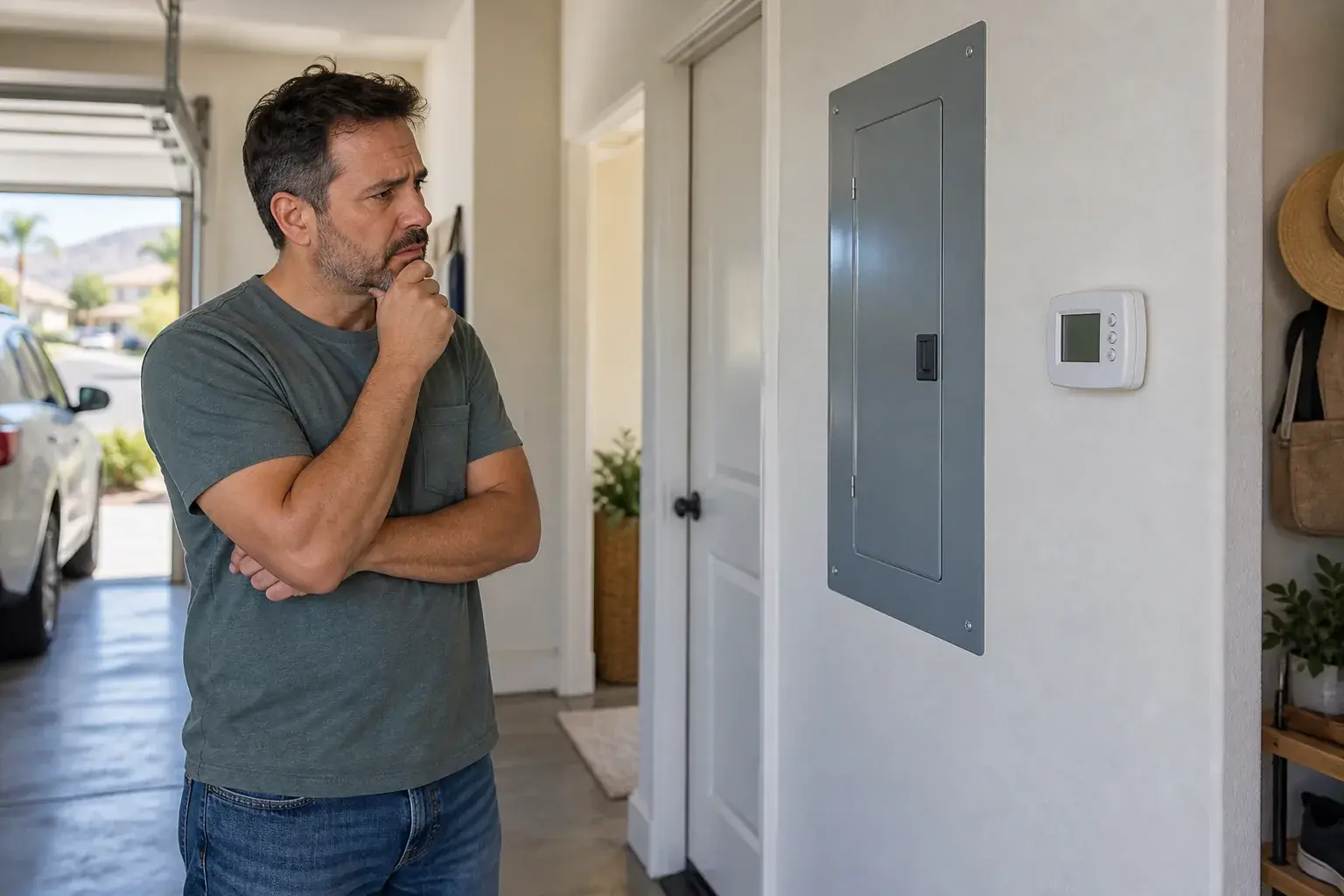
If your AC keeps tripping the breaker, leave the cooling call off and do not keep resetting it. A breaker opens to protect wiring from excessive current or a short-circuit condition, but the trip alone cannot identify whether the cause is in the HVAC equipment, branch circuit, breaker, connections, or power supply. Record when it trips and request an on-site diagnosis.
- A repeated trip is a protective electrical event, not a repair instruction.
- Trip timing can help a technician reproduce the concern, but it does not confirm a failed part.
- Do not open panels, test capacitors, alter wiring, or install a larger breaker.
On this page
- Quick Answer: stop repeated resets and preserve the trip pattern
- Key takeaways
- What a tripped breaker tells you—and what it does not
- Safe observations before the appointment
- Why trip timing is useful but not diagnostic
- Do not change the breaker to make the AC run
- Local next step for Inland Empire and East LA County homes
Quick Answer: stop repeated resets and preserve the trip pattern
When an AC keeps tripping the breaker, the useful homeowner response is to stop calling for cooling, leave electrical enclosures closed, and write down which breaker opened and when. The U.S. Consumer Product Safety Commission explains that circuit breakers disconnect power before overcurrent or a short damages wiring. That protection event signals the need for diagnosis; it does not name the failed component.
Key takeaways
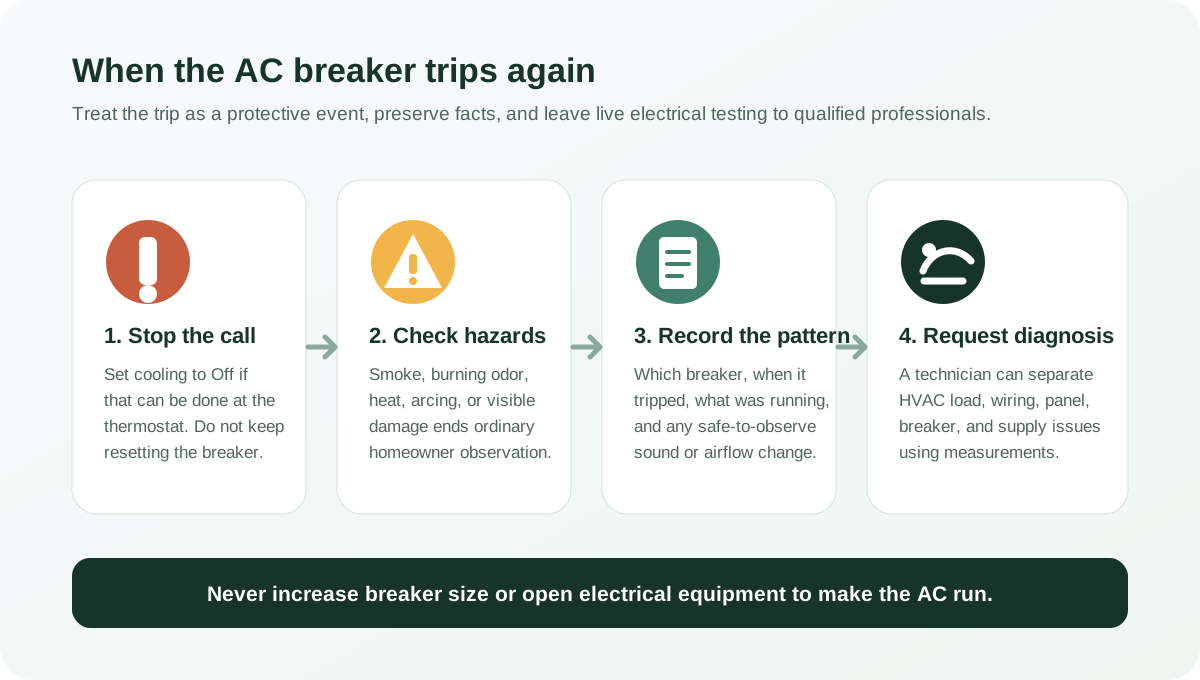
- Treat a second trip as a stop condition rather than a prompt to reset again.
- Record the thermostat mode, approximate time, weather context, and whether indoor or outdoor equipment appeared to start.
- Keep away from smoke, burning odor, heat, arcing, damaged wiring, and wet electrical equipment.
- A qualified professional should compare measured operation with the equipment and circuit requirements.
What a tripped breaker tells you—and what it does not
A conventional breaker may respond to current that builds long enough to create heat or to a sudden short-circuit condition. ESFI also lists frequently tripped breakers among electrical warning signs. Still, a homeowner cannot infer a capacitor, compressor, fan motor, breaker, wire, or utility problem from the handle position alone. Even the time of the trip is only evidence for the service call.
| Observed pattern | Useful detail to record | What not to conclude |
|---|---|---|
| Trips as cooling is requested | Thermostat mode, time, and whether any unit started | A specific starting component failed |
| Trips after running | Approximate runtime and any safe-to-hear sound change | Heat or dirt is the confirmed cause |
| Only indoor air moves | Whether air is present at several supply registers | The outdoor unit or breaker is definitely faulty |
| Burning odor, smoke, heat, or arcing | Location observed from a safe distance | That another reset is safe |
Safe observations before the appointment
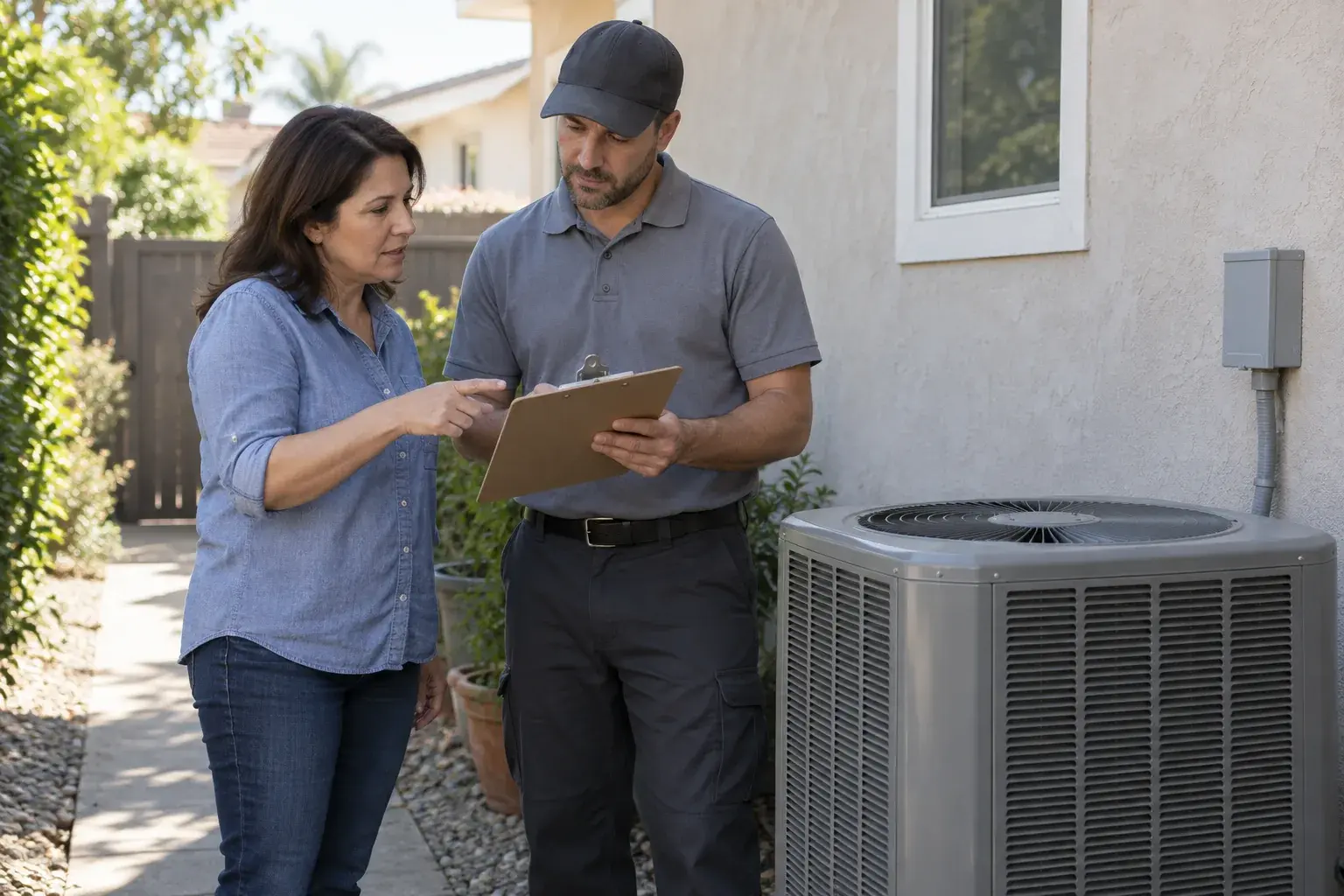
Without opening equipment, note the thermostat setting, which labeled circuit appears open, when the trip occurred, and whether the indoor blower or outdoor unit appeared to run. If the normal user-accessible filter can be checked without removing a cabinet panel, record its condition. Trane advises contacting an HVAC professional when the AC breaker has tripped; this article deliberately stops short of instructing a reset.
Why trip timing is useful but not diagnostic
A trip immediately after a cooling call, after several minutes, or only under certain conditions gives the technician a reproduction clue. Samsung's current support guidance lists startup current, overload, component faults, and wiring problems as possible categories, then directs repeated trips to professional inspection. A proper visit should distinguish the HVAC load from the branch circuit, breaker, panel connections, and supply before recommending work.
Do not change the breaker to make the AC run
Never increase breaker size, bypass protection, hold a breaker on, probe live wiring, or open a capacitor or equipment compartment. The circuit and equipment nameplate requirements must be evaluated together. If the concern is limited to a broad no-start symptom with no repeated trip, use our separate AC not turning on guide. For weak indoor airflow or unusual blower sounds, see AC blower motor failure signs.
Local next step for Inland Empire and East LA County homes
Alex Air & Heating serves Ontario, Pomona, the Inland Empire, and nearby East Los Angeles County communities; this does not imply a Los Angeles city storefront. Use our AC repair page to request an on-site evaluation with the breaker label, trip timing, thermostat mode, and safe observations. Appointment availability depends on the current schedule.
Frequently asked questions
The circuit is seeing a condition that makes its protective device open. Possible categories include an HVAC motor or compressor load, wiring or connection fault, breaker or panel issue, supply problem, or another overcurrent condition. The trip itself does not identify which one.
No. If the breaker trips again, leave the cooling call off and arrange professional diagnosis. Do not force the handle, hold it on, or replace it with a larger breaker.
A dirty filter can restrict airflow and make the system work harder, but it does not prove why a breaker opened. If the breaker repeats, the electrical and HVAC sides still need measured evaluation.
If the trip occurs when the AC starts or runs, an HVAC technician can evaluate the equipment load and controls. If measurements point to the branch circuit, breaker, panel, or supply, a qualified electrician may also be needed.
Stop routine checks, keep away from the equipment, and follow emergency procedures for an active fire or smoke condition. Do not touch the panel or attempt another reset.
Local next step
Turn this guide into a site-specific answer.
Guides explain the decision. Equipment condition, access, and safe next steps still need to match the home or business. Review the relevant service scope or request an assessment for Ontario, the Inland Empire, or East Los Angeles County. Availability depends on the current schedule.