AC Making Loud Noise? What Every AC Sound Really Means
Is your AC making a loud noise? Learn what buzzing, banging, hissing, clicking and screeching mean, which are urgent, and when to shut the unit off now.

Owner & Lead HVAC Technician, Alex Air & Heating · EPA 608 Universal Certified · Ontario, CA
TL;DR
When your AC is making a loud noise, the sound tells you the problem: buzzing means electrical trouble, banging usually means a failing compressor, hissing points to a refrigerant leak, and screeching signals a worn motor or bearing, so any loud banging or burning-smell buzzing means shut it off and call a pro.
- An AC making a loud noise is diagnostic: match the sound to the cause before you panic or pay for the wrong repair.
- Loud banging or clanking usually means a failing compressor or a loose internal part, shut the unit off immediately to avoid a costly domino failure.
- Buzzing plus a burning smell is an electrical fire hazard, cut power at the breaker and call for emergency AC repair.
- Hissing points to a refrigerant leak, which is unsafe and illegal to handle without EPA 608 certification, so it always needs a pro.
- Clicking at startup is normal, but constant clicking, screeching, or rattling means schedule service before a small part takes out a big one.
On this page
- Why is my AC making a loud noise in the first place?
- What does a buzzing or humming AC noise mean?
- Is a loud banging or clanking AC noise an emergency?
- What does a hissing or bubbling AC noise mean?
- What do clicking, screeching, and rattling AC noises mean?
- Which AC noises can I check myself vs. when to call a pro?
- How do I keep my AC from getting loud in the first place?
Why is my AC making a loud noise in the first place?
If your AC is making a loud noise, the good news is that the sound itself is a diagnostic clue, air conditioners fail in predictable ways and each type of failure has its own signature. A healthy system produces a steady, low hum plus the whoosh of air. Anything sharper, louder, or brand new, buzzing, banging, hissing, clicking, screeching, or rattling, is your equipment telling you something has come loose, worn out, shorted, or started leaking.
The wrong move is to ignore it and hope it goes away. A screeching bearing that costs a few hundred dollars today can seize the whole motor next week. A refrigerant hiss that starves your coil eventually burns out the compressor, the single most expensive part in the system. Below we walk through each noise, its likely cause, how urgent it is, and whether it is a safe DIY check or a call to a certified technician. For our neighbors across the Inland Empire, our same-day AC repair team hears these sounds every summer, so we know which ones can wait and which ones cannot.
What does a buzzing or humming AC noise mean?
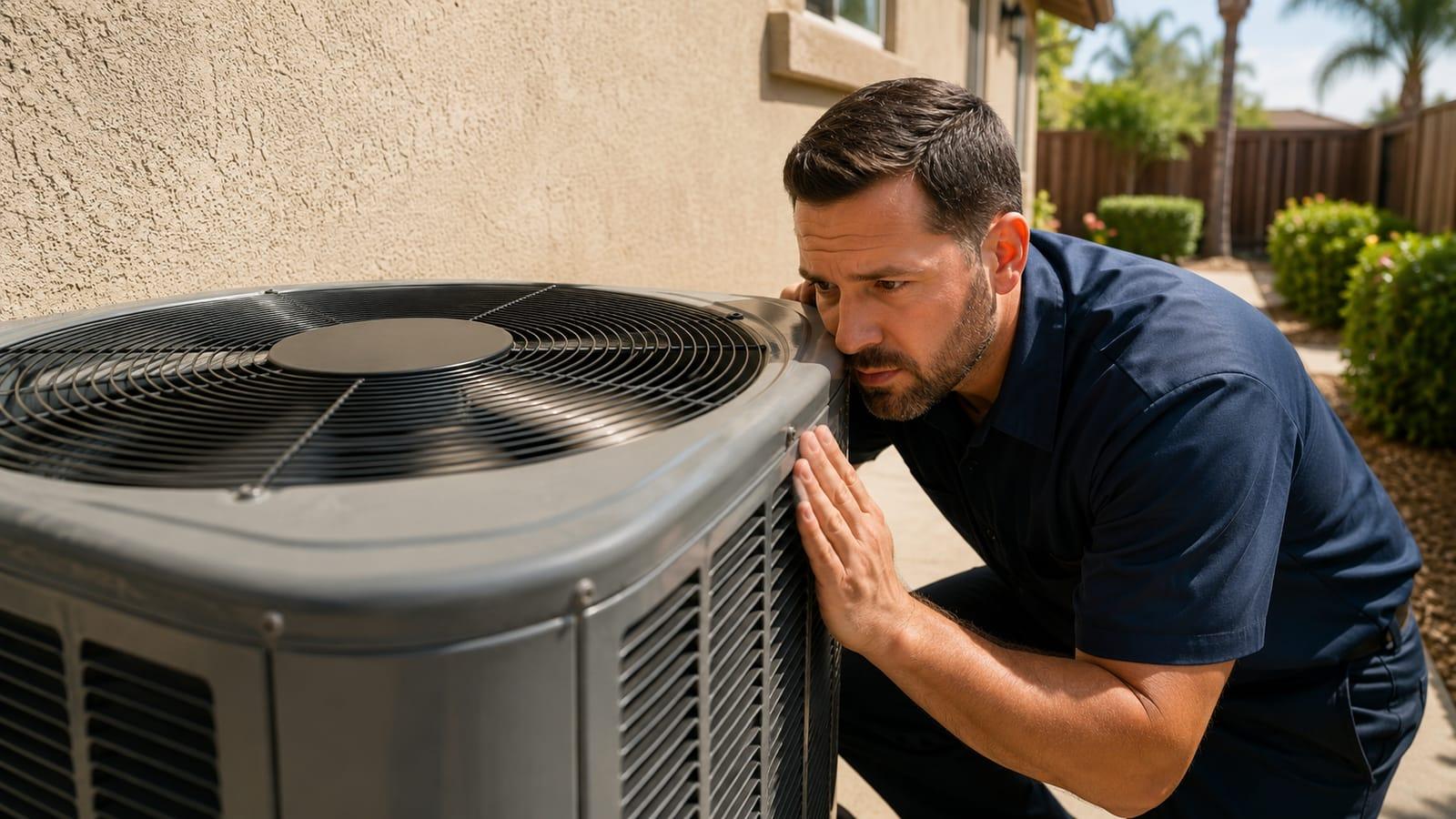
Buzzing and humming are electrical sounds, and they range from harmless to house-fire serious. A soft hum from the outdoor unit while it runs is normal, that is the compressor and fan motor doing their jobs. The problem is a hum or buzz that is louder than usual, or that comes with the unit failing to start.
A loud buzz where the outdoor fan will not spin often means a failed capacitor, the component that gives the motor its starting jolt. Buzzing can also come from a failing condenser fan motor, loose electrical connections, or debris rattling against the fan blade. Indoors, buzzing paired with weak airflow can mean a frozen evaporator coil, which is why an AC that hums but blows warm deserves attention, see our guide on why your AC is blowing warm air.
- Loud buzz, fan not spinning: likely a bad capacitor or contactor, needs a pro.
- Buzzing with a burning or hot-plastic smell: STOP, cut power at the breaker, this is an electrical fire hazard.
- Buzzing plus ice on the indoor coil: turn the unit off, let it thaw, then have the airflow and refrigerant checked.
- Rhythmic buzz or rattle: could be loose hardware or debris in the outdoor unit.
The one buzzing scenario that means shut it off now is buzzing combined with a burning smell. That points to arcing wiring or an overheating motor, and running it risks a fire. Kill power at the breaker and book emergency AC repair rather than resetting it and walking away.
| Noise | Likely cause | Urgency | DIY or call a pro |
|---|---|---|---|
| Buzzing (fan not spinning) | Failed capacitor, contactor, or fan motor | High | Call a pro |
| Buzzing + burning smell | Arcing wiring or overheating motor | Shut off now | Cut power, emergency pro |
| Banging / clanking | Failing compressor or loose internal part | Shut off now | Call a pro immediately |
| Hissing / bubbling | Refrigerant leak or high system pressure | High | Call a pro (EPA 608) |
| Screeching / squealing | Worn motor bearing or slipping belt | Medium-High | Call a pro |
| Constant clicking | Failing relay, capacitor, or thermostat | Medium | Call a pro |
| Rattling | Loose screws, debris, or bent blade | Low-Medium | DIY check, then pro |
| Whistling | Clogged filter or ductwork airflow issue | Low | DIY: change filter |
Is a loud banging or clanking AC noise an emergency?
Yes, treat loud banging as an emergency. A hard banging or clanking from the outdoor unit almost always means something inside the compressor has broken loose, a connecting rod, a piston pin, or a mounting spring, or that the compressor itself is failing. Banging can also come from a blower wheel that has come off balance or a foreign object knocking around inside the housing.
Whatever the exact part, the fix for banging is the same first step: turn the system off immediately. The compressor is the heart and the most expensive component of your AC, and running it while it bangs lets a small broken part chew up everything around it, turning a repair into a full replacement. Do not keep cycling it to see if the noise stops. Shut it down and have a technician open it up. This is the classic same-day call our crews handle around Ontario, Fontana, and Rancho Cucamonga in July when compressors are pushed hardest.
What does a hissing or bubbling AC noise mean?
A steady hiss is the sound you should never brush off, because the most common cause is a refrigerant leak. Refrigerant moves through the system under pressure, and a crack or pinhole in a coil or line lets it escape with a hiss, sometimes a bubbling or gurgling if the leak is larger. As refrigerant drops, your AC cools worse, runs longer, and eventually risks compressor burnout.
Refrigerant is not a DIY fix. Handling it legally requires EPA Section 608 certification, and the leak has to be found and sealed before the system is recharged, otherwise you are just paying to leak expensive gas again. A loud hiss or shriek right at the compressor can also signal dangerously high internal pressure, in which case shutting the unit off is the safe move. If the hiss is faint and near the ductwork instead, it may just be air escaping a loose duct connection, a much smaller issue, but still worth verifying.
What do clicking, screeching, and rattling AC noises mean?
Not every noise is a crisis, but each still points somewhere specific:
- Clicking at startup and shutdown: normal, that is the thermostat and relays talking to the system. Constant or rapid clicking is not normal and can mean a failing relay, a dying capacitor, or a thermostat fault, if the AC also will not start, see our guide on an AC that will not turn on.
- Screeching or squealing: usually a worn fan motor bearing or, on older belt-driven blowers, a slipping belt. A high metallic screech means metal on metal, catch it early before the motor seizes.
- Rattling: often the least serious, loose screws, bent fan blades, a build-up of leaves and twigs, or loose sheet metal panels vibrating. It can also be an early warning that something is working its way loose.
- Clicking, then silence: the compressor tries to start and can't, a classic hard-start or capacitor symptom that needs a pro.
Rattling from debris is one of the few noises with a safe homeowner check. With the unit powered off at the disconnect and breaker, you can clear leaves and twigs from the outdoor coil and confirm the top grille screws are snug. If the rattle continues once it is clean and buttoned up, the source is internal and it is time to call.
Which AC noises can I check myself vs. when to call a pro?
A short list of safe DIY checks, always with the power off at both the thermostat and the outdoor disconnect or breaker: clear visible debris from around and inside the outdoor coil, replace a clogged air filter (a dirty filter can cause whistling and strained-motor sounds), and confirm exterior panel screws are tight. That is the safe boundary.
Everything past that, capacitors, contactors, motors, refrigerant, and anything inside the sealed system, carries a shock, fire, or high-pressure risk and calls for a certified technician. As an EPA 608 certified shop based in Ontario, CA, we diagnose the noise, quote upfront pricing before any work, and offer same-day and emergency AC repair across the Inland Empire, including Chino, Pomona, and Corona. Homeowners near us can also start on our Ontario AC repair page.
How do I keep my AC from getting loud in the first place?
Most alarming noises trace back to skipped maintenance. Loose hardware, dirty coils, low airflow, and aging capacitors are exactly the problems an annual tune-up catches while they are still cheap. The U.S. Department of Energy recommends yearly professional service plus regular filter changes to keep a system running efficiently and quietly, and in the dusty, triple-digit Inland Empire summer that maintenance matters even more.
Change your filter every one to three months, keep two feet of clearance around the outdoor unit, gently rinse the outdoor coil each spring, and book a professional inspection before cooling season. Do that and the odds you ever hear a bang or a hiss drop sharply, and if you do hear one, you will already know whether to keep calm or cut the power.
Sources & references
Frequently asked questions
Yes. Cooling today does not mean the part causing the noise is healthy. A screeching bearing, a leaking coil, or a buzzing capacitor will keep degrading and can take out a bigger component if ignored. Get it diagnosed early while the repair is still small.
Loud banging or clanking (likely compressor failure) and buzzing paired with a burning smell (an electrical fire hazard) both mean turn it off right away. Cut power at the breaker and call for professional or emergency AC repair rather than cycling the unit to test it.
It can be. Hissing most often means a refrigerant leak, which cripples cooling and can burn out the compressor over time. A sharp hiss at the compressor can also signal unsafe internal pressure. Refrigerant requires EPA 608 certification to handle legally, so this is always a pro job.
A single click at startup and shutdown is normal, that is the thermostat signaling the relays and contactor. It only becomes a concern when the clicking is constant, rapid, or the system clicks but fails to start, which usually points to a failing relay or capacitor.
With the power off, you can safely clear debris, replace a dirty filter, and tighten exterior panel screws. Anything involving capacitors, motors, wiring, or refrigerant carries shock, fire, or pressure risk and should be handled by a certified technician.
Yes. Alex Air & Heating is EPA 608 certified and based in Ontario, CA, offering same-day and emergency AC repair with upfront pricing across the Inland Empire, including Fontana, Rancho Cucamonga, Chino, Pomona, and Corona.
Local next step
Turn this guide into a site-specific answer.
Guides explain the decision. Equipment condition, access, and safe next steps still need to match the home or business. Review the relevant service scope or request an assessment for Ontario, the Inland Empire, or East Los Angeles County. Availability depends on the current schedule.