Commercial HVAC Replacement Cost in 2026: Real LA Numbers
Commercial HVAC replacement cost in 2026 runs about $2,000-$5,000 per ton installed. Real ranges by tonnage, the hidden line items, and how to read a bid.

Owner & Lead HVAC Technician, Alex Air & Heating · EPA 608 Universal Certified · Ontario, CA
TL;DR
In 2026, commercial HVAC replacement cost runs roughly $2,000 to $5,000 per ton installed. A 5-ton packaged rooftop unit typically lands at $12,000-$25,000, a 10-ton at $22,000-$45,000, a 20-ton at $40,000-$90,000. Add $1,500-$4,500 for crane rigging, $800-$3,000 for a curb adapter, and $500-$3,500 for electrical. A2L equipment adds 8-15% over 2024 pricing.
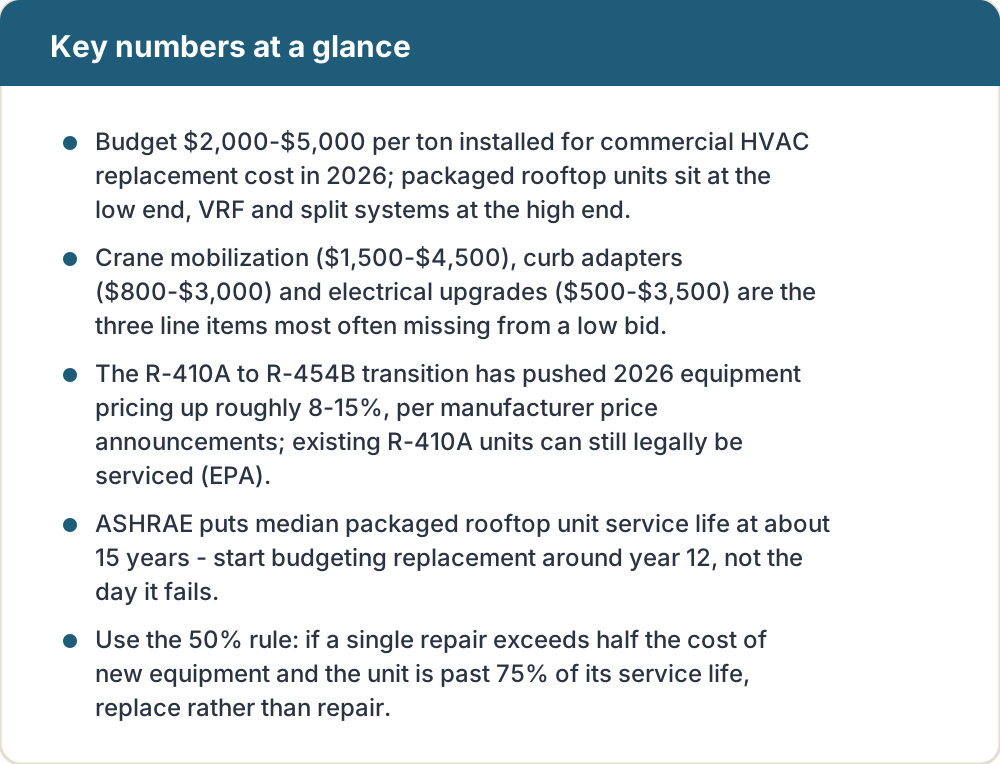
- Budget $2,000-$5,000 per ton installed for commercial HVAC replacement cost in 2026; packaged rooftop units sit at the low end, VRF and split systems at the high end.
- Crane mobilization ($1,500-$4,500), curb adapters ($800-$3,000) and electrical upgrades ($500-$3,500) are the three line items most often missing from a low bid.
- The R-410A to R-454B transition has pushed 2026 equipment pricing up roughly 8-15%, per manufacturer price announcements; existing R-410A units can still legally be serviced (EPA).
- ASHRAE puts median packaged rooftop unit service life at about 15 years - start budgeting replacement around year 12, not the day it fails.
- Use the 50% rule: if a single repair exceeds half the cost of new equipment and the unit is past 75% of its service life, replace rather than repair.
On this page
- What is the commercial HVAC replacement cost in 2026?
- How much does a rooftop unit cost by tonnage?
- Packaged, split or VRF - which costs more?
- What hidden costs blow a commercial HVAC budget?
- How does the R-454B refrigerant transition affect 2026 pricing?
- When should a commercial unit be replaced instead of repaired?
- Should you phase the replacement or do a full changeout?
- How do you read a commercial HVAC quote?
What is the commercial HVAC replacement cost in 2026?
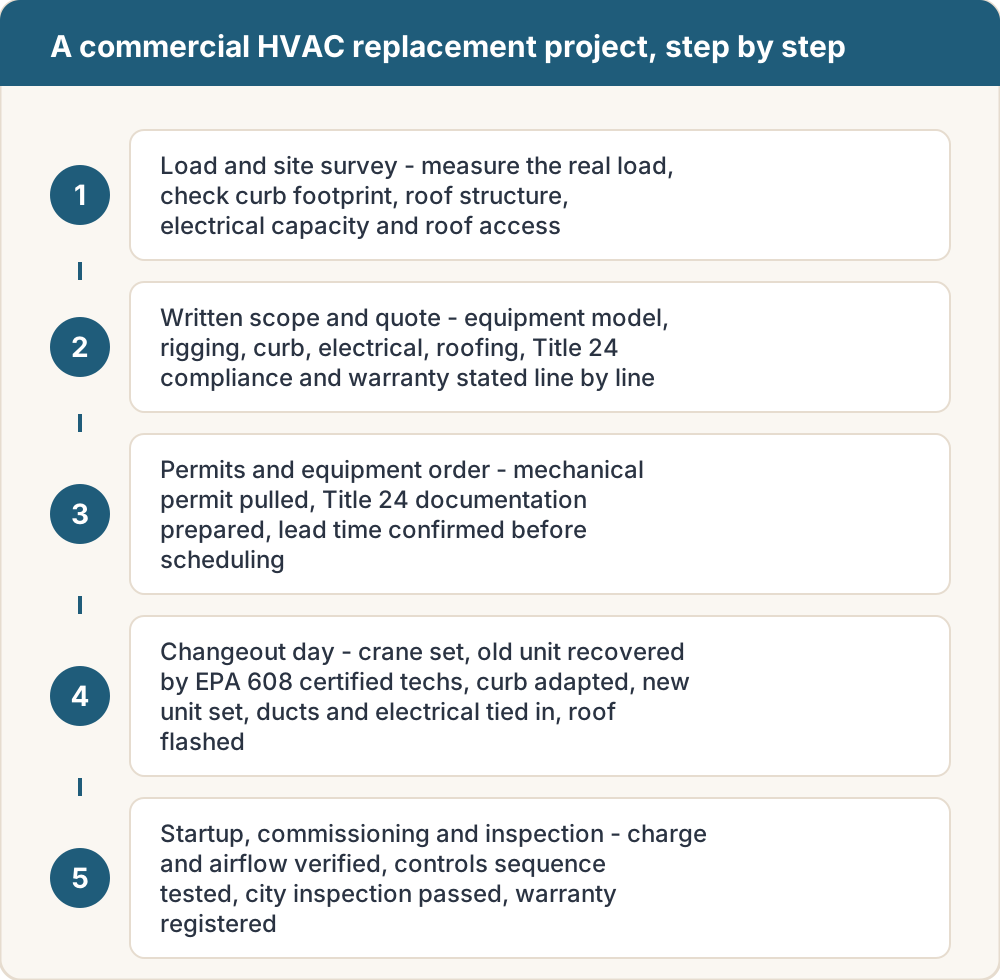
Commercial HVAC replacement cost in 2026 works out to roughly $2,000 to $5,000 per ton installed for most packaged rooftop equipment, which means a typical 10-ton changeout on a Los Angeles County retail or office building lands between $22,000 and $45,000 all-in. Small 5-ton units start around $12,000. Twenty-ton and larger units regularly clear $40,000 and can pass $90,000 once high-efficiency equipment, controls and code work are included.
That is a wide band, and the width is the point. Two buildings on the same street in Pomona can get quotes $15,000 apart for identical tonnage, because the price is driven less by the box on the roof than by what it takes to get the box up there, tie it in, and pass inspection. Equipment is usually only 40-55% of a commercial project. The rest is rigging, sheet metal, electrical, controls, permits and roofing.
Facility managers who budget only for the equipment number are the ones who end up with a change order. If you are scoping a project now, our commercial HVAC installation team quotes the full scope in writing before anything is ordered, so the number you approve is the number you pay.
How much does a rooftop unit cost by tonnage?
Tonnage is the single biggest driver, but cost per ton actually falls as units get larger. A 3-ton unit might cost $4,000 per ton installed; a 25-ton unit might cost $1,800 per ton. The fixed costs - crane, permit, mobilization, roof work - get spread across more capacity.
For sizing sanity checks in the Inland Empire and East Los Angeles County, most commercial space runs 350-450 square feet per ton, but a Rowland Heights restaurant kitchen or a Diamond Bar server room can run under 200. Never let a contractor size a replacement purely off what is already up there. The old unit may have been wrong for fifteen years.
- 5 ton: small retail suite, one restaurant dining room, a 2,000-2,500 sq ft office
- 7.5-10 ton: a full retail pad, medical office suite, small warehouse office block
- 15 ton: mid-size restaurant with kitchen makeup air, a strip-center anchor
- 20-25 ton: light industrial, church sanctuary, large open-plan office floor
- Multiple smaller units usually beat one large unit for zoning and redundancy - if one fails, you are not fully down
One more sizing note specific to our market: rooftop equipment in Ontario, Pomona and the San Gabriel Valley sees ambient temperatures well above the 95F design condition many units are rated at. Capacity drops as outdoor temperature climbs, so a unit that looks adequate on paper can be short on a 108F August afternoon. We size for the actual local design day, not the catalog.
| System size | Building type it suits | Installed cost (2026) | Notes |
|---|---|---|---|
| 3-5 ton | Small retail suite, 2,000-2,500 sq ft office, single restaurant dining room | $8,000 - $25,000 | Often craneable by boom truck; lowest fixed costs but highest cost per ton |
| 7.5 ton | Retail pad, small medical suite, warehouse office block | $16,000 - $34,000 | Crane usually required; check curb footprint before ordering |
| 10 ton | Full retail pad, mid-size office floor, light industrial | $22,000 - $45,000 | Most common commercial changeout size; crane is standard at this tonnage |
| 15 ton | Restaurant with kitchen exhaust, strip-center anchor, church hall | $32,000 - $65,000 | Makeup air and economizer requirements add cost under Title 24 |
| 20 ton | Large open-plan office, light manufacturing, big-box retail bay | $40,000 - $90,000 | Structural roof review may be required; electrical upgrade common |
| 25 ton+ | Industrial, multi-tenant anchor, large assembly space | $50,000 - $110,000+ | Cost per ton drops, but rigging, controls and permitting complexity rise |
| Commercial split (10 ton equiv.) | Buildings where roof cannot carry packaged equipment | $20,000 - $35,000 | Roughly 10-20% above RTU for equal capacity due to line sets and labor |
| VRF (multi-zone, 10-15 ton equiv.) | Multi-tenant, mixed-use, varied load profiles | $40,000 - $90,000+ | Highest up-front; strongest zoning control and part-load efficiency |
Packaged, split or VRF - which costs more?
Packaged rooftop units are the cheapest way to condition a commercial building, running roughly $14-$28 per square foot installed. Commercial split systems come in about 10-20% higher for the same capacity because of the refrigerant line runs and extra labor. VRF systems are the most expensive up front, commonly $24-$38 per square foot, but they zone far better and often win on operating cost in buildings with mixed occupancy.
For a single-story building with existing roof curbs and ductwork, packaged RTU is almost always the right answer on a straight replacement. You already have the curb, the duct drops and the roof penetration. Switching system types mid-life turns a two-day changeout into a multi-week construction project.
VRF starts to make sense when you have a multi-tenant building with wildly different load profiles - a Claremont mixed-use building with ground-floor retail and upstairs offices, for example - or where roof structure will not carry more packaged units. Just go in knowing the up-front premium is real: roughly $10-$12 more per square foot than a comparable RTU layout.
What hidden costs blow a commercial HVAC budget?
This is the section that saves you money. The base equipment quote is the easy part; the line items below are where a $28,000 project becomes $41,000. Ask every bidder to price each of these explicitly, in writing, or to state clearly that it is excluded.
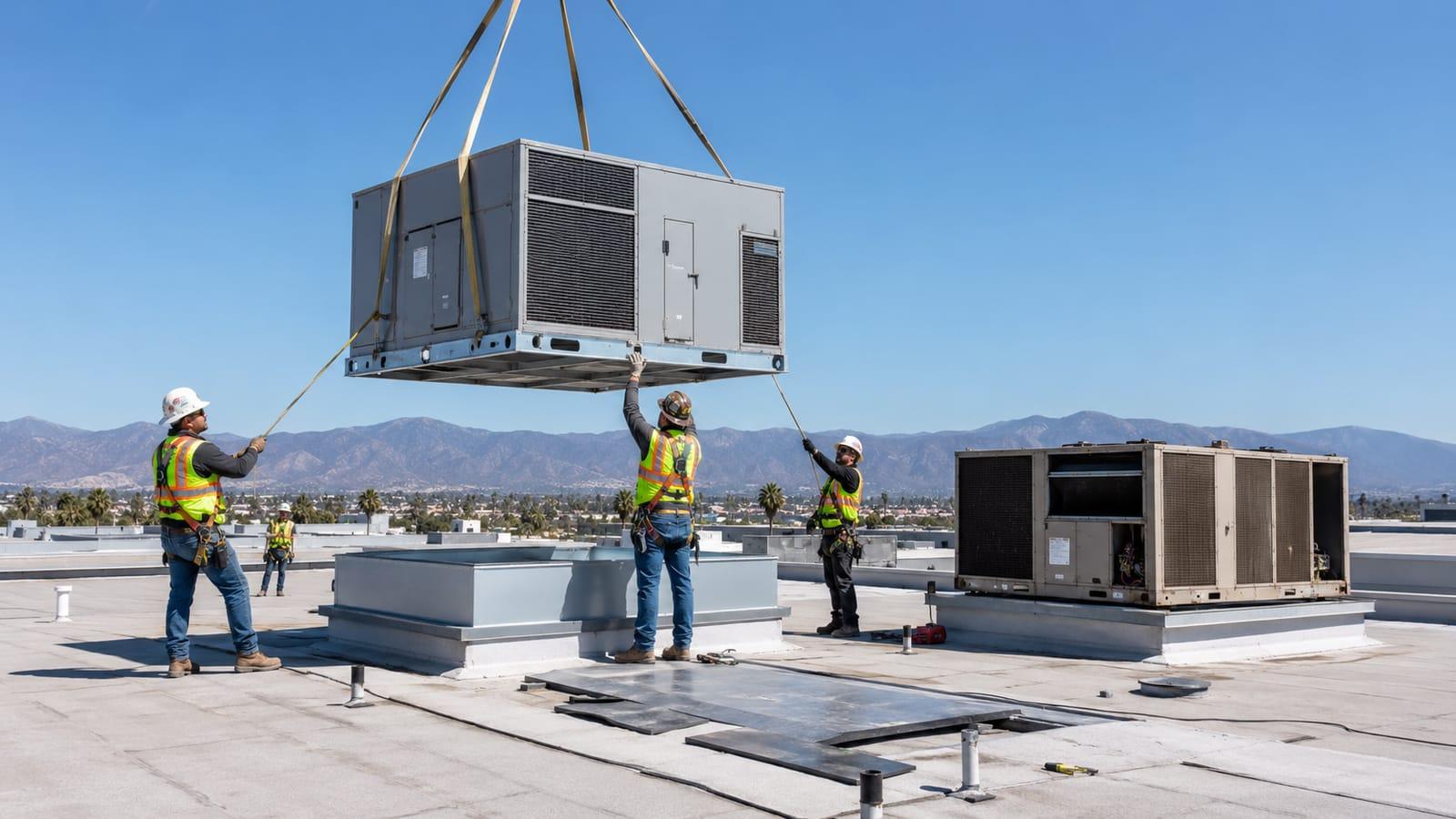
- Crane and rigging - $1,500-$4,500. Almost any unit above 10 tons needs a crane. Street closure permits, tight alley access or a two-story setback in an older Pomona or Walnut commercial block push this higher.
- Curb adapter - $800-$3,000. New units rarely match the old footprint. Industry estimates put curb adapters on the large majority of rooftop replacements. If a bid does not mention the curb, it is not a complete bid.
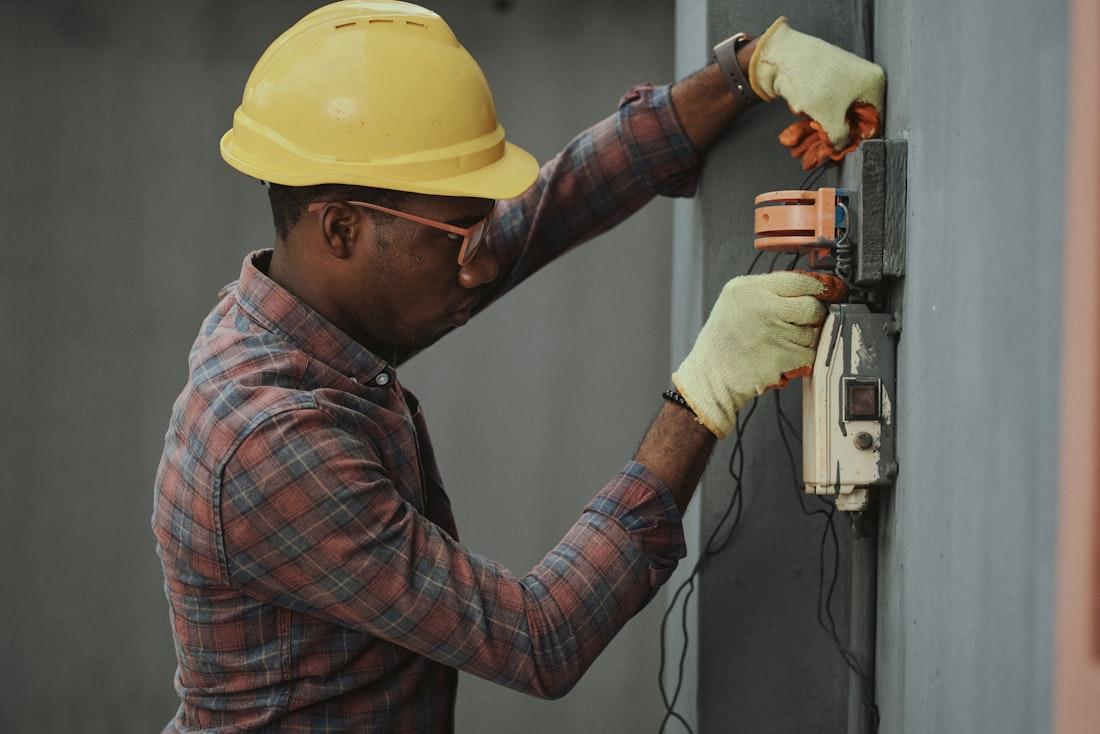
- Electrical - $500-$3,500. Higher-efficiency equipment often draws differently, and disconnects, whips and panel capacity on 20-year-old buildings frequently do not meet current code.
- Roofing and flashing - $400-$1,200. Cutting out an old curb means opening the roof membrane. Who patches it, and does it void your roof warranty? Get that in the contract.
- R-22 recovery and disposal - $500-$3,000 per unit on legacy equipment, handled by EPA 608 certified technicians.
- Permits and inspection - $150-$600 typical, higher in dense jurisdictions. Los Angeles County and most Inland Empire cities require a mechanical permit and a Title 24 compliance form for commercial changeouts.
- After-hours labor - occupied buildings often mean night or weekend work at premium rates.
The single most common mistake we see: comparing three bids on price alone when only one of them included the curb adapter and the electrical. The cheap bid is not cheap, it is incomplete, and the difference reappears as a change order once the old unit is already off the roof and your building is uncooled. When a unit fails mid-summer and you are weighing an emergency fix against a planned replacement, our emergency commercial repair crew can keep you running while you get real replacement bids instead of panic-buying.
How does the R-454B refrigerant transition affect 2026 pricing?
The EPA's Technology Transitions Rule under the AIM Act moved new equipment off high-GWP R-410A toward A2L refrigerants like R-454B and R-32. Practically, that means the equipment you buy in 2026 is A2L equipment, and it costs more. Manufacturer announcements through 2025 and 2026 put the increase in the 8-15% range, with some commercial price increases stacking tariff-driven adjustments on top.
Two things commercial owners get wrong here. First, the rule does not force you to replace working equipment - existing R-410A systems can legally keep running and be serviced. Second, EPA announced in December 2025 that it is treating the January 2026 installation prohibition as a low enforcement priority while it reconsiders the rule, so the regulatory picture is still moving. That is a reason to plan deliberately, not to panic-buy.
What does change for you operationally: A2L refrigerants are mildly flammable, which brings leak detection requirements, different service procedures and, in many markets, higher labor rates. Also relevant to larger commercial equipment - as of January 1, 2026, HFC leak-repair requirements apply to appliances with a full charge of 15 pounds or more, which covers a lot of rooftop and split equipment. Whoever services your building should be EPA 608 certified and current on A2L handling.
When should a commercial unit be replaced instead of repaired?
Use the 50% rule: replace when a single repair costs more than half of new equipment and the unit has passed about 75% of its expected service life. ASHRAE data puts median service life for a packaged rooftop unit at roughly 15 years, so 75% is about year 11.
Beyond the arithmetic, a few conditions push clearly toward replacement: a failed compressor on a unit past year 10, a leaking evaporator or condenser coil, R-22 equipment that needs a charge, or a unit that has needed three or more service calls in a single cooling season. Any one of those on aging equipment usually means you are funding a partial rebuild of a machine that will still be old afterward.
The counterargument for repair is straightforward: if the unit is under 10 years old, the failure is a discrete component like a motor, contactor or board, and it has been maintained, fix it. A well-maintained rooftop unit can reach 20 years. That maintenance is not optional - a scheduled commercial maintenance plan is what separates a 20-year unit from a 12-year one, and it also gives you the service history you need to defend a capital request. For a deeper walkthrough of common rooftop failures and what they cost, see our rooftop HVAC unit repair guide.
Should you phase the replacement or do a full changeout?
If your building has multiple rooftop units of similar age, you have a choice: replace them all at once, or one to two per year over several budget cycles. Both are defensible, and the right answer depends on your capital situation more than on the equipment.
Full changeout wins on unit price. Contractors mobilize a crane once, permit once, and buy equipment in quantity - you can often save 10-20% per unit versus doing them one at a time. It also puts your whole fleet on the same age, same refrigerant and same controls platform, which simplifies service for the next decade.
Phased replacement wins on cash flow and risk. You spread the spend across fiscal years, you keep the building partly operational during work, and you learn from the first unit before committing to five. The downside is repeat mobilization costs and a mixed fleet - some R-410A units, some A2L, two sets of parts, two sets of controls. If you phase, replace the worst-performing and highest-load units first, and document the plan so it survives a change in facility staff.
How do you read a commercial HVAC quote?
A complete commercial bid should let you compare apples to apples on eight points. If a quote is one line and a number, it is not a quote, it is a placeholder.
- Equipment: manufacturer, model number, tonnage, efficiency rating and refrigerant type - not just 'new 10-ton unit'
- Rigging: crane included or excluded, and whether street/access permits are the contractor's responsibility
- Curb: new curb, adapter, or reuse of existing - with a dollar figure attached
- Electrical: disconnect, whip, breaker sizing, and who pulls the electrical permit
- Roofing: who cuts, patches and flashes, and whether your roof warranty is preserved
- Code: Title 24 compliance documentation, economizer and controls work where required
- Startup and commissioning: airflow balance, charge verification, control sequence check
- Warranty: labor, parts and compressor terms stated separately, in years
On that last point, ours is 3 years labor, 5 years parts and 7 years on the compressor, stated on the quote rather than described verbally. We are EPA 608 certified, based in Ontario CA 91761, and we handle commercial replacements across the Inland Empire and East Los Angeles County - Pomona, Diamond Bar, Walnut, Claremont and Rowland Heights included. If you want to understand what ongoing service costs look like after the install, our breakdown of commercial maintenance in Los Angeles covers typical contract pricing and what should be in scope.
We quote commercial HVAC replacements across Los Angeles County and the Inland Empire with upfront written pricing and a clear scope - no surprise line items. Commercial HVAC installation
Sources & references
- 1.US EPA - Regulatory Actions for Technology Transitions (AIM Act)
- 2.ENERGY STAR - Light Commercial HVAC
- 3.California Energy Commission - Building Energy Efficiency Standards (Title 24)
- 4.DOE Better Buildings - Advanced Rooftop Units
- 5.ASHRAE - Equipment Life Expectancy Chart
- 6.ACHR News - EPA Offers Temporary Relief on R-410A Installations
Frequently asked questions
Expect $22,000 to $45,000 installed in 2026 for a 10-ton packaged rooftop replacement in Los Angeles County or the Inland Empire. That range assumes crane rigging, a curb adapter, electrical tie-in and permit. High-efficiency equipment, structural roof work or after-hours installation push the number toward the top of the range or above it.
No. The EPA rule restricts what manufacturers can produce and what can be newly installed - it does not ban operating or servicing existing R-410A equipment. EPA also announced in December 2025 that it is treating the January 2026 installation prohibition as a low enforcement priority while reconsidering the rule. Replace on condition and economics, not on refrigerant alone.
ASHRAE puts the median service life of a packaged rooftop unit at about 15 years. Well-maintained units in moderate duty regularly reach 20 years or more, while neglected units in high-heat rooftop conditions - common across the Inland Empire - can fail closer to 12. Start capital planning at about year 12.
Because the equipment is often less than half the project cost. Crane access, curb adapters, electrical capacity, roof work, Title 24 compliance and warranty terms vary enormously between bids. A quote that is thousands cheaper is usually missing scope rather than offering a better deal - compare line items, not totals.
Usually yes. Doing multiple units in a single mobilization spreads crane, permit and travel costs across the whole project and often saves 10-20% per unit compared with one-at-a-time replacement. The tradeoff is a larger single capital outlay, which is why many facility managers phase two units per fiscal year instead.
Yes. Los Angeles County and Inland Empire cities require a mechanical permit for a commercial changeout, and California's Title 24 energy code adds efficiency, economizer and controls requirements beyond federal minimums for commercial equipment. A like-for-like swap is not always permissible anymore, so confirm your contractor is handling the Title 24 documentation.
Local next step
Turn this guide into a site-specific answer.
Guides explain the decision. Equipment condition, access, and safe next steps still need to match the home or business. Review the relevant service scope or request an assessment for Ontario, the Inland Empire, or East Los Angeles County. Availability depends on the current schedule.