Rooftop HVAC Unit Repair: A Guide for LA Property Owners
What actually breaks on a commercial RTU, what you can safely check from inside, typical rooftop HVAC unit repair costs, and when repair stops paying off in LA.

Owner & Lead HVAC Technician, Alex Air & Heating · EPA 608 Universal Certified · Ontario, CA
TL;DR
Most rooftop HVAC unit repair calls trace back to five things — failed capacitors or contactors, worn belts and blower motors, clogged condenser coils, refrigerant leaks, and stuck economizers — and the fix usually means a technician diagnosing the unit on the roof, not from inside the building.
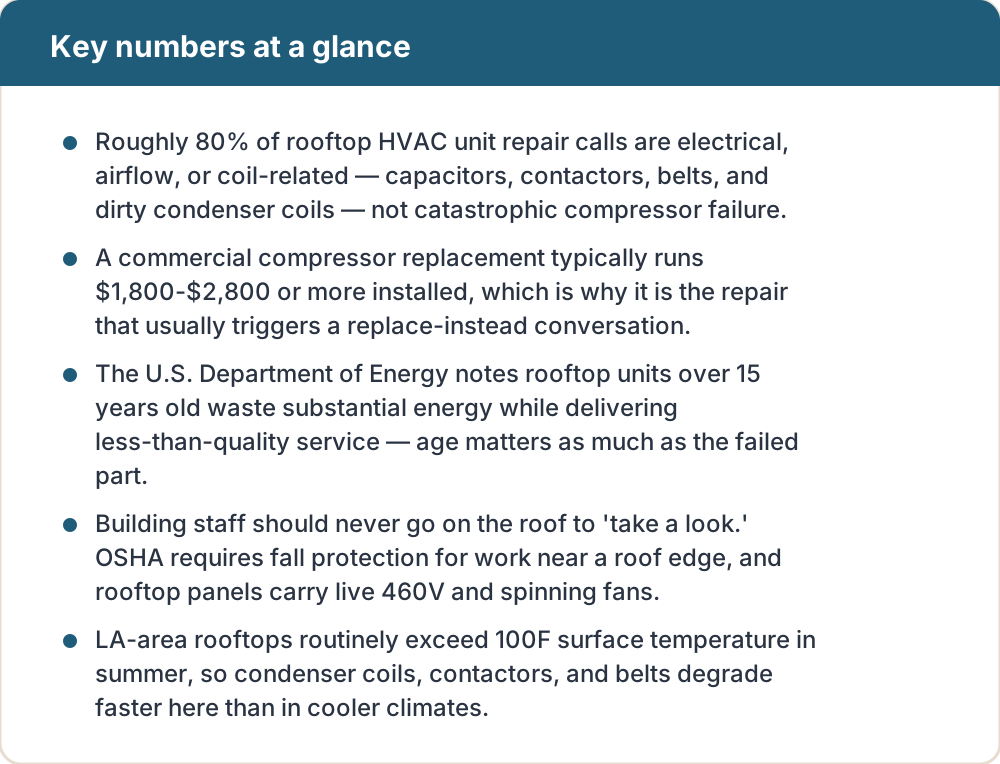
- Roughly 80% of rooftop HVAC unit repair calls are electrical, airflow, or coil-related — capacitors, contactors, belts, and dirty condenser coils — not catastrophic compressor failure.
- A commercial compressor replacement typically runs $1,800-$2,800 or more installed, which is why it is the repair that usually triggers a replace-instead conversation.
- The U.S. Department of Energy notes rooftop units over 15 years old waste substantial energy while delivering less-than-quality service — age matters as much as the failed part.
- Building staff should never go on the roof to 'take a look.' OSHA requires fall protection for work near a roof edge, and rooftop panels carry live 460V and spinning fans.
- LA-area rooftops routinely exceed 100F surface temperature in summer, so condenser coils, contactors, and belts degrade faster here than in cooler climates.
On this page
- What is a rooftop HVAC unit, and why do so many LA businesses have one?
- What are the most common rooftop unit failures — and what do they feel like inside?
- What can you safely check from inside the building?
- Why should untrained staff never go on the roof?
- What does rooftop HVAC unit repair actually cost?
- When does repairing a rooftop unit stop making sense?
- Why do Los Angeles-area rooftop units fail sooner?
- What should you do when a rooftop unit goes down?
What is a rooftop HVAC unit, and why do so many LA businesses have one?
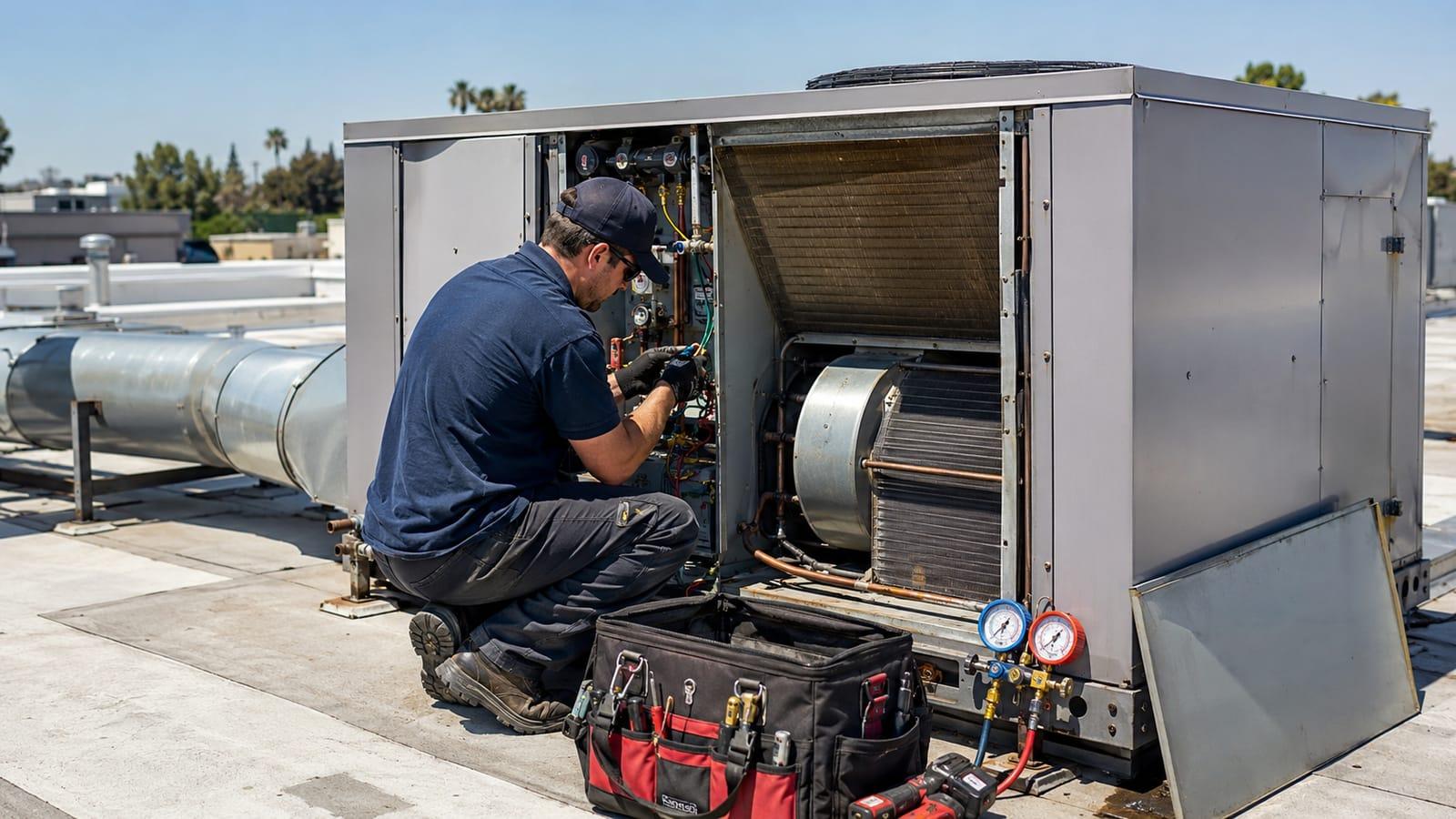
A rooftop unit — an RTU, or packaged unit — is a self-contained heating and cooling system that sits on a steel curb on your roof. Unlike a split system, everything lives in one cabinet: compressor, condenser coil, evaporator coil, blower, filters, controls, and usually a gas heat section. Ductwork drops straight through the roof into the ceiling plenum below. That single-cabinet design is exactly why rooftop HVAC unit repair works differently from residential service — there is no indoor half of the system to inspect, and almost all diagnosis happens on the roof.
Businesses across the San Gabriel Valley and East Los Angeles County choose RTUs for a simple reason: they don't consume leasable floor space. A retail strip in Pomona, a warehouse in Walnut, a medical suite in Claremont — all of them can put three, five, or fifteen tons of capacity overhead instead of surrendering a mechanical room. Modular capacity is another advantage. If you add a tenant, you add a unit.
The tradeoff is exposure. Rooftop units sit in full sun, full dust, and full wind for their entire service life, and nobody sees them unless someone climbs a ladder. That combination — critical equipment, zero visibility — is why RTUs are the most commonly neglected mechanical equipment in commercial buildings, and why so many failures arrive as surprises rather than warnings.
What are the most common rooftop unit failures — and what do they feel like inside?
You almost never diagnose an RTU from the tenant space. What you get instead is a symptom, and symptoms map fairly reliably to causes. Here is what facility managers actually report, and what is usually behind it.
- Unit hums but won't start, or trips the breaker: failed run capacitor or a pitted contactor. These are the two cheapest and most frequent failures, and heat accelerates both.
- Air blows but it isn't cold: low refrigerant charge from a leak, a failed compressor, or a condenser coil so packed with dust that the unit can't reject heat.
- Weak airflow at the diffusers: a slipped or broken blower belt, a failing blower motor, or filters that were last changed two seasons ago.
- Cooling that quits in the afternoon and returns overnight: high head pressure from a dirty coil or a failing condenser fan motor — classic Inland Empire heat-of-day failure.
- Outside air that feels wrong — muggy in summer, freezing in winter: a stuck economizer damper. Economizers fail quietly and are one of the largest hidden energy losses on a rooftop.
- Water stains on ceiling tiles under the unit: a plugged condensate drain pan, or a failed roof curb seal letting rainwater in around the unit.
- Rattles, squeals, or grinding: bearings, belts, or a loose fan wheel. Our guide to what AC noises actually mean breaks the sounds down by cause.
Compressor failure gets the headlines because it is expensive, but it is rarely the first thing that broke. A compressor usually dies because something upstream — a leak, a dirty coil, a stuck contactor cycling it thousands of extra times — went unaddressed. That is the practical case for commercial HVAC maintenance: the cheap failures are the ones that kill the expensive parts.
| Problem | Symptom you notice | Typical fix | Typical cost |
|---|---|---|---|
| Failed run capacitor | Unit hums but won't start; intermittent cooling | Test and replace capacitor | $400-$650 installed (5-ton RTU) |
| Burned or pitted contactor | Unit won't engage, or won't shut off; buzzing at the unit | Replace contactor, inspect wiring | $150-$400 installed |
| Broken or slipping blower belt | Weak airflow at diffusers; squealing | Replace belt, check sheave alignment and tension | $150-$350 |
| Clogged condenser coil | Cooling fades in afternoon heat; high energy bills | Chemical coil cleaning, fin comb | $250-$600 per unit |
| Refrigerant leak / low charge | Long runtimes, poor cooling, ice on lines | Leak search, repair, EPA-compliant recharge | $450-$1,500+ depending on leak location |
| Compressor failure | Unit runs, no cooling at all; breaker trips | Compressor replacement, or unit replacement if aged | $1,800-$2,800+ installed |
| Stuck economizer damper | Muggy or overcooled air; unexplained energy spike | Repair or replace actuator and linkage, recalibrate | $400-$1,200 |
| Plugged drain pan / curb leak | Ceiling tile stains below the unit | Clear drain, treat pan, reseal curb flashing | $200-$900 |
What can you safely check from inside the building?
There is a short list of checks that are genuinely useful and involve no risk. Do these before you call, because they occasionally solve the problem and they always shorten the diagnosis.
- Thermostat: confirm mode, setpoint, and that it isn't in a scheduled setback or a hold left over from a previous tenant. Replace the batteries if it takes them.
- Electrical panel: look for a tripped breaker serving the unit. Reset it once. If it trips again, stop — a repeat trip means a real fault, and forcing it can destroy a compressor.
- Filters: if your filter rack is accessible from inside the ceiling or a return grille, check it. Restricted airflow causes an enormous share of no-cooling calls.
- Disconnect or service switch inside the building, if your layout has one — occasionally it gets shut off during unrelated work and nobody logs it.
- Note the symptom precisely: time of day it fails, whether the fan runs, whether the breaker trips, any smell (burnt plastic, mustiness) or noise. Ten seconds of detail saves diagnostic time.
That is the entire safe list. Everything else — refrigerant pressures, amp draws, capacitor testing, belt tension, coil cleaning, economizer linkage, drain pan clearing — happens on the roof, inside a cabinet with live power. If you smell burning or see smoke, cut power at the panel and call for emergency service rather than investigating further.
Why should untrained staff never go on the roof?
This is the part of rooftop HVAC unit repair we push hardest on, because the temptation is real. A tenant complains, the maintenance guy has a ladder, and it seems reasonable to go look. It isn't.
OSHA's general industry fall protection rule (29 CFR 1910.28) requires protection for employees working near an unprotected roof edge, and the narrow allowances for temporary and infrequent work assume trained personnel and a planned approach — not an improvised trip with a ladder. Skylights are a specific hazard: they read as solid surfaces and are not, and falls through them are a recurring source of serious injuries in California.
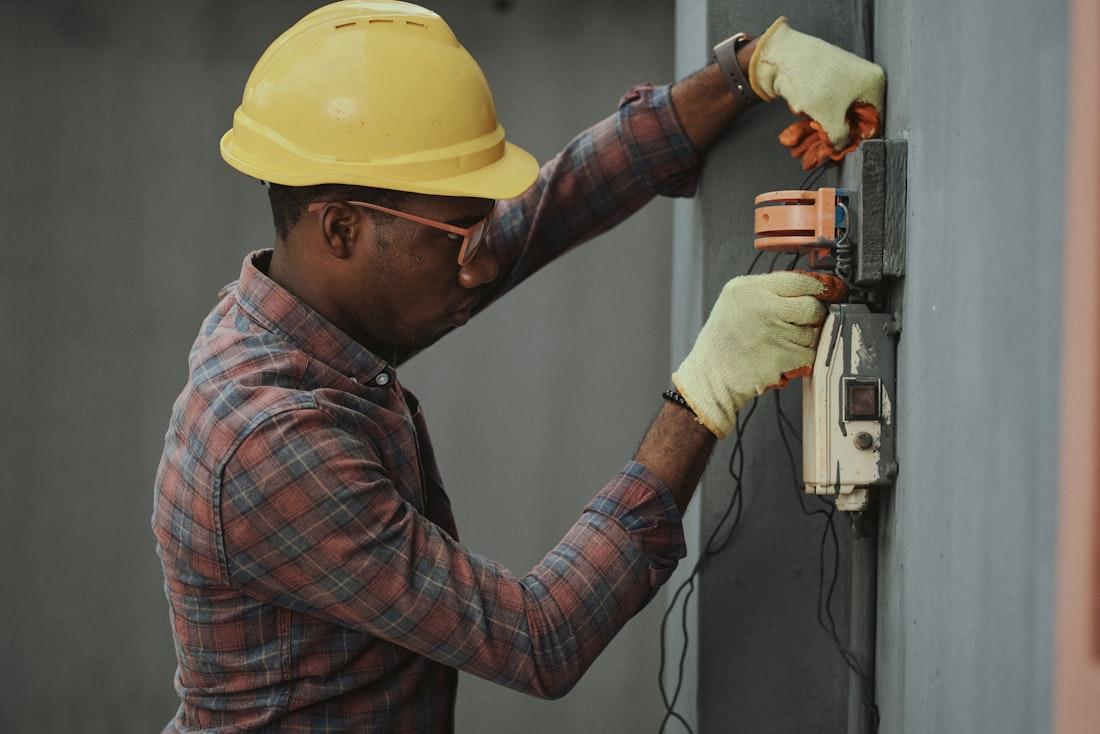
Then there is the equipment itself. RTU access panels cover 208V, 460V, or 480V three-phase power. Capacitors hold a lethal charge after the disconnect is pulled. Condenser fans restart on their own when a pressure switch closes. Add a hot, slick, membrane roof surface, and an untrained person opening a panel is exposed to electrocution, amputation, and a fall, all at once.
There is a building-side cost too. Foot traffic on a single-ply roof membrane — especially soft, sun-heated membrane in an Inland Empire July — causes punctures and scuffs that turn into leaks months later. Techs who work on roofs daily know where to walk. Your staff shouldn't have to learn.
What does rooftop HVAC unit repair actually cost?
Commercial pricing is wider than residential because unit sizes range from 3 tons to 25+ tons, parts get more specialized as capacity climbs, and roof access adds labor. Published 2026 industry data puts a straightforward capacitor replacement on a 5-ton rooftop unit in roughly the $400-$650 range installed, contactors in a similar band once labor is included, and commercial compressor replacement commonly at $1,800-$2,800 or higher depending on tonnage and warranty status. Broader commercial RTU service work is frequently quoted anywhere from a few hundred dollars up past $4,800 for major component work.
Three things move your number within those ranges: tonnage, access difficulty (a crane or lift changes everything), and whether the failure is single-part or cascading. A capacitor caught early is a small ticket. The same capacitor left to short-cycle a compressor for three weeks is not.
We quote commercial HVAC repair with upfront written pricing before work begins, including the diagnostic finding and the recommended fix. If you own multiple sites across Pomona, Diamond Bar, and Rowland Heights, ask for a per-unit breakdown so you can compare which units are costing you money year over year.
When does repairing a rooftop unit stop making sense?
There is no single rule, but four signals together make the replace case clearly. First, age. The U.S. Department of Energy's rooftop unit guidance notes that units over 15 years old can waste substantial energy and money while providing less-than-quality service — and DOE's Advanced RTU Campaign documents that upgrading older rooftop units can cut their energy use by 30-50%. A 17-year-old unit that needs a compressor is rarely worth the compressor.
Second, repair cost against replacement. Once a single repair approaches roughly a third of replacement cost — and compressor and coil jobs frequently do — the math tips, especially factoring the energy delta over the next decade.
Third, repair frequency. Three service calls in eighteen months on the same unit means you are funding a replacement in installments while still absorbing the downtime.
Fourth, refrigerant. Units running phased-down refrigerants face rising charge costs and shrinking parts availability. A leaking older unit can become expensive to keep charged regardless of how simple the leak repair looks.
Against all of that, replacement isn't automatically right. If a 7-year-old unit throws a blower motor, you fix it. The honest version of this conversation includes the age, the repair history, and what the next two failures are likely to be — not just today's quote.
Why do Los Angeles-area rooftop units fail sooner?
A rooftop in the Inland Empire is a genuinely hostile environment. On a 105F day, a dark low-slope membrane can push surface temperatures well past 140F, and the air a condenser coil is trying to reject heat into is already superheated. That means higher head pressures, longer runtimes, and compressors and contactors working near their design limits for months at a stretch — not the occasional peak week a milder climate produces.
Dust compounds it. The corridor through Ontario, Pomona, and Walnut carries agricultural dust, freeway particulate, and construction debris, and every bit of it gets pulled through a condenser coil by fans running thousands of hours a season. A coil that looks clean from three feet away can be substantially blocked internally. Blocked coil equals higher head pressure equals shortened compressor life — the single most common way an LA-area rooftop unit dies early.
Santa Ana wind events add leaf and trash loading and can pack debris into coils and drain pans in a single afternoon. UV is the quiet one: sun degrades belts, wire insulation, gaskets, and curb flashing continuously, which is why belts crack here on a shorter cycle than manufacturer intervals suggest.
None of this is unfixable — it just means an LA-area rooftop needs a shorter service interval than the factory schedule assumes. Twice-yearly commercial HVAC maintenance with coil cleaning ahead of summer is the highest-return thing most property owners can do for equipment they never see.
What should you do when a rooftop unit goes down?
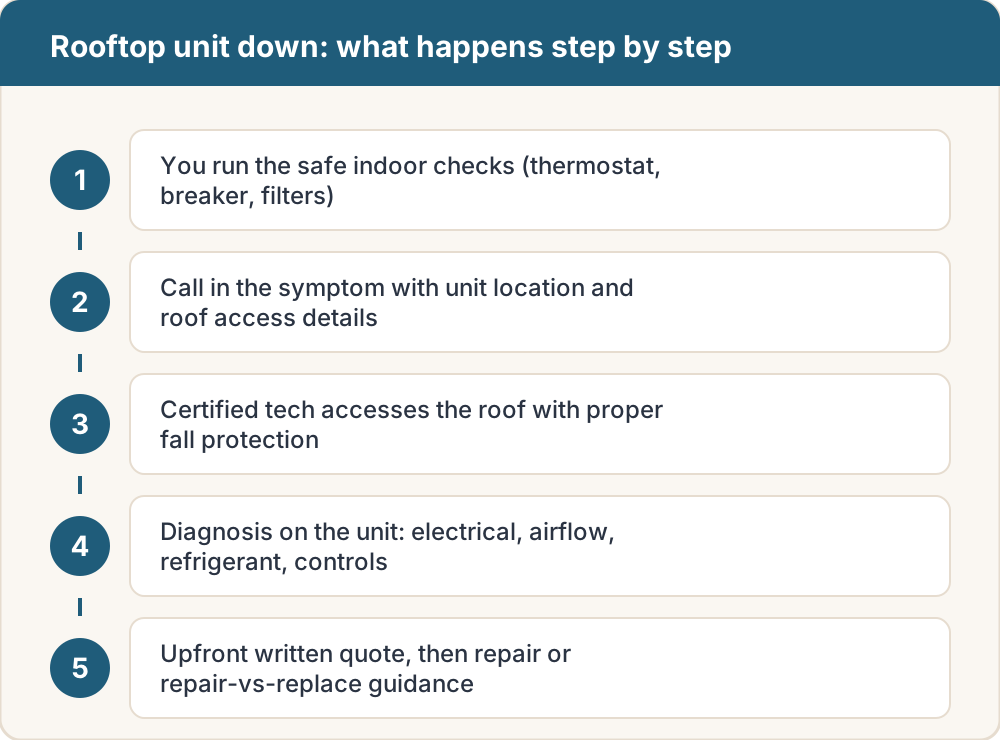
Run the safe indoor checks: thermostat, breaker (one reset only), accessible filters. Note the exact symptom and the time of day it happens. Then call — and when you do, have the unit's make, model, serial, and rooftop location ready if you have them, plus how roof access is arranged (interior hatch, exterior ladder, gated). That detail routinely takes a chunk of time off the visit.
Alex Air & Heating is based in Ontario, CA and services commercial rooftop equipment across the Inland Empire and East Los Angeles County, including Pomona, Diamond Bar, Walnut, Claremont, and Rowland Heights. Our technicians are EPA 608 certified for refrigerant handling, we offer same-day and emergency response for down units, and you get upfront written pricing before any work starts.
If your building has been running the same rooftop units for years without a service record, the most valuable call isn't the emergency one — it's the assessment that tells you which units are close to failing before a July afternoon tells you first.
Sources & references
- 1.U.S. Department of Energy - What is the #1 Way to Save Money on Your Rooftop Unit? Fix it BEFORE it Breaks
- 2.DOE Better Buildings - Upgrade your RTUs and reduce energy use by 30 to 50%
- 3.U.S. Department of Energy - What's on Your Roof? RTU Efficiency Advice from the Advanced RTU Campaign
- 4.OSHA - 29 CFR 1910.28 Duty to Have Fall Protection and Falling Object Protection
- 5.OSHA - Fall Protection While Performing Temporary and Infrequent Work on Roofs (2020 interpretation)
- 6.CCPIA - Commercial Rooftop Unit (RTU) Basics
Frequently asked questions
Most commercial rooftop units are planned around a 15-20 year service life, though harsh conditions shorten that. The U.S. Department of Energy notes that units over 15 years old can waste substantial energy while providing less-than-quality service. In the Inland Empire, sustained heat and dust loading often push units toward the lower end of that range unless they are maintained on a shorter interval.
Only if they are trained for rooftop work and your building has compliant roof access and fall protection. OSHA requires fall protection for work near unprotected roof edges, and skylights present a serious hazard. If the filter rack is accessible from inside the ceiling, that is a safe task; if it requires going on the roof, it should be part of a scheduled service visit instead.
That pattern almost always points to heat rejection. When a condenser coil is dirty or a condenser fan motor is weakening, the unit can keep up in the morning but trips on high pressure once ambient and roof temperatures peak. It recovers overnight and works again the next morning, which makes it easy to dismiss. Coil cleaning and a fan motor check usually resolve it.
Repair is usually cheaper up front, but the calculation shifts with age and repair size. Once a single repair approaches roughly a third of replacement cost on a unit past 15 years, replacement typically wins on total cost — DOE's Advanced RTU Campaign documents 30-50% energy reductions from upgrading older rooftop units. A younger unit with a one-off component failure should almost always be repaired.
We offer same-day and emergency response for commercial rooftop equipment from our Ontario, CA base, covering the Inland Empire and East Los Angeles County including Pomona, Diamond Bar, Walnut, Claremont, and Rowland Heights. Having your unit's model and serial number and your roof access arrangement ready when you call speeds up the visit considerably.
An economizer is a damper assembly that brings in outside air for free cooling when outdoor conditions are mild enough. When the actuator or linkage fails, the damper sticks — either closed, so you lose the free cooling savings, or open, so you pull hot or humid outside air into the building. Because it fails silently, it is one of the most commonly overlooked sources of wasted energy on a rooftop unit.
Local next step
Turn this guide into a site-specific answer.
Guides explain the decision. Equipment condition, access, and safe next steps still need to match the home or business. Review the relevant service scope or request an assessment for Ontario, the Inland Empire, or East Los Angeles County. Availability depends on the current schedule.