Indoor Air Quality Los Angeles: What Drives It in Your Home
A plain guide to indoor air quality Los Angeles homeowners can act on: where the pollution starts, how smog and wildfire smoke get in, and what actually helps.

Owner & Lead HVAC Technician, Alex Air & Heating · EPA 608 Universal Certified · Ontario, CA
TL;DR
Indoor air quality Los Angeles homes experience is driven by three things: outdoor pollution leaking in, indoor sources like gas cooking and cleaning products, and the HVAC system itself. The LA basin traps traffic smog and wildfire smoke under an inversion layer, and EPA finds indoor PM2.5 still reaches 55-60% of outdoor levels with windows closed. Better filtration, sealed ducts, kitchen venting and 30-50% humidity fix most of it.
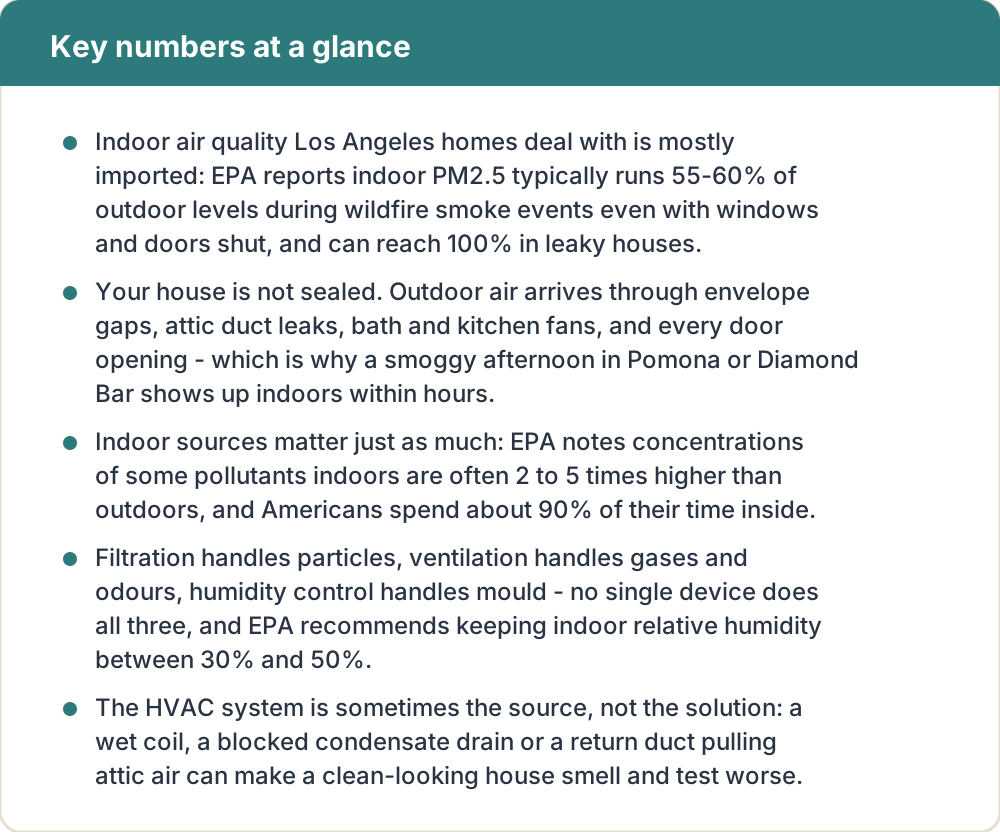
- Indoor air quality Los Angeles homes deal with is mostly imported: EPA reports indoor PM2.5 typically runs 55-60% of outdoor levels during wildfire smoke events even with windows and doors shut, and can reach 100% in leaky houses.
- Your house is not sealed. Outdoor air arrives through envelope gaps, attic duct leaks, bath and kitchen fans, and every door opening - which is why a smoggy afternoon in Pomona or Diamond Bar shows up indoors within hours.
- Indoor sources matter just as much: EPA notes concentrations of some pollutants indoors are often 2 to 5 times higher than outdoors, and Americans spend about 90% of their time inside.
- Filtration handles particles, ventilation handles gases and odours, humidity control handles mould - no single device does all three, and EPA recommends keeping indoor relative humidity between 30% and 50%.
- The HVAC system is sometimes the source, not the solution: a wet coil, a blocked condensate drain or a return duct pulling attic air can make a clean-looking house smell and test worse.
On this page
- What affects indoor air quality in Los Angeles homes?
- Why does the LA basin create a specific indoor air problem?
- Where does the pollution inside your house actually come from?
- How does outdoor air get into a closed-up house?
- What does wildfire smoke season actually do to indoor air?
- What do the AQI numbers mean, and what should you do on a bad-air day?
- How much can filtration, ventilation and humidity control really do?
- When is your HVAC system itself the cause?
- What are the most common indoor air quality mistakes LA homeowners make?
What affects indoor air quality in Los Angeles homes?
Indoor air quality Los Angeles homeowners live with comes down to a simple balance: what gets in from outside, what you generate inside, and how well your HVAC system removes it. Everything else is detail. In the LA basin the outside half of that equation is unusually loaded - regional smog, freeway and warehouse traffic, summer ozone, and a wildfire smoke season that can push fine particles to levels the rest of the country only sees a few days a decade.
That matters more than most people assume, because the US EPA notes Americans spend roughly 90% of their time indoors, and that concentrations of some pollutants indoors are often 2 to 5 times higher than typical outdoor levels. The air you actually breathe is your house's air, not the air on the AQI map.
The practical upshot for a home in Ontario, Claremont or Rowland Heights: you cannot fix indoor air by watching an app. You fix it with three levers - filtration, ventilation and moisture - and by keeping the equipment that moves air around your house clean. Regular AC maintenance and tune-ups exist largely to keep those levers working.
Why does the LA basin create a specific indoor air problem?
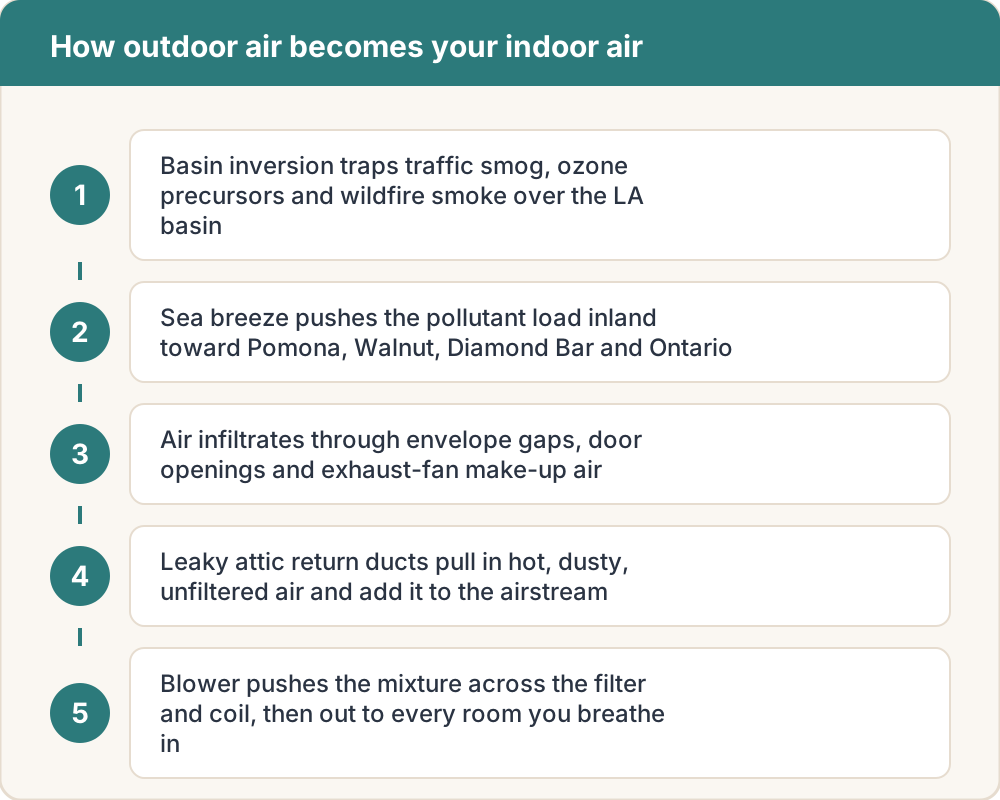
Because geography traps pollution here in a way it does not in most US metros. The South Coast Air Basin sits in a bowl between the ocean and the San Gabriel and San Bernardino mountains. A warm upper air mass frequently settles over the cool marine layer and forms a lid - an inversion - holding emissions near ground level instead of letting them disperse.
South Coast AQMD - the agency covering the southern two-thirds of Los Angeles County, all of Orange County and western Riverside and San Bernardino counties - still classifies this basin as nonattainment for the federal ozone standard. Sunlight plus vehicle and industrial emissions cooks ground-level ozone through the afternoon, and the sea breeze pushes it inland.
That inland push is why the eastern edge of the basin often has worse afternoon ozone than the coast. Homes in Pomona, Walnut, Diamond Bar and out toward Ontario sit downwind of the whole metro area - on a hot July afternoon the air arriving at your back door has already spent hours accumulating pollutants over central LA.
| Pollutant | Where it comes from | Health effect | What actually helps |
|---|---|---|---|
| PM2.5 (fine particles) | Wildfire smoke, freeway and diesel traffic, cooking, candles, fireplaces | Reaches deep lung tissue and the bloodstream; aggravates asthma and heart disease | High-efficiency filtration with the fan set to ON; portable air cleaner in the bedroom; windows closed |
| Ozone | Formed outdoors when sunlight reacts with vehicle and industrial emissions; peaks inland on hot afternoons | Airway irritation, coughing, reduced lung function during exertion | Keep windows closed on high-ozone afternoons; ozone decays quickly indoors; media filters do not remove it |
| Nitrogen dioxide (NO2) | Gas cooktops and ovens, unvented gas heaters, attached-garage exhaust | Airway inflammation; linked to childhood asthma | Range hood ducted outdoors, used every time you cook; never heat a room with the oven |
| VOCs | Paints, solvents, adhesives, air fresheners, cleaning products, new furnishings | Headaches, eye and throat irritation; some are long-term hazards | Source control and dilution ventilation; activated carbon helps with odour but has limited capacity |
| Pollen | Spring grasses, trees and weeds across the Inland Empire; enters with air and on clothing | Allergic rhinitis, sinus congestion, asthma triggers | Filtration plus a sealed filter frame; keep windows shut on high-pollen mornings |
| Mould spores | Wet AC coil, blocked condensate drain, bath fan venting into the attic, plumbing leaks | Musty odour, allergic and asthmatic reactions | Fix the moisture source; clean the coil and clear the drain; keep indoor RH between 30% and 50% (EPA) |
| Dust and dust-mite allergen | Textiles, bedding, pets, foot traffic, attic dust drawn in by leaky return ducts | Sneezing, congestion, asthma triggers, chronic surface dust | Seal duct leaks; correctly fitted filter; HEPA vacuum; reduce humidity in bedrooms |
| Carbon monoxide | Furnaces with a cracked heat exchanger, water heaters, fireplaces, garage vehicle exhaust | Headache and nausea at low levels; life-threatening at high levels | Working CO alarms on every level; annual combustion safety check on gas equipment |
Where does the pollution inside your house actually come from?
Roughly half from outside, half from inside - and the indoor half is the half people ignore. EPA is explicit that most pollutants affecting indoor air quality come from sources inside the building. Cooking, cleaning, furnishings, pets and combustion appliances all contribute daily.
- Cooking and gas appliances: gas ranges release nitrogen dioxide (NO2) and fine particles straight into the kitchen. A 2024 Stanford-led study found gas and propane stove use raises indoor NO2 exposure, and estimated the pollutant mix from these stoves may be responsible for as many as 200,000 current cases of childhood asthma in the US.
- VOCs: paints, solvents, adhesives, air fresheners, cleaning sprays and new furniture off-gas volatile organic compounds. Particle filters do not capture them.
- Dust, dander and dust-mite allergen: generated continuously by people, pets, textiles and foot traffic.
- Pollen: heavy in the Inland Empire spring, arriving with every open door as well as through the building envelope.
- Mould and bacteria: driven by moisture - a bathroom without working exhaust, a slab leak, or a wet AC coil.
- Combustion by-products: fireplaces, unvented heaters and attached garages leaking exhaust and carbon monoxide indoors.
How does outdoor air get into a closed-up house?
Through dozens of small openings you never think about, plus your own ductwork. No California house is airtight. Air moves in around window and door frames, through recessed lights and attic hatches, at plumbing and wiring penetrations, and through the gap under every exterior door.
The bigger route in most Southern California homes is the duct system. Supply and return ducts usually run through an unconditioned attic that hits 130 degrees in August and is full of dust and insulation fibres. When those ducts leak - and older flex duct with failed mastic almost always does - the return side pulls attic air straight into the airstream and blows it out your registers. Homeowners who have chased a stubborn dusty smell for years often find the answer is failing or disconnected ductwork, not anything in the room.
Exhaust fans add to it. Every bathroom fan, dryer and kitchen hood pulls air out of the house, and that volume has to be replaced - it returns through the leakiest paths available, which on a smoky day means unfiltered outdoor air. That is why closing the windows during a smoke event helps less than people expect.
What does wildfire smoke season actually do to indoor air?
It raises indoor fine particle levels to a substantial fraction of outdoor levels, even in a shut-up house. EPA's guidance is specific: during wildfire smoke events with doors and windows closed and no portable air cleaner running, indoor PM2.5 typically settles at around 55% to 60% of outdoor levels - and the range across real homes runs from about 30% to as much as 100%. A tight, newer house in Claremont lands near the bottom of that range. A 1970s house with leaky attic ducts lands near the top.
Wildfire smoke is mostly PM2.5 - particles small enough to reach deep into the lungs and cross into the bloodstream. That is what separates a smoke day from an ordinary smoggy day: the particle load is far higher and it persists for days.
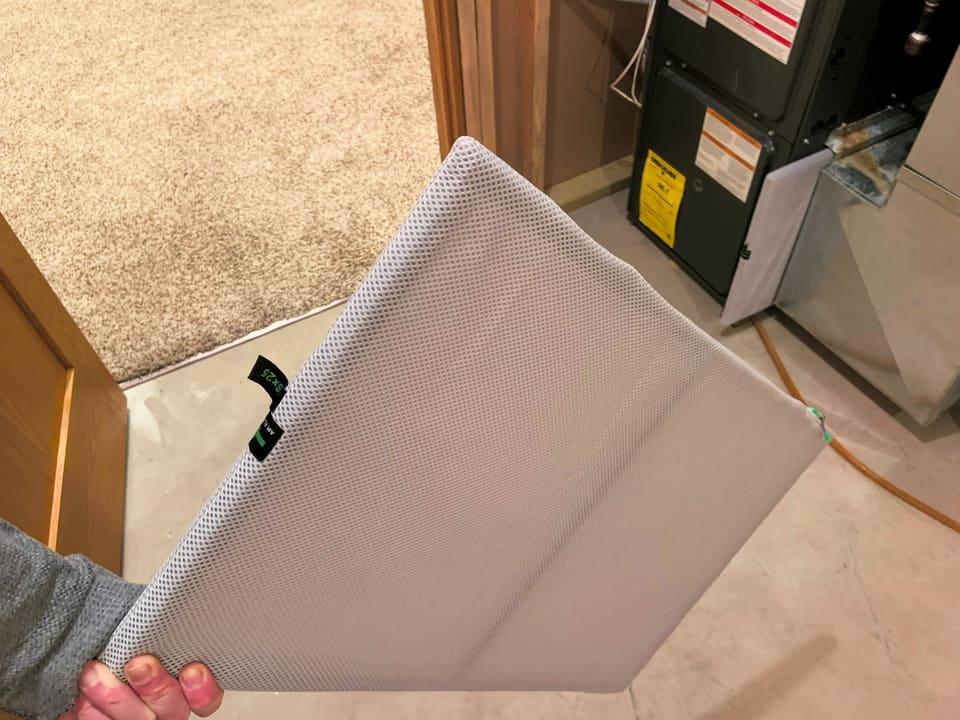
The good news is that particles are the pollutant HVAC handles best. EPA notes that running the system fan continuously with a high-efficiency filter can cut indoor PM2.5 by roughly 50%, and that even a standard low-efficiency filter running continuously reduces particles by about 24%. It also recommends upgrading to a filter rated MERV 13 or higher during smoky periods - though a filter that dense needs a system with enough static pressure headroom to handle it, which is a separate decision covered in our guide to filter MERV ratings.
What do the AQI numbers mean, and what should you do on a bad-air day?
The AQI is a 0-500 scale, and for fine particles EPA tightened the breakpoints in 2024 when it lowered the annual PM2.5 standard from 12.0 to 9.0 micrograms per cubic metre. Under the current scale, Good (AQI 0-50) is 0.0-9.0 ug/m3 of PM2.5; Moderate (51-100) is 9.1-35.4; Unhealthy for Sensitive Groups (101-150) is 35.5-55.4; and Unhealthy (151-200) is 55.5-125.4.
- AQI under 50: ventilate freely - a good time to air the house out.
- AQI 51-100: fine for most people. If someone has asthma or COPD, keep windows shut in the afternoon when ozone peaks inland.
- AQI 101-150: close windows, switch the thermostat fan from AUTO to ON so air keeps passing the filter, and set any fresh-air intake to recirculate.
- AQI over 150: add a portable air cleaner in the bedroom, avoid frying and candles, skip the fireplace, and postpone vacuuming without a HEPA machine.
- Any smoke day: check the filter afterwards - smoke loads it far faster than normal dust, and a clogged filter chokes airflow.
One point people get backwards: on a bad-AQI day you want more circulation through the filter, not less. Setting the fan to ON keeps the whole house volume cycling through the filter media even when the compressor is off. It costs a few dollars a month in blower electricity and it is the most effective free action available.
How much can filtration, ventilation and humidity control really do?
Each one solves a different category of problem, and none of them solves all three. Understanding the split stops you from buying the wrong thing.
Filtration removes particles - smoke, dust, pollen, dander, mould spores. It does essentially nothing for gases. Ozone, NO2 and VOCs pass straight through a pleated media filter. That is the most common misunderstanding in this whole topic: an expensive filter will not stop a smog smell or a solvent odour.
- Gases need dilution or source control: a range hood ducted outdoors (not a recirculating one) while cooking, a working bathroom fan, and storing solvents and paints in the garage rather than a closet.
- Ozone is partly self-solving indoors - it is highly reactive and breaks down on surfaces - so keeping windows closed on high-ozone afternoons is genuinely effective.
- Humidity control prevents biological growth. EPA recommends keeping indoor relative humidity below 60%, ideally 30% to 50%. Above 60%, mould, dust mites and bacteria all become far more viable.
- Airflow is the enabler for all of it - a filter only cleans the air that reaches it.
In practice most Inland Empire homes are dry rather than humid, so the moisture risk is not ambient - it is localised. Condensate that never drains, a bath fan venting into the attic, or a coil that stays damp because the blower stops the instant the compressor does. Those create wet spots inside a dry house.
When is your HVAC system itself the cause?
More often than homeowners expect. Air conditioners dehumidify by condensing moisture on a cold evaporator coil, and that coil sits in a dark metal box the entire house's air passes through. If it is dirty, or the pan holds standing water from a partly blocked drain, you have built a biological amplifier and connected it to every room.
- Musty smell in the first minute after the AC starts - the classic wet coil or dirty drain pan signature.
- A return duct in the garage or drawing from a leaky attic run - pulls exhaust fumes, stored chemicals or attic dust into the supply air.
- A filter fitted backwards, undersized, or with gaps around the frame - air simply bypasses the media.
- Crushed or disconnected flex duct - starves rooms of airflow, so those rooms never get filtered.
- A blower wheel caked with dust - cuts total airflow, so less air gets filtered per hour.
None of these show up on an AQI app and none are fixed by a purifier. They are found by opening the equipment and looking. A tune-up should cover the blower, the evaporator coil, the condensate drain, static pressure and whether the filter actually seals. If the coil is already fouled or the drain has overflowed, that moves from maintenance into AC repair territory - worth knowing which one you are buying before the truck arrives.
What are the most common indoor air quality mistakes LA homeowners make?
Almost all of them come from treating indoor air as a product to buy rather than a system to manage. These are the ones we see repeatedly across Ontario, Pomona and Rowland Heights.
- Buying a purifier and ignoring the ducts. A room purifier cleans one room; leaky attic ductwork contaminates every room whenever the system runs.
- Leaving the thermostat fan on AUTO during a smoke event. The filter only works while the blower runs, and on a mild smoky day the compressor may barely cycle.
- Fitting the densest filter available without checking airflow. A restrictive filter in an undersized return raises static pressure, cuts airflow and can freeze the coil - see how often to change your HVAC filter for the maintenance side.
- Running a recirculating range hood. If it does not duct outdoors, cooking NO2 and grease particles stay in the house.
- Airing the house out at the wrong time. Late afternoon is peak ozone inland; early morning is usually the cleanest window in the eastern basin.
- Assuming an ozone-generating or ionising device is a filter. Anything that intentionally produces ozone adds a lung irritant to a basin already failing the federal ozone standard.
A maintenance visit checks filtration, airflow and the coil and drain where mould starts - across Ontario, the Inland Empire and East LA County, with upfront written pricing. AC maintenance & tune-ups
Sources & references
- 1.US EPA - Indoor Air Quality (Report on the Environment)
- 2.US EPA - Wildfire Smoke: Strategies to Reduce Exposure Indoors
- 3.US EPA - PM NAAQS Air Quality Index Fact Sheet (2024)
- 4.South Coast AQMD - About South Coast AQMD
- 5.US EPA - Mold Course Chapter 2: Why and Where Mold Grows
- 6.Stanford Report - Gas stoves emit unsafe levels of nitrogen dioxide
Frequently asked questions
Often, yes. EPA reports that concentrations of some pollutants are frequently 2 to 5 times higher indoors than in typical outdoor air, because indoor sources like cooking, cleaning products and furnishings emit into a small, poorly ventilated volume. During a wildfire smoke event the picture flips for particles - outdoor PM2.5 is higher, but EPA still measures indoor levels at around 55-60% of outdoor levels with the house closed up.
It helps significantly but it is not a seal. Homes are not airtight, and running exhaust fans pulls unfiltered replacement air in through the leakiest gaps. EPA's data show indoor PM2.5 during smoke events ranges from about 30% to 100% of outdoor levels depending on how tight the house is. Combining closed windows with continuous fan operation and a portable air cleaner in the bedroom does far more than closing windows alone.
No. Pleated media filters capture particles, not gases. Ozone, nitrogen dioxide and VOCs pass straight through. Ozone is at least partly self-limiting indoors because it reacts on surfaces and breaks down, so keeping windows shut on high-ozone afternoons is the practical control. For gases from cooking and cleaning, ventilation and source control are the answer.
That signature almost always points to moisture in the air handler - a dirty evaporator coil or a condensate drain that is partly blocked, leaving standing water in the pan. Because all of the house's air passes over that coil, whatever grows there gets distributed to every room. Clearing the drain and cleaning the coil is standard maintenance work, not a replacement job.
Not usually as a first step. Sealing duct leaks, fitting a correctly sized filter that actually seals in its frame, running the fan continuously on bad-air days and venting the kitchen and bathrooms outdoors will solve most of the problem for far less money. Add-on purification makes sense when someone in the household has a specific medical need or the basics are already handled.
Once a year at minimum, ideally before cooling season, with a filter check every one to three months in between. An annual visit should cover coil condition, condensate drain, blower cleanliness, static pressure and duct integrity - the items that determine how much of your air actually gets filtered. Alex Air & Heating offers a maintenance membership at $199 per system per year with upfront written pricing, serving Ontario, the Inland Empire and East Los Angeles County.
Local next step
Turn this guide into a site-specific answer.
Guides explain the decision. Equipment condition, access, and safe next steps still need to match the home or business. Review the relevant service scope or request an assessment for Ontario, the Inland Empire, or East Los Angeles County. Availability depends on the current schedule.