Restaurant HVAC Ventilation Requirements: A 2026 Operator's Guide
What restaurant HVAC ventilation really requires in California: Type I vs Type II hoods, exhaust CFM sizing, makeup air, NFPA 96 cleaning and LA inspections.

Owner & Lead HVAC Technician, Alex Air & Heating · EPA 608 Universal Certified · Ontario, CA
TL;DR
A commercial kitchen needs three coordinated systems, not one. Restaurant HVAC ventilation requires a Type I hood with grease filters and fire suppression over any appliance producing grease-laden vapors, a Type II hood over heat-and-steam-only equipment, an exhaust fan sized to the hood's length and cooking duty, and a makeup air unit replacing roughly 80 to 90 percent of what you exhaust. Any hood exhausting over 400 CFM must have makeup air.
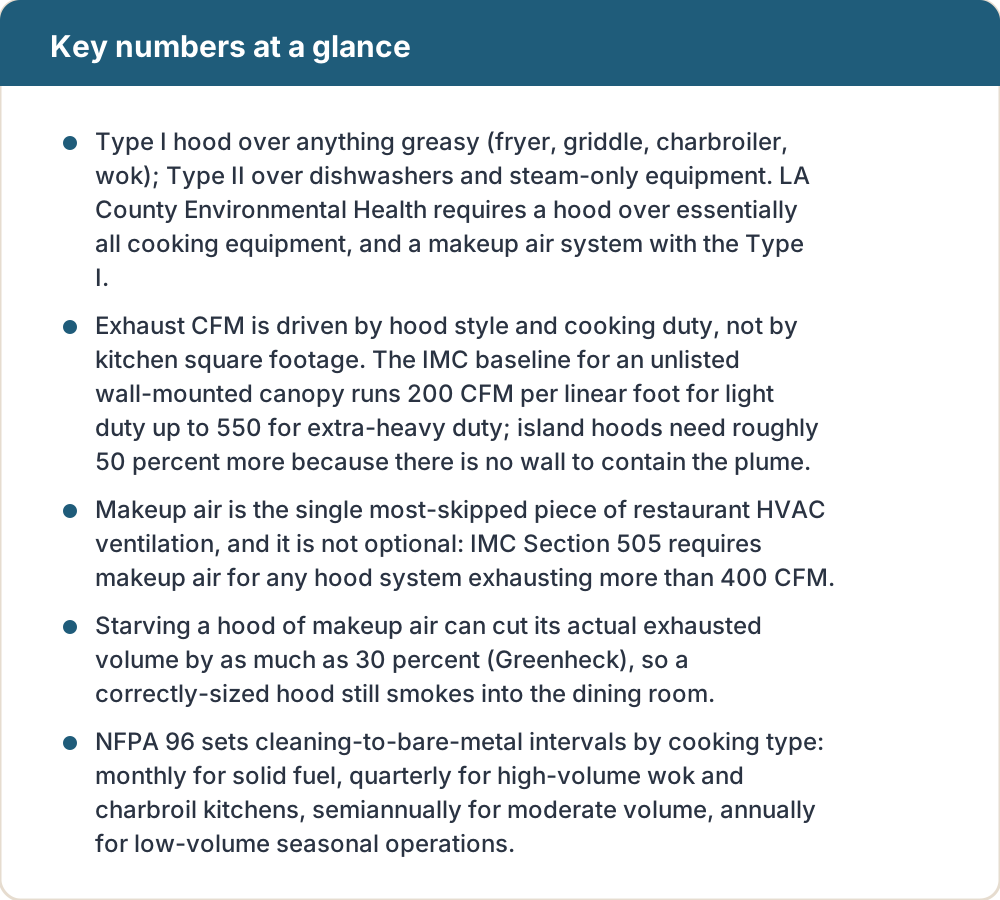
- Type I hood over anything greasy (fryer, griddle, charbroiler, wok); Type II over dishwashers and steam-only equipment. LA County Environmental Health requires a hood over essentially all cooking equipment, and a makeup air system with the Type I.
- Exhaust CFM is driven by hood style and cooking duty, not by kitchen square footage. The IMC baseline for an unlisted wall-mounted canopy runs 200 CFM per linear foot for light duty up to 550 for extra-heavy duty; island hoods need roughly 50 percent more because there is no wall to contain the plume.
- Makeup air is the single most-skipped piece of restaurant HVAC ventilation, and it is not optional: IMC Section 505 requires makeup air for any hood system exhausting more than 400 CFM.
- Starving a hood of makeup air can cut its actual exhausted volume by as much as 30 percent (Greenheck), so a correctly-sized hood still smokes into the dining room.
- NFPA 96 sets cleaning-to-bare-metal intervals by cooking type: monthly for solid fuel, quarterly for high-volume wok and charbroil kitchens, semiannually for moderate volume, annually for low-volume seasonal operations.
On this page
- What ventilation does a commercial kitchen legally need in California?
- Type I vs Type II hoods: which one does your equipment require?
- How is exhaust CFM actually sized?
- Why is makeup air the piece most operators miss?
- What happens when the hood and the dining-room HVAC fight each other?
- What do LA County inspectors actually check?
- How often does a grease duct need cleaning?
- What are the most common restaurant ventilation mistakes?
- When should you rebalance versus redesign?
What ventilation does a commercial kitchen legally need in California?
At minimum: a listed hood over every piece of cooking equipment, an exhaust fan sized to that hood, a makeup air source, and — for grease-producing appliances — a Type I hood with grease filters and an automatic fire suppression system. Restaurant HVAC ventilation is regulated by three separate authorities at once in Los Angeles County, and all three have to sign off before you open.
The California Mechanical Code governs hood, duct and fan design. LA County Environmental Health reviews plans for food-safety ventilation and requires hood elevations, duct details to the roof fans for both exhaust and makeup air, manufacturer spec sheets for the exhaust fan, makeup air fan and filters, static pressure calculations, and the number and location of makeup air diffusers. The local fire authority enforces NFPA 96 for the grease duct and suppression system.
That three-way split is why kitchen ventilation is its own discipline. A contractor who is excellent at rooftop package units on a Pomona strip center is not automatically the right person to design a hood system. Grease-laden vapor, fire-rated duct enclosure, capture-and-containment airflow and interlocked makeup air are a different body of knowledge from comfort cooling — treat it as a specialty scope inside your commercial HVAC installation package, not an afterthought.
Type I vs Type II hoods: which one does your equipment require?
Type I over grease. Type II over heat and steam. The test is whether the appliance produces grease-laden vapor — if it does, you need a Type I hood, full stop.
A Type I hood is the heavy version: grease-tight construction, listed grease filters that also block flame from passing into the duct, a grease collection cup, a grease-rated duct to a roof-mounted upblast fan, and a UL 300 wet-chemical suppression system with nozzles aimed at each appliance.
- Type I required: deep fryers, flat-top griddles, charbroilers, woks, open ranges, rotisseries, tilting skillets, solid-fuel grills
- Type II typical: high-temperature dishwashers, steamers, steam kettles, most convection and pizza ovens that produce no grease, coffee roasters
- Type II hoods use plain ductwork, no grease filters and no fire suppression — which is exactly why misclassifying a greasy appliance under one is a serious problem
- Solid fuel (wood, charcoal) usually needs its own dedicated exhaust system separate from the rest of the line
The mistake we see most in San Gabriel Valley kitchens is a menu change without a ventilation change. A cafe in Claremont adds a flat-top for breakfast sandwiches under an existing Type II dishwasher hood, or a Rowland Heights restaurant swaps a steamer for a wok range. The hood is now undersized and uncertified for what is underneath it, and the first fire inspection catches it.
| Cooking equipment | Hood type | Typical exhaust CFM | Makeup air needed? |
|---|---|---|---|
| High-temperature dishwasher | Type II | About 100-200 CFM per linear foot (heat and steam only) | Yes if the system exceeds 400 CFM |
| Steam kettle, steamer, grease-free oven | Type II | About 150-250 CFM per linear foot | Yes if the system exceeds 400 CFM |
| Convection oven, gas range with oven | Type I (light duty) | About 200 CFM per linear foot | Yes |
| Flat-top griddle, fryer bank | Type I (medium to heavy duty) | About 300-400 CFM per linear foot | Yes - dedicated MUA typical |
| Gas charbroiler, wok range | Type I (heavy to extra-heavy duty) | About 400-550 CFM per linear foot | Yes - dedicated interlocked MUA |
| Solid fuel grill (wood, charcoal) | Type I on a dedicated system | Extra-heavy duty, roughly 550 CFM per linear foot | Yes - dedicated MUA, separate duct |
| Island cook line (no back wall) | Type I single-island canopy | Roughly 50% higher per foot than wall-mounted | Yes - island hoods are the most makeup-air sensitive |
How is exhaust CFM actually sized?
By the hood's linear footage and the cooking duty underneath it — never by kitchen square footage or a rule-of-thumb air-changes number. That is the calculation that shows up on your plan check.
For an unlisted hood, the International Mechanical Code baseline for a wall-mounted canopy is approximately 200 CFM per linear foot for light duty, 300 for medium, 400 for heavy and 550 for extra-heavy duty. A single-island canopy needs roughly 50 percent more per foot — around 400 to 700 CFM depending on duty — because there is no wall behind it to contain the thermal plume, so the rising column of hot air is exposed on all sides.
Listed hoods are different and usually better. A hood tested and listed by the manufacturer carries its own certified airflow rating, which is frequently well below the unlisted-hood baseline because the hood geometry does the work. That matters in California, where Title 24 also imposes a maximum net exhaust flow rate per linear foot — for a wall-mounted canopy the ceiling is roughly 140 CFM per foot light duty to 385 extra-heavy — on large systems. You can be simultaneously required to exhaust enough and prohibited from exhausting too much, which is precisely why the calculation belongs on paper before equipment is ordered.
Why is makeup air the piece most operators miss?
Because it is invisible on the equipment list and expensive on the quote, so it gets value-engineered out. Then the kitchen never works right. Every cubic foot you blow out the roof has to come back in from somewhere, and physics does not care whether you budgeted for it.
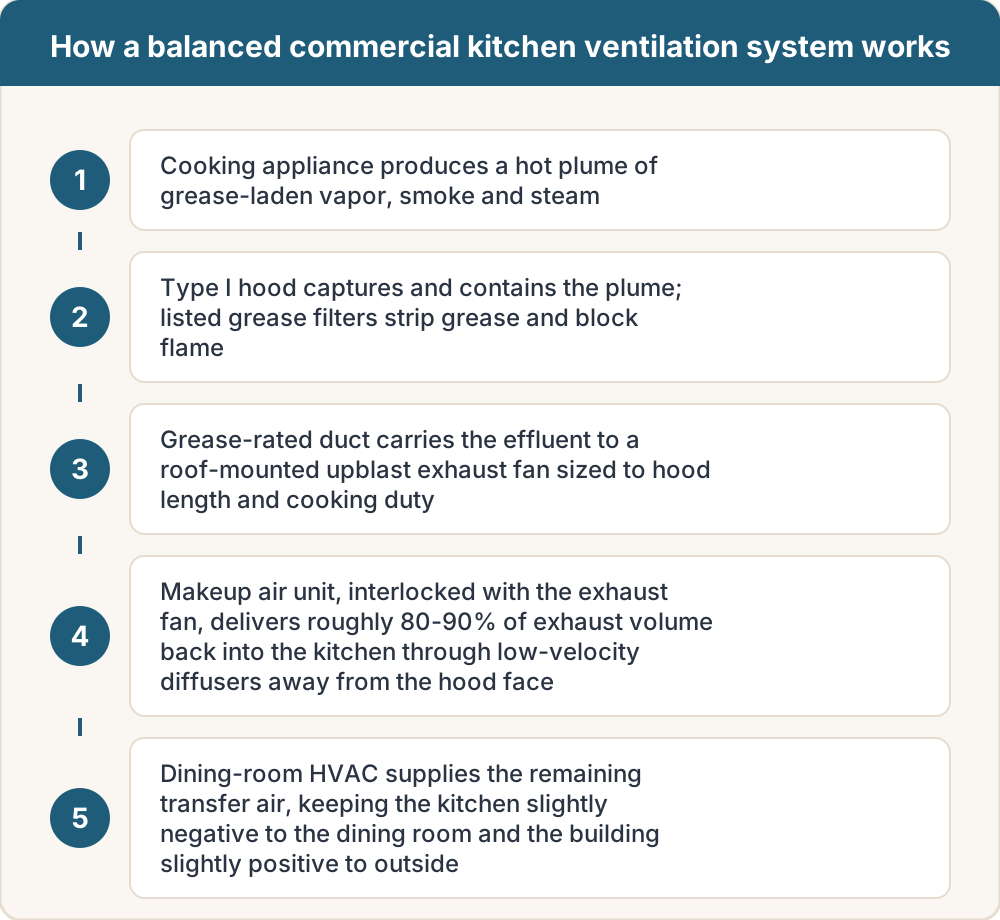
IMC Section 505 requires makeup air for any hood system capable of exhausting more than 400 CFM — which is essentially every commercial kitchen. Under roughly 800 CFM you may be able to source it from the building's rooftop unit. At 800 CFM and above the practical answer is a dedicated makeup air unit (MUA) electrically interlocked with the exhaust fan, so the supply fan starts and stops with the hood.
The usual target is to replace about 80 to 90 percent of exhaust volume mechanically, leaving the kitchen slightly negative relative to the dining room so odors migrate toward the hood rather than out to the guests. What you do not want is a short-circuit approach where large volumes of untempered air are dumped directly into the hood cavity — research cited by the California Energy Commission found that direct supply exceeding about 10 percent of hood exhaust significantly degrades capture and containment. Makeup air should enter the room low and slow, through diffusers positioned away from the hood face, not blasted across it.

What happens when the hood and the dining-room HVAC fight each other?
The kitchen goes negative, the hood underperforms, and the dining room becomes unconditionable. Starve a hood of makeup air and it can lose as much as 30 percent of its rated exhaust volume, per Greenheck — the fan is running, the ammeter looks fine, and smoke still rolls out over the line.
The symptoms are consistent and easy to spot once you know them. Excess negative pressure pulls replacement air through whatever gaps exist: door undercuts, the dining room, the walk-in gasket, even down the flue of an atmospherically-vented water heater, which is a carbon monoxide risk rather than a comfort complaint.
- Exterior or vestibule doors that are hard to pull open, or that whistle and slam
- Smoke or steam spilling past the hood lip even at full fan speed
- Cooking odors reaching the dining room or an upstairs tenant
- Pilot lights or atmospheric flues backdrafting — stop and call for service immediately
- The dining-room rooftop unit running constantly and never satisfying, because it is conditioning air that is being pulled straight into the kitchen and thrown away
- Dust streaks around door frames and ceiling tiles lifting slightly when the hood starts
In older Pomona and East LA County buildings the sequence is often historical: a 1970s dining-room system, a hood added in the 1990s, a bigger fryer added last year. Nobody rebalanced. Fixing it usually means measuring actual exhaust and supply CFM, then either adding MUA capacity or resetting the dining-room unit's outside-air damper — a job that overlaps with rooftop unit service since both ends of the airflow story sit on the same roof.
What do LA County inspectors actually check?
Two separate visits, two different checklists. Environmental Health looks at whether the ventilation adequately removes steam, heat, grease, vapors, odors and smoke, and whether it is cleanable. The fire inspector looks at the grease duct, the suppression system and the service tags.
Health-side items that trip operators: hood coverage and overhang over every piece of cooking equipment including the high-temp dishwasher, filters that are listed and removable, a functioning makeup air system, cleanable surfaces and finished ceilings around the hood, and no condensation dripping onto food-contact surfaces. On the fire side: current wet-chemical suppression service (semiannual is the standard interval), fusible links replaced, nozzles correctly aimed at appliances that have not been rearranged since installation, a manual pull station on the egress path, gas shutoff interlocked to the suppression system, and a legible hood cleaning certificate showing the date and the cleaning company.
The most common fire-inspection failure has nothing to do with equipment: the line got rearranged. A fryer moves eighteen inches to make room for a new griddle, the suppression nozzle no longer points at the fryer, and the system is non-compliant even though every component works. If you move appliances under a Type I hood, the suppression system needs to be reconfigured.
How often does a grease duct need cleaning?
NFPA 96 sets the interval by what you cook, not by the calendar year. The entire system — hood, filters, duct and fan — is cleaned to bare metal on this schedule.
Solid fuel cooking (wood, charcoal) is monthly. High-volume operations such as charbroiling, wok cooking and 24-hour kitchens are quarterly. Moderate-volume cooking is semiannual. Low-volume seasonal operations such as a church hall or a summer-only kitchen are annual. These are minimums, not targets — a heavy fryer line can justify more frequent service, and a cleaning company that finds measurable grease depth should tell you to shorten the interval.
- Monthly: solid fuel — wood-fired, charcoal, mesquite grills
- Quarterly: high-volume charbroiling, wok lines, 24-hour operations
- Semiannual: moderate-volume general restaurant cooking
- Annual: low-volume, seasonal or occasional-use kitchens
- Separately: grease filters cleaned nightly or per shift, grease cups emptied daily, suppression system serviced semiannually
- Keep every certificate on site — the inspector will ask for the most recent one
Note the division of labor. A hood cleaning company handles grease removal to bare metal. The mechanical side — exhaust fan belts and bearings, MUA burners and filters, damper linkages, controls and airflow balance — belongs on a commercial HVAC maintenance plan. Both matter, and a clean duct on a failing fan still gives you a smoky kitchen.
What are the most common restaurant ventilation mistakes?
Almost every smoky-kitchen call we run in the Inland Empire and East LA County traces back to one of a short list of design or operating errors. None of them are exotic.
- Skipping or undersizing the makeup air unit to hit a build-out budget — the single most expensive mistake to correct later, because it usually means new roof penetrations and structural work
- Sizing exhaust from kitchen square footage or a generic air-changes figure instead of hood length and cooking duty
- Buying the hood before the ventilation calculation exists, so the equipment plan and the airflow plan never match
- Locating makeup air diffusers too close to the hood face, where the incoming stream shears the thermal plume and defeats capture
- Adding a fryer, griddle or charbroiler under an existing hood without re-evaluating CFM, filter type and suppression nozzle coverage
- Leaving the MUA unit off in summer because it blows warm air — the kitchen then goes hard negative for the entire hot season
- Running the hood at full speed all day when a variable-speed control tied to duct temperature would cut both exhaust volume and the conditioned air you are throwing away
- Treating a hood cleaning certificate as proof the system works — it certifies grease removal, not airflow
One more worth calling out separately: nobody measured. Plenty of kitchens have never had actual exhaust and supply CFM read with an instrument. Design intent on a drawing and real airflow after five years of duct grease, worn belts and loaded filters are two different numbers, and only one of them determines whether your kitchen smokes.
When should you rebalance versus redesign?
Rebalance when the equipment is right and the airflow drifted. Redesign when the menu or the line has outgrown the hood. The dividing line is whether your current hood type, length and CFM rating still match what is cooking underneath it.
Rebalancing is the cheaper path and solves more problems than operators expect: measure exhaust and makeup CFM, verify the MUA interlock actually fires with the hood, adjust fan speed or drive, reset the dining-room unit's outside-air damper, and confirm the kitchen sits slightly negative relative to the dining room and the building sits slightly positive relative to outside. Many chronically smoky kitchens in Diamond Bar and Walnut strip centers are fixed at this level.
Redesign is warranted when you have changed cooking category — adding a charbroiler or wok line to a hood specified for light duty — when the hood does not physically overhang the appliances, or when there is no makeup air path at all. At that point you are back in plan check with Environmental Health and the fire authority, and the honest answer is that it is a project, not a service call. Either way, get the airflow numbers measured first; if something has already failed mechanically, that is a commercial HVAC repair question, and if the system is sound but neglected, our broader guide to keeping commercial systems running in Los Angeles covers the servicing rhythm.
Alex Air & Heating is EPA 608 certified and based in Ontario, California, working across the Inland Empire and East Los Angeles County — Pomona, Diamond Bar, Walnut, Claremont and Rowland Heights included. We design, install and balance commercial kitchen ventilation, offer same-day and emergency response, and quote in writing before work starts.
Our EPA-certified team designs, installs and balances commercial kitchen ventilation across Los Angeles County and the Inland Empire, with upfront written pricing. Commercial HVAC installation
Sources & references
- 1.Los Angeles County Department of Public Health - Construction Requirements for Retail Food Facilities
- 2.Greenheck - When is Make-Up Air Required for Kitchens
- 3.California Energy Commission - 2022 Commercial Kitchens Fact Sheet
- 4.Energy Code Ace - Prescriptive Requirements for Commercial Kitchens (Title 24)
- 5.UpCodes - Maximum Net Exhaust Flow Rate, CFM per Linear Foot of Hood Length
- 6.Streivor Air Systems - CKV Design Guide 1: Selecting and Sizing Exhaust Hoods
Frequently asked questions
Yes. The requirement is triggered by grease-laden vapor, not by appliance size or whether it sits on a counter. Any fryer produces grease-laden vapor and needs a Type I hood with listed grease filters and fire suppression coverage. LA County Environmental Health requires ventilation over cooking equipment generally, and countertop equipment is not exempt.
It varies with CFM, whether the unit is heated or tempered, and roof access and structural work, so any honest answer requires a site look. What we can say is that adding MUA after the fact costs substantially more than including it in the original design, because it usually means new roof penetrations, new curbs, electrical and often structural review. Get a written number during design rather than discovering it at inspection.
Sometimes, for smaller systems. Under roughly 800 CFM of exhaust, a properly configured rooftop unit with an adequate outside-air setting can cover it. At 800 CFM and above, a dedicated makeup air unit interlocked with the exhaust fan is the practical approach, because pushing that much outside air through a comfort unit creates control and comfort problems and drives up cooling cost.
The most common cause is insufficient makeup air. When the kitchen goes strongly negative, the fan cannot move its rated volume - Greenheck notes losses of up to 30 percent - so the hood loses capture even though everything sounds normal. Other causes are a loaded or wrong-type grease filter, a slipping fan belt, or an appliance that has been moved out from under the hood's overhang.
NFPA 96 sets the minimum by cooking type: monthly for solid-fuel cooking, quarterly for high-volume charbroiling, wok and 24-hour kitchens, semiannually for moderate-volume cooking, and annually for low-volume seasonal operations. The whole system including duct and fan must be cleaned to bare metal, and you should keep the certificate on site for the fire inspector.
Check three things before the new equipment is ordered: whether the new appliance changes the cooking duty category, whether the existing hood's CFM rating and physical overhang still cover it, and whether the fire suppression nozzles will still aim correctly at the rearranged line. If any of the three changes, you likely need a plan revision with the health department and the fire authority rather than a straight equipment swap.
Local next step
Turn this guide into a site-specific answer.
Guides explain the decision. Equipment condition, access, and safe next steps still need to match the home or business. Review the relevant service scope or request an assessment for Ontario, the Inland Empire, or East Los Angeles County. Availability depends on the current schedule.