AC Running Nonstop But Stuck 3-5° Above the Setting? 7 Reasons (Inland Empire Guide)
Your AC runs all afternoon but the house stays warm. Here are the 7 real causes—from a dirty coil to a system too small for a 105°F Ontario heat wave—and how to fix each.

Owner & Lead HVAC Technician, Alex Air & Heating · EPA 608 Universal Certified · Ontario, CA
TL;DR
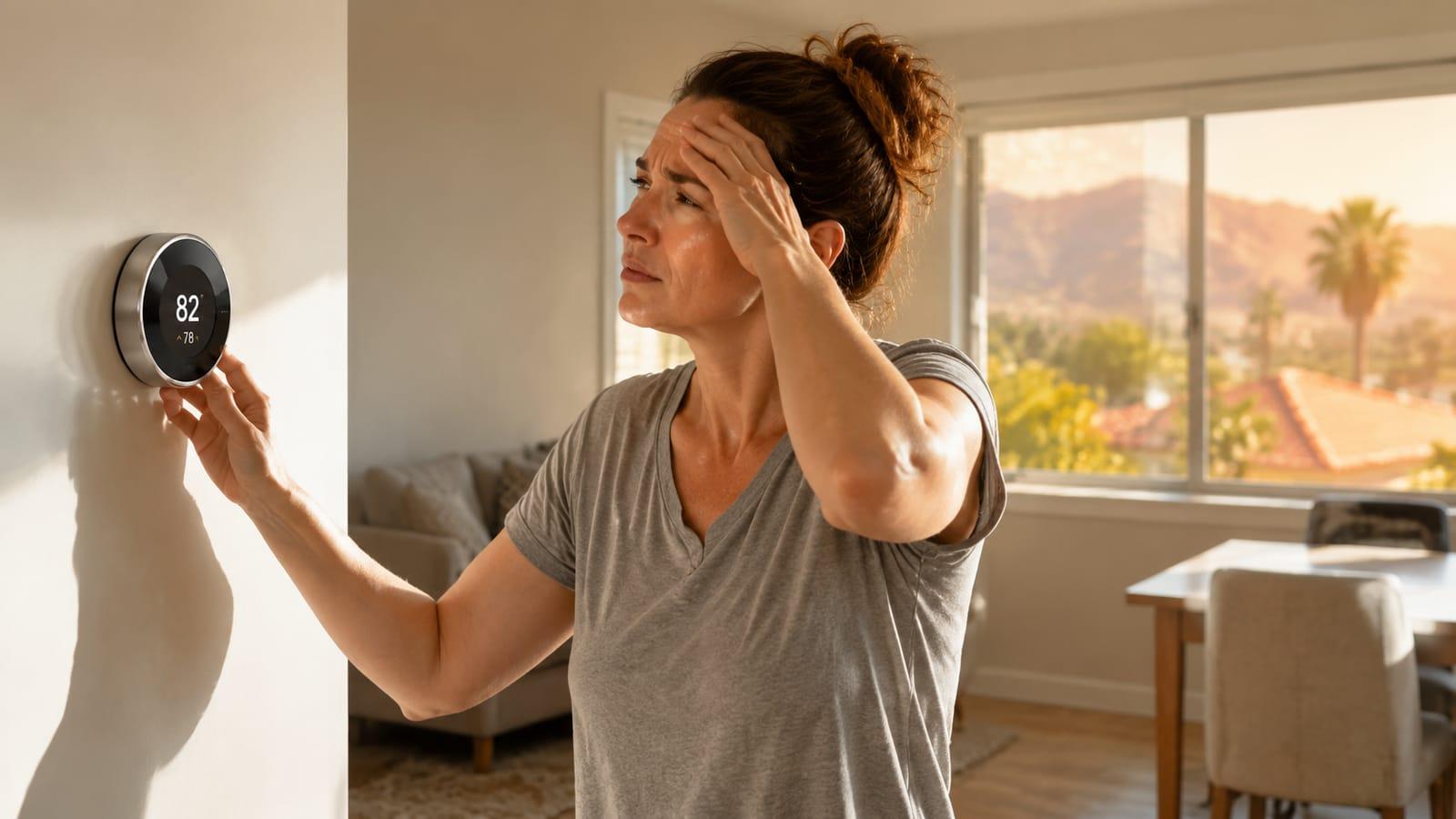
If your AC runs nonstop but the thermostat won't reach the set temperature, the usual causes are a clogged filter or coil, low refrigerant from a leak, leaky ducts, or a system undersized for a 100°F+ Inland Empire heat wave - most fixable, some just physics.
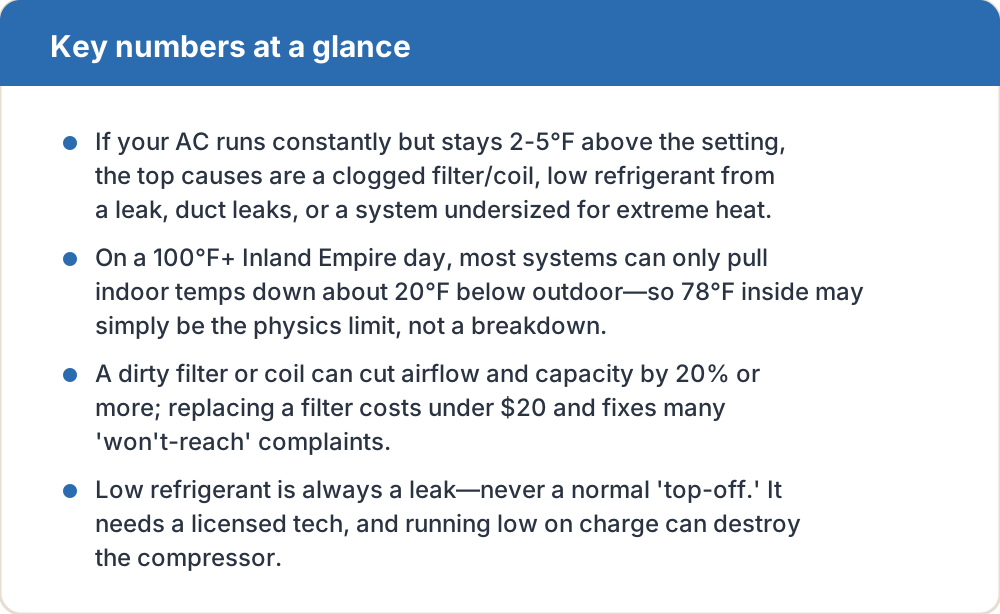
- If your AC runs constantly but stays 2-5°F above the setting, the top causes are a clogged filter/coil, low refrigerant from a leak, duct leaks, or a system undersized for extreme heat.
- On a 100°F+ Inland Empire day, most systems can only pull indoor temps down about 20°F below outdoor—so 78°F inside may simply be the physics limit, not a breakdown.
- A dirty filter or coil can cut airflow and capacity by 20% or more; replacing a filter costs under $20 and fixes many 'won't-reach' complaints.
- Low refrigerant is always a leak—never a normal 'top-off.' It needs a licensed tech, and running low on charge can destroy the compressor.
On this page
- Why won't my AC reach the temperature I set even though it never shuts off?
- Is it just too hot outside? (The 20-degree rule)
- Could a dirty filter or coil be the problem?
- Do I have low refrigerant?
- Are duct leaks stealing my cool air?
- Is my thermostat lying to me?
- Is my AC simply too small (or too old) for the house?
- What should I check before calling a pro?
Why won't my AC reach the temperature I set even though it never shuts off?
When an air conditioner runs continuously but the thermostat stays a few degrees above your target, it means the system is removing heat slower than heat is entering the house. The unit isn't 'broken' in the on/off sense—it simply can't keep up. That gap is almost always one of two things: the system has lost cooling capacity (dirty filter, dirty coil, low refrigerant, failing parts), or the heat load on the house is larger than the system can handle (extreme outdoor heat, duct leaks, poor insulation, or an undersized unit).
The fastest way to narrow it down: check the easy, cheap items first (filter, vents, outdoor unit, thermostat location), then move to the items that need a technician (refrigerant, coils, ductwork, sizing). Below we walk through all seven in that order.
This guide is for an AC that **cools but can't close the last few degrees** and runs constantly. If the vents blow **warm or hot** air, see Why is my AC blowing warm air?. If it blows cool air but the house never gets cold, read AC running but not cooling.
Is it just too hot outside? (The 20-degree rule)
A properly working central AC is generally designed to cool the indoor air roughly 20°F below the outdoor temperature. So when it's 105°F outside in Ontario or Fontana during a July heat wave, a system holding your home at 82-85°F may be performing exactly as designed—not failing. Trying to hit 72°F on the hottest afternoon of the year is often asking for more than the equipment was ever sized to deliver.
The tell: if your AC keeps the house comfortable on 85-90°F days but falls behind only during extreme heat, sizing and heat load—not a malfunction—are the likely story. If it can't keep up even on mild days, keep reading.
| Likely cause | Telltale sign | Who fixes it | Typical cost |
|---|---|---|---|
| Clogged filter | Weak airflow, dusty vents | DIY | $10-$25 |
| Dirty outdoor coil | Warm air, high bills | DIY rinse / pro clean | $0-$200 |
| Low refrigerant (leak) | Ice on lines, hissing | Licensed tech (EPA 608) | $200-$1,500+ |
| Duct leaks | Some rooms never cool | Pro seal/insulate | $300-$1,500 |
| Thermostat misplaced/old | Runs nonstop, false reading | DIY / pro upgrade | $0-$300 |
| Undersized or aging unit | Can't keep up even on mild days | Pro (Manual J) | Repair vs. replace |
| Extreme outdoor heat | Only falls behind above ~100°F | Manage load | $0 |
Could a dirty filter or coil be the problem?
This is the single most common fixable cause. A clogged air filter chokes airflow across the indoor coil; a dirty outdoor condenser coil traps heat the system is trying to reject. Either one forces the equipment to run longer while delivering less cooling. Manufacturers and utilities widely note that restricted airflow and dirty coils can cut efficiency and capacity substantially—often 20% or more in bad cases.
The good news: this is DIY-friendly and cheap. Replace a 1-inch filter every 30-90 days (monthly during peak Inland Empire cooling season), keep supply and return vents unblocked by furniture or rugs, and gently rinse the outdoor unit's fins with a garden hose after shutting off power. If the indoor evaporator coil itself is caked in dirt, that's a professional cleaning—those coils are sealed and easy to damage.
- Change the filter monthly in summer; a $15 filter is the cheapest fix you'll find.
- Clear leaves, grass clippings, and dryer lint off the outdoor condenser—give it 2 feet of clearance.
- Never bend the aluminum fins or use a pressure washer on the outdoor coil.
Do I have low refrigerant?
Refrigerant is the fluid that actually moves heat out of your home. When it's low, the system loses its ability to absorb heat, so the air coming from the vents is only slightly cool and the house never reaches the setting. Classic signs are ice or frost on the copper lines or indoor coil, a hissing or bubbling sound, and warm air despite the unit running hard.
Critical point: refrigerant is a sealed loop. It does not get 'used up.' If you're low, you have a leak—full stop. Anyone offering to just 'add a pound' without finding the leak is treating the symptom, not the cause. This requires an EPA Section 608-certified technician, both because handling refrigerant legally requires certification and because running a system undercharged can overheat and destroy the compressor, the most expensive part of the system.
Are duct leaks stealing my cool air?
In many homes, cooled air is lost before it ever reaches the rooms. The U.S. Department of Energy estimates that in a typical house, about 20-30% of the air moving through the duct system is lost to leaks, holes, and poorly connected ducts. In our region, a lot of ductwork runs through blazing-hot attics and garages, so leaky ducts don't just lose volume—they dump your cold air into 130°F attic space while pulling hot attic air back into the return.
Symptoms include rooms far from the unit that never cool, a big temperature difference between rooms, and unusually high bills. Sealing accessible duct joints with mastic (not cloth 'duct tape') and insulating attic runs can restore a surprising amount of lost capacity.
Is my thermostat lying to me?
Sometimes the system is cooling fine, but the thermostat is reading the wrong temperature. If it's mounted on a wall that gets afternoon sun, near a supply vent, next to a lamp or TV, or on an exterior wall, it can sense a false temperature and either short-cycle or run endlessly chasing a number the rest of the house already passed.
Check placement first: a thermostat should sit on an interior wall, about 5 feet up, away from direct sun, vents, and heat-producing electronics. An old or failing thermostat can also misread the room—if yours is more than 10-15 years old, upgrading to a modern or smart thermostat both improves accuracy and unlocks scheduling that reduces runtime.
Is my AC simply too small (or too old) for the house?
An undersized system will run constantly, never reach the setting on hot days, and wear out its compressor faster. Undersizing happens when equipment was spec'd on the cheap, when a home was expanded (a converted garage, an added room, new west-facing windows), or when insulation has degraded. Aging systems lose capacity too: a 15-20 year old unit with a worn compressor and low SEER rating can't move heat the way it did when new.
The correct fix isn't guesswork—it's a Manual J load calculation, which sizes equipment to your home's actual square footage, insulation, window orientation, and local design temperatures. Oversizing is a mistake too (it short-cycles and won't dehumidify), so 'just buy bigger' isn't the answer. If your system is old and struggling, comparing repair cost against a right-sized, high-efficiency replacement is the smart move.
What should I check before calling a pro?
Run through the cheap, safe items first. Many 'my AC won't reach temperature' calls end after step one or two—and you'll save a service fee if you catch it yourself.
- Replace the air filter (do this even if it 'looks okay').
- Confirm all supply vents are open and returns aren't blocked by furniture.
- Rinse the outdoor condenser coil and clear 2 feet of space around it.
- Set the thermostat fan to AUTO (not ON) and check its placement.
- Lower window blinds on sun-facing windows to cut heat load.
- If you see ice on the lines, warm air, or hear hissing—shut it off and call a licensed tech; those point to refrigerant or airflow failures that get worse if you keep running the unit.
Frequently asked questions
On the hottest Inland Empire days, continuous running can be normal for a right-sized system—it's simply keeping up with the heat load. What's not normal is running nonstop while the temperature keeps drifting further from your setting, or running all day on a mild 80°F afternoon. That points to a capacity problem worth diagnosing.
As a rule of thumb, a properly working central AC cools the air roughly 20°F below the outdoor temperature. At 105°F outside, an indoor temperature around 82-85°F may be the equipment's real limit rather than a malfunction. Reducing heat load—closing blinds, sealing ducts, adding insulation—helps close that gap.
No. Refrigerant handling legally requires EPA Section 608 certification, and low refrigerant always means there's a leak that needs to be found and repaired. Adding refrigerant without fixing the leak is temporary, and running the system undercharged risks destroying the compressor—the costliest part to replace.
It can, in two ways. A poorly placed or aging thermostat may misread the room and run the system endlessly. And a modern smart thermostat lets you schedule setbacks so the AC isn't fighting peak heat all day, reducing runtime and wear even when the underlying equipment is fine.
Local next step
Turn this guide into a site-specific answer.
Guides explain the decision. Equipment condition, access, and safe next steps still need to match the home or business. Review the relevant service scope or request an assessment for Ontario, the Inland Empire, or East Los Angeles County. Availability depends on the current schedule.