Title 24 HVAC Requirements in California: A 2026 Homeowner Guide
Title 24 HVAC requirements explained in plain English: when a permit and HERS test are triggered, what the rater checks, and how a licensed installer handles it all.

Owner & Lead HVAC Technician, Alex Air & Heating · EPA 608 Universal Certified · Ontario, CA
TL;DR
Title 24 HVAC requirements mean that replacing a central AC, furnace, or ducts in California triggers a mechanical permit plus independent HERS (now ECC) field verification of duct leakage, refrigerant charge, and airflow before your job can pass final inspection.
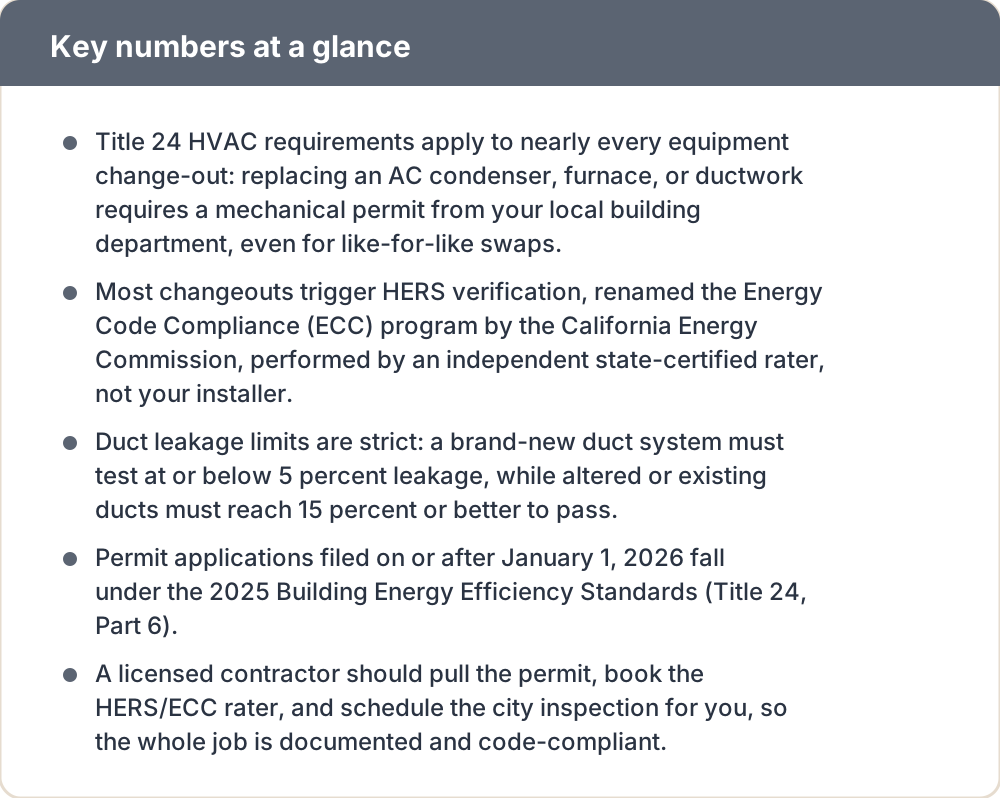
- Title 24 HVAC requirements apply to nearly every equipment change-out: replacing an AC condenser, furnace, or ductwork requires a mechanical permit from your local building department, even for like-for-like swaps.
- Most changeouts trigger HERS verification, renamed the Energy Code Compliance (ECC) program by the California Energy Commission, performed by an independent state-certified rater, not your installer.
- Duct leakage limits are strict: a brand-new duct system must test at or below 5 percent leakage, while altered or existing ducts must reach 15 percent or better to pass.
- Permit applications filed on or after January 1, 2026 fall under the 2025 Building Energy Efficiency Standards (Title 24, Part 6).
- A licensed contractor should pull the permit, book the HERS/ECC rater, and schedule the city inspection for you, so the whole job is documented and code-compliant.
On this page
- What are Title 24 HVAC requirements in plain English?
- When does HVAC work trigger a permit and a HERS test?
- What does HERS (ECC) verification actually check?
- Why do Title 24 HVAC requirements matter for your home?
- How much do the permit and HERS test add to the job?
- How does a licensed installer handle Title 24 for you?
- Do these rules apply in Ontario and the Inland Empire?
What are Title 24 HVAC requirements in plain English?
Title 24 HVAC requirements are the parts of California's Building Energy Efficiency Standards (Title 24, Part 6 of the state code) that control how heating and cooling equipment is installed and verified. In short, when you replace an air conditioner, furnace, heat pump, or ducts, the state wants proof that the new system is efficient, correctly charged, and not leaking conditioned air into your attic. That proof comes from two things: a mechanical permit and, in most cases, an independent field test.
The California Energy Commission updates these standards on a roughly three-year cycle. Permit applications filed on or after January 1, 2026 fall under the 2025 Energy Code. If your paperwork went in before that date, the older 2022 cycle applies. Either way, the core homeowner obligations are the same: get a permit and pass verification. Whether you are booking central AC installation or a new gas furnace, the code follows the equipment, not the brand.
When does HVAC work trigger a permit and a HERS test?
The trigger is simpler than most homeowners expect: almost any equipment change-out counts. Replacing a condenser, a furnace (FAU), a coil, or a meaningful run of ductwork requires a permit in nearly every California jurisdiction, including like-for-like replacements of the same size and fuel type. Adding or replacing more than about 40 feet of duct, or relocating equipment, also pulls a permit.
On top of the permit, most changeouts require HERS field verification, which the California Energy Commission now administers under the Energy Code Compliance (ECC) program. The rule of thumb: if you touch the refrigerant circuit or the ducts, expect testing. A simple thermostat swap or a capacitor repair usually does not trigger any of this.
- Replace the AC condenser or coil: permit plus refrigerant charge and airflow verification.
- Replace the furnace or air handler: permit plus, in most cases, duct leakage testing.
- Replace or add significant ductwork: permit plus duct leakage testing.
- Full system changeout: permit plus all three HERS/ECC checks.
| HVAC work | Permit needed? | HERS test? | What it verifies |
|---|---|---|---|
| Replace AC condenser or coil | Yes | Yes | Refrigerant charge and airflow across the coil |
| Replace furnace / air handler | Yes | Usually | Duct leakage; safe combustion and venting at inspection |
| Replace or add ductwork | Yes | Yes | Total duct leakage (5% new, 15% altered/existing) |
| Full system changeout | Yes | Yes | Duct leakage, refrigerant charge, and airflow |
| Thermostat swap or minor repair | Often no | No | No verification typically required |
What does HERS (ECC) verification actually check?
A HERS rater, now called an ECC field verifier, is a state-certified third party who acts as a special inspector. The single most important rule: they must be independent. Your HVAC contractor cannot test and sign off on their own work, which is exactly what makes the result trustworthy for the city and for a future buyer. There are three main checks, and not every job needs all three.
- Duct leakage: the rater seals every register and pressurizes the duct system to measure total leakage. A brand-new duct system must test at or below 5 percent; altered or existing ducts must reach 15 percent or better.
- Refrigerant charge: for AC and heat pump work, the rater measures subcooling (TXV systems) or superheat (fixed-orifice systems) to confirm the charge matches the manufacturer's spec within a tight tolerance.
- Airflow and fan power: the rater confirms the system moves enough air across the coil, generally around 350 CFM per ton on new equipment and near 300 CFM per ton on retrofits, and that the blower is not wasting energy.
An overcharged or undercharged system can still blow cold air while quietly wasting energy and shortening equipment life, which is precisely why the state built independent verification into the code.
Why do Title 24 HVAC requirements matter for your home?
It is easy to see the permit and testing as red tape, but each requirement maps to a real benefit. Safety comes first: a permitted job means an inspector confirms gas connections, electrical, and combustion venting are correct on furnace work, protecting your family from carbon monoxide and fire risk. Efficiency is next. A correctly charged, properly airflowed, low-leakage system delivers the SEER2 rating you paid for instead of quietly bleeding 20 to 30 percent of your conditioned air into the attic.
Resale and insurance are the ones homeowners forget. Unpermitted HVAC work can surface during escrow, force a costly retroactive permit, or even let an insurer deny a claim. A finalized permit and a HERS/ECC certificate are clean paperwork that a buyer's agent and inspector can verify. If you are weighing the full picture, our guide to AC replacement cost in California breaks down where permit and testing fees fit into a realistic budget.
How much do the permit and HERS test add to the job?
The permit fee itself is set by your city or county and is usually modest, often issued over the counter or online the same day for a straightforward mechanical changeout. The HERS/ECC verification is a separate third-party cost, commonly in the range of a few hundred dollars depending on how many tests your job needs and your region.
A reputable installer folds both into an upfront quote so there are no surprises. At Alex Air & Heating we handle the permit filing, coordinate the independent rater, and schedule the city inspection as part of the install, and we quote it all before work begins. Be cautious of any bid that is suspiciously low and silent on permits, that is usually a sign the work will not be verified or documented.
How does a licensed installer handle Title 24 for you?
The value of a licensed, EPA-608-certified contractor is that Title 24 compliance becomes invisible to you. We pull the mechanical permit with your local building department, size the equipment properly, install to code, register the job in the state compliance database, bring in the independent HERS/ECC rater, and walk the final inspection. You get a working system and a complete paper trail.
This is also where local knowledge pays off. Whether you need furnace replacement or a full duct replacement, the process is smoother when your contractor already knows the counter staff and inspectors in your city. A statewide code applied by a crew that has never pulled a permit in your town is where delays happen.
Do these rules apply in Ontario and the Inland Empire?
Yes. Title 24 is a statewide code, so the same requirements apply from the coast to the Inland Empire. What changes locally is the counter: permits are pulled with each city's own building department. We regularly handle permits and HERS/ECC verification for homeowners in Ontario, Rancho Cucamonga, Chino, Upland, and Pomona, and each of those cities requires the permit be filed with its local building division before work is finalized.
Because we are based in Ontario, CA, we know how each Inland Empire jurisdiction routes mechanical permits and schedules inspections. If you are starting a project, our Ontario AC installation page shows how the permit, testing, and inspection steps fit together for a local, code-compliant job.
Sources & references
- 1.California Energy Commission — 2025 Building Energy Efficiency Standards
- 2.California Energy Commission — Energy Code Update Guides Cleaner, Healthier Buildings
- 3.California Energy Commission — Building Energy Efficiency Standards overview
- 4.Contra Costa County — Residential Air Conditioning Building Inspection Requirements (PDF)
Frequently asked questions
Almost always, yes. A central AC or condenser change-out requires a mechanical permit in nearly every California jurisdiction, including like-for-like replacements. The permit lets a city inspector confirm the install is safe and code-compliant, and it protects your resale value and insurance coverage.
They are the same field verification. The California Energy Commission renamed the HERS (Home Energy Rating System) process to the Energy Code Compliance (ECC) program. Either way, an independent state-certified rater tests your system's duct leakage, refrigerant charge, and airflow to confirm it meets Title 24.
No. The rater must be an independent third party, not the company that installed the equipment. That independence is what makes the result credible to the building department and to a future buyer. A good installer coordinates and pays for the rater on your behalf but does not perform the test.
Skipping the permit can lead to fines, a forced retroactive permit, or even a tear-out and reinstall. It can also surface during a home sale and complicate escrow, and some insurers will deny claims tied to unpermitted work. Permitting up front is far cheaper than fixing it later.
It depends on when the permit is applied for. Applications filed on or after January 1, 2026 fall under the 2025 Building Energy Efficiency Standards. Applications filed before that date fall under the previous 2022 cycle. Your contractor uses the correct compliance software for whichever applies.
Local next step
Turn this guide into a site-specific answer.
Guides explain the decision. Equipment condition, access, and safe next steps still need to match the home or business. Review the relevant service scope or request an assessment for Ontario, the Inland Empire, or East Los Angeles County. Availability depends on the current schedule.