Is R-454B Safe? Understanding the New 'Mildly Flammable' A2L Refrigerant in Your Home
R-454B is classed A2L, or 'mildly flammable' — but that label is far scarier than the reality. Here's what A2L actually means, why it's nothing like propane, and why the EPA approved it for California homes.

Owner & Lead HVAC Technician, Alex Air & Heating · EPA 608 Universal Certified · Ontario, CA
TL;DR
Is R-454B safe for your home? Yes — R-454B is safe for residential air conditioning and is EPA-approved for it. It carries an ASHRAE A2L rating, meaning 'mildly flammable,' but that class sits right next to the non-flammable refrigerants: A2L blends have a very low burning velocity, need a strong sustained ignition source, and behave nothing like propane. Modern R-454B systems add leak-detection sensors and safety controls, and the small charge stays sealed inside copper lines.
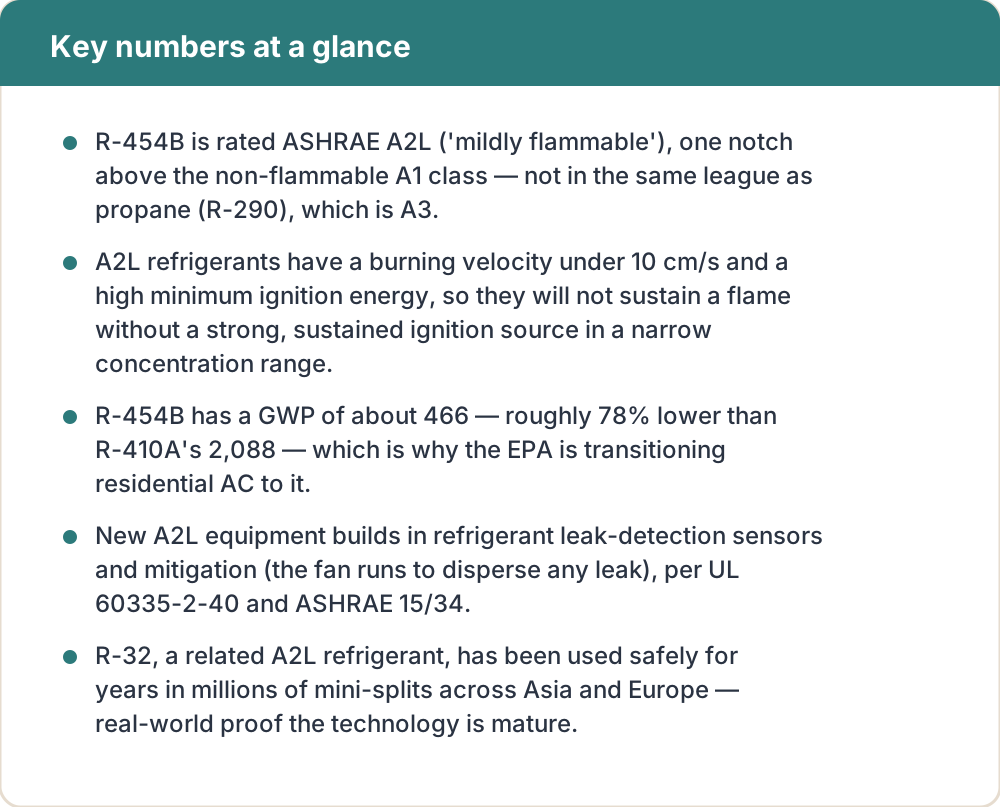
- R-454B is rated ASHRAE A2L ('mildly flammable'), one notch above the non-flammable A1 class — not in the same league as propane (R-290), which is A3.
- A2L refrigerants have a burning velocity under 10 cm/s and a high minimum ignition energy, so they will not sustain a flame without a strong, sustained ignition source in a narrow concentration range.
- R-454B has a GWP of about 466 — roughly 78% lower than R-410A's 2,088 — which is why the EPA is transitioning residential AC to it.
- New A2L equipment builds in refrigerant leak-detection sensors and mitigation (the fan runs to disperse any leak), per UL 60335-2-40 and ASHRAE 15/34.
- R-32, a related A2L refrigerant, has been used safely for years in millions of mini-splits across Asia and Europe — real-world proof the technology is mature.
On this page
Is R-454B safe to have in your home air conditioner?
Yes — R-454B is safe for home use. It's classed A2L, or 'mildly flammable,' which means it's very hard to ignite (low burning velocity, high ignition energy) and behaves nothing like propane. Modern systems add leak-detection sensors and safety controls, and the EPA has approved it for residential AC.
If you've shopped for a new air conditioner in the Inland Empire lately, you've probably heard the phrase 'mildly flammable refrigerant' and felt a jolt of worry. It's a fair reaction — nobody wants a fire hazard bolted to the side of their house. But the label is far more alarming than the science behind it. Let's unpack what A2L really means, why R-454B is a2l refrigerant flammable only in a very narrow, engineered-around sense, and what you as a homeowner in Ontario, Pomona, or Rancho Cucamonga actually need to do about it.
What the ASHRAE safety classes really tell you
Every refrigerant gets a two-part safety code from ASHRAE. The letter rates toxicity: 'A' means lower toxicity. The number rates flammability, from 1 (no flame propagation) up to 3 (highly flammable). The '2L' in A2L is a special subclass: mildly flammable, but with a low burning velocity. That single letter 'L' is the whole story — it separates gently smoldering blends from gases that flash and spread.
| Class | Flammability | Example refrigerants | Typical use |
|---|---|---|---|
| A1 | No flame propagation | R-410A, R-22 | Older / phased-down home AC |
| A2L | Mildly flammable (low burning velocity) | R-454B, R-32, R-1234yf | New home AC, heat pumps, car AC |
| A2 | Flammable | R-152a | Some specialty systems |
| A3 | Highly flammable | R-290 (propane), R-600a (isobutane) | Small commercial refrigeration |
| B-series | Higher toxicity (any flammability) | R-717 (ammonia) | Industrial refrigeration |
Look at where R-454B lands. It sits one row below the R-410A that's been in millions of American homes for two decades, and two full classes above propane. The A2L category was created specifically because these low-GWP blends are so hard to ignite that lumping them with truly flammable gases would be misleading.
Why 'mildly flammable' is nothing like propane
Three physical properties make A2L refrigerants like R-454B genuinely hard to ignite, and they're worth understanding if you want real reassurance about r-32 safety and a2l safety in general:
- Low burning velocity — under 10 cm/s. A flame in R-454B creeps rather than races; it cannot flash across a room the way propane can.
- High minimum ignition energy — it takes a strong, sustained spark or open flame to start combustion at all. A static pop or a light switch won't do it.
- Low heat of combustion — even if it does ignite, it releases relatively little energy and won't sustain a self-feeding fire.
- A narrow flammable range — the refrigerant must reach a specific concentration in air before it can burn, and the small sealed charge in a home system makes that hard to achieve outside a lab.
Put together, these mean a mildly flammable refrigerant home system needs three unlikely things to line up at once: a significant leak, that leak accumulating to just the right concentration in an enclosed space, and a strong ignition source arriving at that exact moment. Propane (R-290, an A3) needs none of that fine-tuning — which is exactly why it's in a different class.
The safety engineering built into every new system
You don't have to take flammability on faith, because A2L equipment is engineered to make ignition even less likely. Under the UL 60335-2-40 appliance standard and ASHRAE 15/34, new R-454B systems include:
- Refrigerant leak-detection sensors that watch for any escape of gas.
- Automatic mitigation — if a leak is detected, the indoor blower runs to disperse the refrigerant below any flammable concentration.
- Reduced charge limits that cap how much refrigerant a system can hold based on room size.
- Trained installers — technicians must be certified in A2L handling, brazing, and evacuation before they touch these systems.
This is the same philosophy that has let R-32 — another A2L refrigerant — run safely in millions of mini-splits across Asia and Europe for years. In those markets A2L has been the everyday standard, not a novelty, with a track record measured in tens of millions of installed units. The technology isn't experimental; it's mature and field-proven, now arriving in California under the EPA's phase-down of high-GWP refrigerants. Manufacturers and independent labs put these systems through leak, ignition, and drop-charge testing before they ever reach a showroom floor. If you're weighing your options, our guide to R-454B vs. R-410A for a new AC breaks down the trade-offs, and the questions to ask when buying an A2L system covers what to confirm with your contractor.
Why the switch is happening: the GWP story
The whole reason we're moving to A2L is environmental. R-454B has a global warming potential (GWP) of about 466 — roughly 78% lower than R-410A's 2,088. R-32, the other common A2L, sits at 675. The EPA's Technology Transitions program is phasing down high-GWP refrigerants under the AIM Act, and A2L blends are the approved replacement for residential AC and heat pumps. Put plainly, if a pound of R-410A leaks it warms the planet like more than 2,000 pounds of CO2; the same leak of R-454B does about a fifth of that damage. In other words, the mild flammability is the small, well-managed trade for a massive climate benefit. If you're wondering how long you can keep your current unit running, see is R-410A still available in 2026.
| Refrigerant | Safety class | GWP | EPA status for home AC |
|---|---|---|---|
| R-410A | A1 (non-flammable) | 2,088 | Being phased down |
| R-454B | A2L (mildly flammable) | ~466 | Approved / recommended |
| R-32 | A2L (mildly flammable) | 675 | Approved |
What you should actually do as a homeowner
The safety of an A2L system comes down to installation and upkeep, both of which are firmly in your control. Three simple habits keep you on the right side of every risk we've discussed:
- Buy from a licensed contractor who installs to code and is trained on A2L handling — this is not a job for an unlicensed handyman.
- Never disturb or cut into the refrigerant lines yourself; the charge is sealed for a reason.
- Keep up annual maintenance so any small leak is caught and repaired early, long before it could ever reach a flammable concentration.
That last point matters most. A well-maintained sealed system almost never loses refrigerant, and a professional tune-up catches the rare slow leak while it's still trivial. For a full walkthrough of what a proper service visit covers, see our HVAC maintenance checklist, or read why annual maintenance pays off for the dollars-and-cents case.
Alex Air & Heating installs R-454B systems to code across Ontario, Pomona, Rancho Cucamonga, Fontana, Riverside, and Chino, with A2L-trained technicians and built-in leak detection. Ask us to walk you through the safety features before you buy — and keep it running safely with annual AC maintenance.
Frequently asked questions
No — R-454B is not dangerous in a properly installed home system. It's classed A2L, or mildly flammable, which means it ignites only with a strong, sustained ignition source at a specific concentration. The charge is small and sealed inside copper lines, and new equipment adds leak-detection sensors. The EPA has approved R-454B for residential air conditioning and heat pumps.
A2L is an ASHRAE safety class: the 'A' means lower toxicity, and '2L' means mildly flammable with a low burning velocity (under 10 cm/s). In plain terms, A2L refrigerants are very hard to ignite, release little heat when they do, and can't sustain a flame on their own. They sit right beside the non-flammable A1 class, far from highly flammable A3 gases like propane.
No. Propane is R-290, an A3 refrigerant — highly flammable. R-454B is A2L, which is a completely different safety class. A2L refrigerants have a much higher ignition energy, a far lower burning velocity, and low heat of combustion. Comparing R-454B to propane is like comparing a damp log to gasoline; they behave nothing alike under real conditions.
You don't add anything yourself — the safety features are built into the equipment. Modern R-454B systems include refrigerant leak-detection sensors and mitigation controls that run the indoor fan to disperse any leak, following UL 60335-2-40 and ASHRAE 15/34. Systems also use reduced charge limits. Your job is simply to hire a licensed, A2L-trained installer and keep up annual maintenance.
Because the environmental payoff is large and the flammability risk is minimal. R-454B has a global warming potential of about 466 versus 2,088 for R-410A — roughly 78% lower. The EPA's Technology Transitions rule is phasing down high-GWP refrigerants, and A2L blends like R-454B and R-32 are the approved, proven path forward for residential cooling.
Yes. Inland Empire summers routinely top 100°F, and R-454B systems are engineered and tested for those conditions. High ambient heat does not make A2L refrigerant ignite — ignition still requires a strong, sustained spark or flame at a specific concentration inside a leaking, enclosed space. Keeping up annual maintenance ensures any small leak is caught before it ever matters.
Local next step
Turn this guide into a site-specific answer.
Guides explain the decision. Equipment condition, access, and safe next steps still need to match the home or business. Review the relevant service scope or request an assessment for Ontario, the Inland Empire, or East Los Angeles County. Availability depends on the current schedule.